Renovation Payment Schedule in Singapore Explained

A renovation payment schedule releases money in stages tied to completed, inspected milestones. Never pay more than 20% upfront, and hold back 5-10% of the final payment until all work is done and every defect is fixed.
On this page11 sections · tap to jump
- 01What a progressive payment schedule is
- 02Why stage payments protect you
- 03A sample stage-by-stage schedule
- 04The 20% deposit cap
- 05The 5-10% retention you hold back
- 06Tie each payment to an inspected milestone
- 07Paying for variation orders
- 08What protects the money you have already paid
- 09GST across the payment stages
- 10How a renovation loan disburses
- 11Frequently asked questions
A renovation payment schedule is the clause that decides how much of your money is at risk at any point in the job — and in a trade where money leaves your account long before the work is finished, that matters. From 2017 to 2023 the Consumers Association of Singapore (CASE) received about 120 complaints a year over prepayment losses on incomplete renovations, on contracts averaging around S$7,400. Because the Government sets no minimum qualifications for renovation or interior-design firms, the schedule you agree — not the firm’s reputation — is your enforceable protection. Here is how a progressive payment schedule works, stage by stage.
What a progressive payment schedule is
A progressive payment schedule means you pay the firm in stages as the renovation progresses, rather than the full amount upfront. CASE describes it as “a fairer approach” that benefits both sides: you avoid a large upfront outlay, while the renovator still gets cash to cover materials and labour as the work moves along.
The structure is not fixed by law. CASE is explicit that “as every renovation project is different, the structure of your payment schedule will differ based on the scope of work.” What stays constant is the principle: each payment is released against work that has actually been done, so you are never far ahead of what you have received.
Why stage payments protect you
Paying in stages does three things, in CASE’s words. It protects you “from making unnecessary upfront payments which minimises the risk of losing a large sum in the event of work stoppage” — the firm winding up, a scam, or other unforeseen circumstances. It incentivises the renovator “to complete each stage satisfactorily to ‘unlock’ the next payment.” And it spreads the cost so you are not financing the whole job before you see results.
The logic is simple: the money you have not yet paid is the only leverage you keep once work starts. A schedule that front-loads payments hands that leverage to the firm.
A sample stage-by-stage schedule
There is no official mandated split, but CASE publishes a sample progressive payment schedule you can use as a baseline and adapt to your scope:
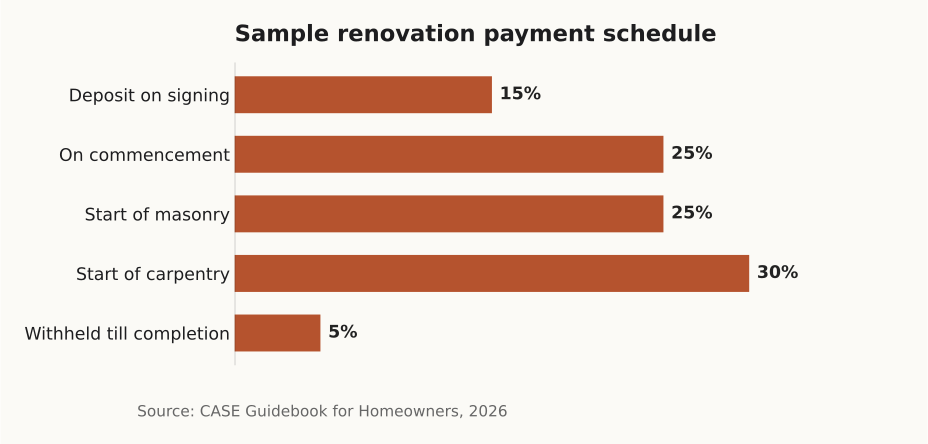
A sample progressive payment schedule — stages, not the calendar.
- 15% deposit on signing the renovation contract
- 25% on commencement of renovation
- 25% on commencement of masonry works
- 30% on commencement of carpentry works
- 5% withheld until satisfactory completion and rectification of all work
The shape matters more than the exact percentages. Notice how little is paid before work begins (15%), how the bulk is released as the two biggest trades — masonry and carpentry — start, and how a slice is held back to the very end. For how these stages line up with the on-site weeks, see the renovation timeline guide.
The 20% deposit cap
The single most important number is the one you pay first. CASE’s rule of thumb for any firm is that “you should never pay more than 20% upfront before work begins,” with the only exception being minor single-task jobs — for example, building wardrobes for one room. Under the CaseTrust accreditation scheme that 20% ceiling is a formal requirement: “initial deposits are also capped at maximum 20% of the total cost.”
A firm pushing for 40%, 50% or “half now for a discount” is asking you to carry its cash-flow risk. Decline. If you are choosing between quotes, read the deposit term as carefully as the price — see how to compare renovation quotes.
The 5-10% retention you hold back
Just as important as the small deposit is the small final payment. CASE advises you to “negotiate a withholding payment by retaining 5-10% of the final payment until all work is satisfactorily completed.” That retention “encourages renovators to promptly address rectifications and perform thorough pre-handover checks.”
Release it only after the final walkthrough, when every defect on your snag list is fixed and you have received the handover documents. CASE does add a note of fairness: withholding gives you leverage, but treat your renovator with respect, because goodwill keeps them coming back for after-sales rectifications.
Tie each payment to an inspected milestone
A stage payment is only safe if you check the stage before you pay. CASE recommends inspecting at critical points of the job — post-demolition / pre-tiling, on completion of electrical and plumbing installations, pre-painting or finishing, and the final walkthrough before handover. Line your payment stages up with these inspections so money is released after a stage passes, not before.
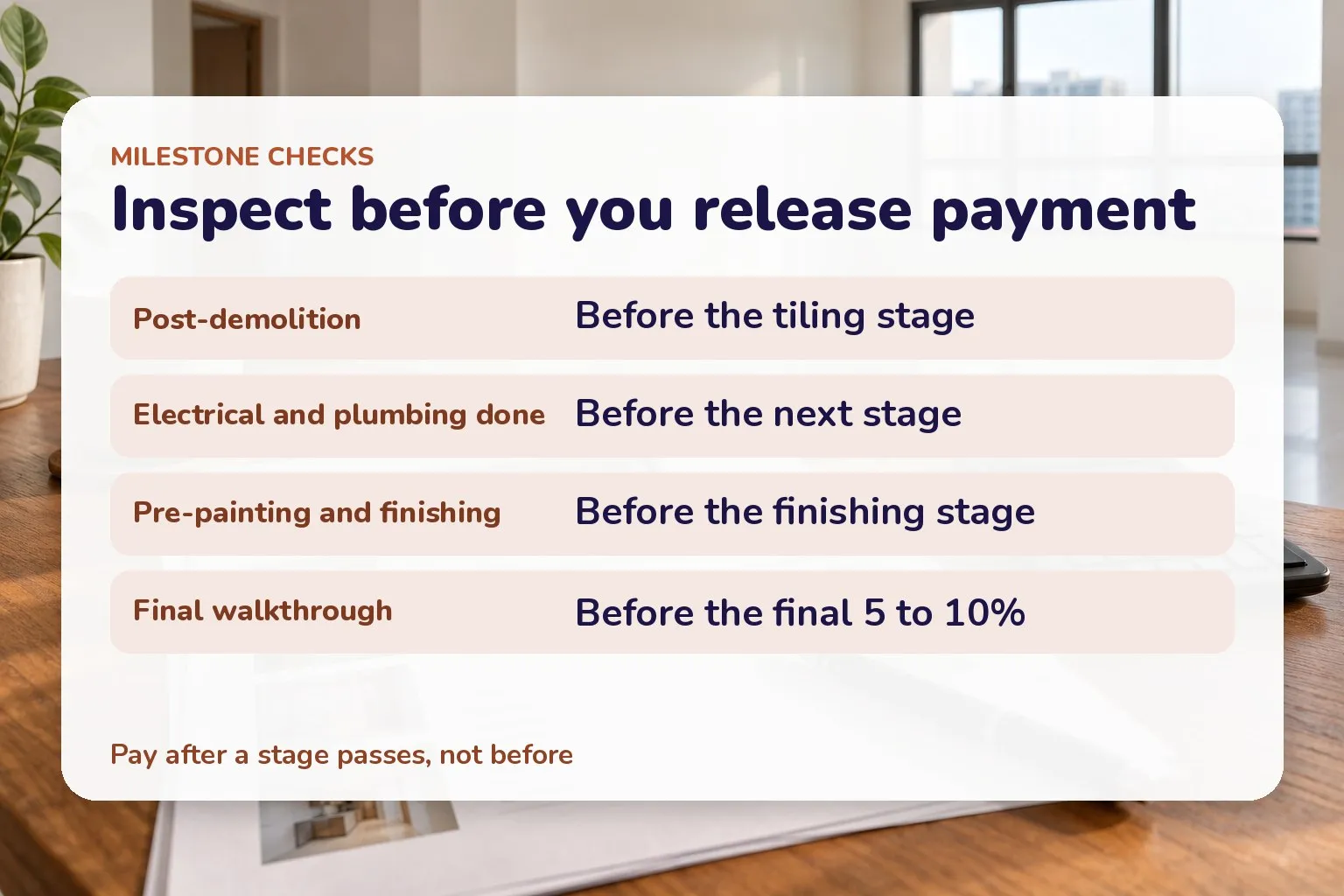
Line each payment stage up with an inspection.
If you are not confident judging the work yourself, CASE’s advice is blunt: “engage a third-party inspector if you are unsure how to assess the work.” The cost of an inspection is small against a stage payment made for work that later has to be redone.
Paying for variation orders
Almost every renovation changes along the way, and every change is a payment. The discipline is to price and agree each one before the work happens. CCCS is explicit that “revisions to the contract or work order variations should be made only with the consumer’s express agreement,” and CASE advises you to “review invoices and variation orders promptly to avoid surprises” rather than letting them pile up.
Treat a variation order as a mini-contract: scope, unit rate, effect on the timeline, signed by both sides, before that trade starts. A verbal “we’ll sort it out later” is how the final bill ends up thousands above the schedule. For the full clause-by-clause read of the contract these sit inside, see what to check in a renovation contract.
What protects the money you have already paid
A schedule limits how much you have paid at any point; it does not, by itself, get that money back if the firm collapses. That is what the deposit performance bond is for — but only with a CaseTrust-accredited firm. CaseTrust-accredited renovation companies “provide a deposit performance bond to safeguard deposit payments against closure, winding up and liquidation,” and payments under the scheme “are collected in phases upon agreed milestones.”
With a non-accredited firm there is no bond, so your deposit has no safety net beyond keeping it small. This is the practical reason to favour accreditation — covered in full in CaseTrust renovation firms explained and the wider vetting in how to choose a renovation firm.
GST across the payment stages
If your firm is GST-registered, GST applies on each payment at the rate in force when the firm receives it. IRAS’s rule for the 2024 rate change shows the principle: where part payment is made before a rate change, “GST will be chargeable at 8% on the payment amount… for the remaining payment, GST will be chargeable at 9%.” The current rate is 9% (from 1 January 2024), and GST-registered businesses must display GST-inclusive prices.
Many smaller renovation firms are not GST-registered, so some quotes carry no GST at all. Confirm whether your quote and each stage invoice are before or after tax before you compare firms — the detail sits among the other hidden renovation costs.
How a renovation loan disburses
If you are borrowing, the money does not pass through your hands. A bank renovation loan is capped at the lower of 6× monthly income or S$30,000 (DBS), is unsecured, and requires a signed, itemised renovation quotation. Crucially, it is disbursed by cashier’s order made out to your contractor — the first cashier’s order is free, with a S$5 fee for each subsequent one at DBS. Fees also come off the top: a 2% handling fee and 1% insurance premium of the approved amount.
So your “payment schedule” and the loan’s disbursement schedule have to line up: the bank releases cashier’s orders against the contractor’s invoices, and you still fund anything above the loan cap — and all the non-loanable items — from cash. CPF cannot help at all: “CPF savings cannot be used for renovation, improvement or repair work for your property.” For the full financing picture, see the renovation loan guide.
Frequently asked questions
Is the 20% deposit cap the law? No. It is a CASE rule of thumb for any firm and a formal requirement under the CaseTrust accreditation scheme — not legislation. For any firm, CASE still advises never paying more than 20% upfront.
Is the 15/25/25/30/5 split compulsory? No. It is CASE’s illustrative sample. Your schedule should match your scope; what matters is keeping the deposit small, tying payments to inspected stages, and withholding a final slice.
What should the final payment wait for? The completed final walkthrough with every defect rectified, plus handover documents — the Completion Certificate, warranty cards, manuals and after-sales contacts. That is exactly what the withheld 5-10% is for.
Can I pay a deposit by credit card or to a personal account? Pay only the corporate entity named in your contract, on the agreed schedule. A request to pay a personal account, or well ahead of the agreed stage, is a warning sign.
Related
- What to check in a renovation contract
- Protecting your renovation deposit
- How to compare renovation quotes
- How to choose a renovation firm
- Renovation loans in Singapore
General information only, not legal or financial advice. The sample schedule and the 20% / 5-10% figures are CASE guidance and CaseTrust requirements, not statute; loan terms are one bank’s published figures. Rules and rates change — confirm current figures before you commit.
Sources
- Guidebook for Homeowners (progressive payments, sample schedule, 20% cap, 5-10% retention, milestone inspections) — Consumers Association of Singapore (CASE) (as of November 2026)
- CaseTrust Accreditation for Renovation Businesses (20% deposit cap, deposit performance bond, progressive milestones) — Consumers Association of Singapore (CASE) (as of November 2026)
- Fair Trading Practices for the Renovation Industry (itemised pricing, agreed schedule, variations by express consent) — Competition and Consumer Commission of Singapore (CCCS) (as of November 2026)
- Written reply to PQs on disputes arising from Interior Design and Renovation firms (120 complaints/year, S$7,400 average) — Ministry of Trade and Industry (MTI) (as of November 2026)
- Renovation Loan (6x income / S$30,000 cap, cashier's order disbursement, fees) — DBS Bank (as of November 2026)
- Can I use my CPF savings for renovation and repairs of my property? — Central Provident Fund Board (CPF) (as of November 2026)
- GST Rate Change for Consumers (9% rate, GST applies on payment received) — Inland Revenue Authority of Singapore (IRAS) (as of November 2026)