Hidden Renovation Costs in Singapore to Expect
Hidden renovation costs are the ones outside the headline quote: provisional sums and excluded works, variation orders, 9% GST, setup bills, post-hacking repairs, and furniture that no renovation loan or CPF will cover. Keep a 10–15% contingency.
The quote you sign is almost never the money you spend. In Qanvast’s 2026 survey, hidden or unexpected costs were homeowners’ single biggest renovation anxiety — and the biggest reason budgets overrun. These costs are not scams; most are ordinary items that sit outside the headline figure, in the quote’s fine print, in setup bills, in what hacking uncovers, and in the furniture a renovation loan will never pay for. Here is where they hide and how to budget for each.
The costs that hide inside the quote
The first place costs hide is the quotation itself. The Competition and Consumer Commission of Singapore (CCCS) expects prices to be “transparent, accurate, clear and itemised,” with mandatory charges stated at the outset — and where a charge genuinely cannot be fixed in advance, the firm should disclose that it exists and give an estimate before you sign. A quote that does the opposite is where surprises breed.
- Provisional sums — items quoted as estimates (extra electrical points, hacking, plumbing diversions) that can balloon once actual quantities are known. Ask what rate applies if a provisional sum is exceeded.
- Exclusions — hacking, debris disposal, haulage, protection works and reinstatement are routinely left out of a cheap quote and reappear as variations.
- Variation orders — any change must be, in CCCS’s words, made “only with the consumer’s express agreement.” Priced in writing before the work, they are fine; unpriced and verbal, they are how the bill creeps up. CASE’s advice is to review each invoice and variation order promptly rather than letting them pile up.
- GST — from 1 January 2024 the rate is 9%. IRAS requires GST-registered firms to display GST-inclusive prices, but smaller renovation outfits may not be GST-registered, and some quotes still show a pre-tax figure. Confirm whether your quote is before or after GST before comparing firms.
Setup bills before a single tile is laid
Some money leaves your account before any renovation work happens, and these rarely appear on a contractor’s quote at all.
- Utilities deposit. Opening an SP Services account for a new flat requires a security deposit, billed in your first utilities bill — for a 3- to 5-room HDB flat it is S$70 (GIRO) or S$100 (non-GIRO) for citizens and PRs, higher for larger homes and for foreigners. For a new flat, this account must be open before HDB will grant the renovation permit.
- Permit prerequisites. A new flat needs that utilities account first; some works need another agency’s approval (for example, a Professional Engineer’s endorsement where hacking touches a structural or masonry wall, typically a four-figure sum) before HDB issues the permit. See the HDB renovation permit guide.
- Carrying costs. Rent or a second mortgage keeps running while the flat is unliveable. Budget it across the full on-site period — see the renovation timeline guide for how many weeks that is.
What surfaces once work begins
CASE is blunt that even a well-planned renovation can throw up problems once work starts — hidden leaks, mould, pest damage or faulty wiring, especially in older properties. These are the classic post-hacking surprises:
- Repairs uncovered after hacking — uneven screed to re-level, old waterproofing to redo, water damage behind tiles.
- Ageing services — older flats often need rewiring and a new distribution board; all wiring must be done or supervised by an EMA Licensed Electrical Worker, not a handyman.
- Spalling concrete — corroded steel in the ceiling slab, common in older bathrooms and kitchens. It is the owner’s bill: HDB’s Goodwill Repair Assistance co-pays 50% for Singapore Citizen households, with your share capped, but the rest is yours.
These resale-specific line items — hacking and haulage, rewiring, pipe replacement, spalling — are costed in detail in the resale flat renovation cost guide; a new BTO largely skips them.
The bills that aren’t “renovation”
The largest hidden cost of all is often the spend the renovation quote never claimed to include.
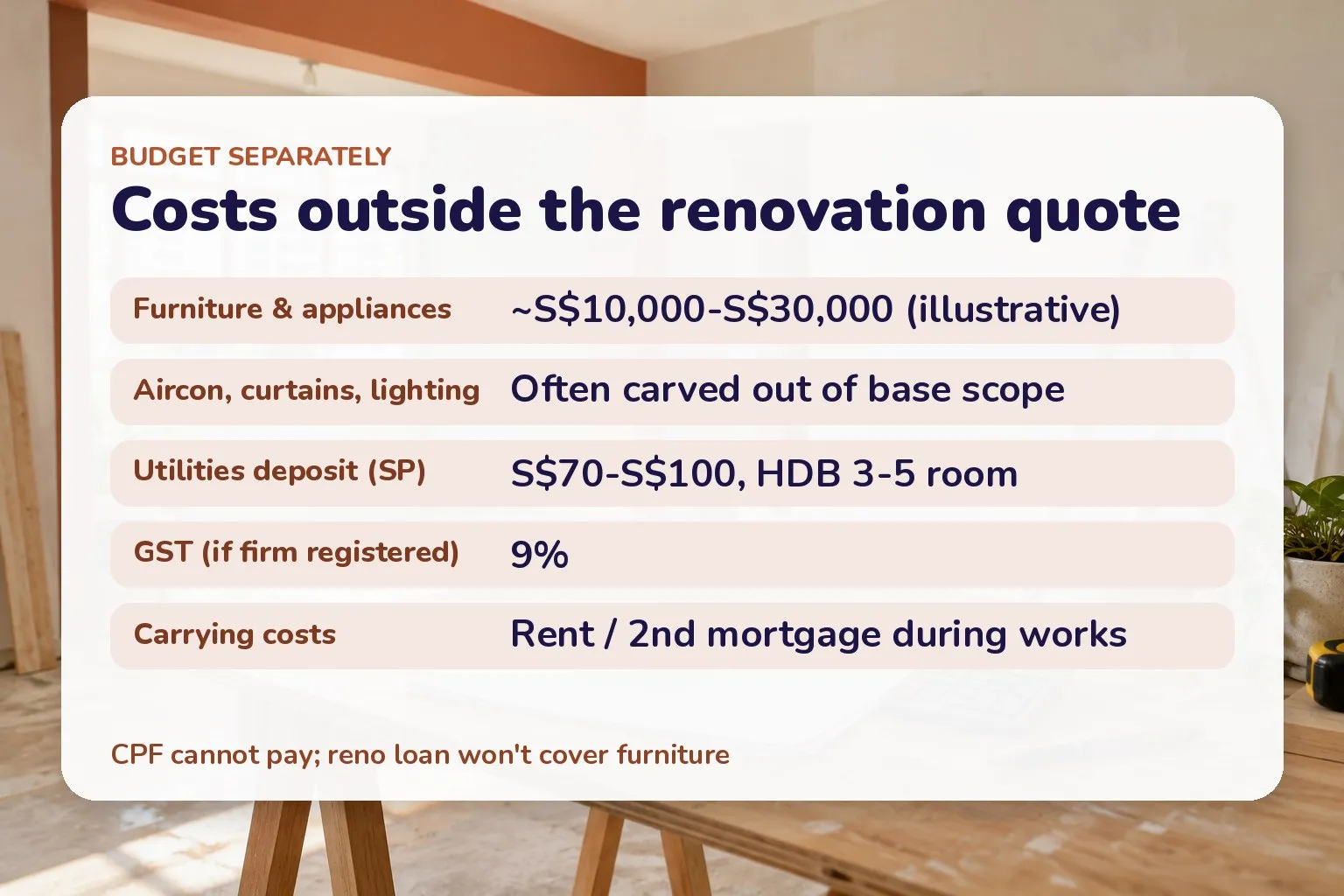
The spend that sits outside the headline renovation quote.
- Furniture, appliances and furnishings are quoted separately — illustratively another S$10,000–S$30,000 (Qanvast) on top of the works.
- Air-conditioning, curtains and blinds, lighting fixtures and smart-home gear are frequently carved out of the base renovation scope; confirm what is in and what is extra.
- CPF cannot help. CPF savings cannot be used for renovation, improvement or repair — that bill is cash or a loan.
- A renovation loan won’t stretch. Bank renovation loans are capped at the lower of 6× monthly income or S$30,000, are ring-fenced to fixed works (not furniture), and are disbursed by cashier’s order to your contractor — DBS, for example, deducts a 2% handling fee and 1% insurance premium, so a S$10,000 loan pays out S$9,700. Most renovations cost more than S$30,000, so plan to fund the balance, and all the non-loanable items, from cash. See the renovation loan guide.
The penalty risk nobody quotes
One “hidden cost” is entirely avoidable: breaking HDB’s rules. Using a contractor not on HDB’s Directory of Renovation Contractors, or carrying out unauthorised hacking, can bring a fine of up to S$5,000 on conviction, and HDB can order you to reinstate the flat at your own cost. Unauthorised work is therefore the most expensive shortcut available — you pay to do it, pay the fine, then pay to undo it.
How big a buffer to keep
CASE recommends a contingency fund of 10–15% of your total budget for unforeseen repairs and adjustments, and warns that budget overruns most often come from discovering hidden issues, changing designs or materials mid-project, and underestimating the cost of fittings, finishes and labour. Keep that contingency untouched and separate from your furniture money.
How to flush hidden costs out before you sign
You cannot remove hidden costs, but you can move most of them into the open before money changes hands:
- Give every firm the same itemised scope and compare like-for-like, not headline totals.
- Ask directly what is excluded — hacking, haulage, disposal, protection, reinstatement — and what provisional sums could move.
- Confirm whether the price is before or after GST.
- Pin down furniture, aircon and curtains as separate lines so you see the true all-in number.
- Keep the payment progressive — CASE advises never paying more than 20% upfront and withholding 5–10% until all work is done — so leftover money is your leverage against surprise charges.
FAQ
Is GST charged on top of a renovation quote? If the firm is GST-registered, 9% applies, and IRAS requires displayed prices to be GST-inclusive. Many smaller renovation firms are not GST-registered. Either way, confirm whether your quote is before or after tax.
Can I avoid variation orders entirely? Rarely — almost every project has some. You can minimise them by settling a detailed scope before work starts, avoiding mid-project design changes, and insisting every variation is priced and signed off in writing before that trade begins.
Who pays to repair spalling concrete? The flat owner. HDB’s Goodwill Repair Assistance co-pays 50% for Singapore Citizen households with a capped share, but the balance is yours. It is more likely in older flats.
Will a renovation loan cover my new sofa and fridge? No. A renovation loan is ring-fenced to fixed renovation works and cannot pay for furniture or appliances, and CPF cannot be used for renovation at all. Those come from cash or a separate personal loan.
Related
- HDB renovation cost guide
- Resale flat renovation cost
- What to check in a renovation contract
- Renovation timeline: week by week
- Renovation loans in Singapore
General information only. Cost figures are illustrative industry ranges, not quotes; official rules and rates (GST, utilities deposit, CPF, HDB penalties) are from IRAS, SP Group, CPF and HDB. Rules and prices change — confirm current figures before you commit.
Sources
- Fair Trading Practices for the Renovation Industry (transparent, itemised pricing; variations) — Competition and Consumer Commission of Singapore (CCCS) (as of October 2026)
- Guidebook for Homeowners (budget overruns, contingency, deposit rules) — Consumers Association of Singapore (CASE) (as of October 2026)
- GST Rate Change for Consumers (9% from 1 Jan 2024, GST-inclusive display) — Inland Revenue Authority of Singapore (IRAS) (as of October 2026)
- Residential Utilities Guide (security deposit, billed in first bill) — SP Group (as of October 2026)
- Can I use my CPF savings for renovation and repairs? — Central Provident Fund Board (CPF) (as of October 2026)
- Important Information on Renovations (DRC, penalties, reinstatement) — Housing & Development Board (HDB) (as of October 2026)
- Renovation Loan (cap, fees, disbursement) — DBS Bank (as of October 2026)