How to Compare Renovation Quotes in Singapore

Give every firm the identical, itemised scope so you compare arithmetic, not sales pitches. Check each quote for named materials, flagged provisional sums, a 20% deposit cap, a staged payment schedule, dated timeline and 12-month warranty — and that the firm is HDB DRC-listed.
On this page10 sections · tap to jump
- 01Compare like for like: one scope, every firm
- 02What a proper itemised quote shows
- 03Provisional sums and exclusions: where quotes diverge
- 04Why the cheapest quote is rarely the cheapest job
- 05Check the firm behind the quote
- 06Deposit and payment terms in the quote
- 07Timeline and warranty in the quote
- 08Red flags when comparing quotes
- 09If a quote turns into a dispute
- 10Frequently asked questions
Three renovation quotes rarely arrive in the same shape, which is exactly why the cheapest one so often turns out to be the most expensive. The renovation trade is one of Singapore’s highest-complaint sectors — the Competition and Consumer Commission of Singapore (CCCS) notes CASE received 1,300 complaints against contractors in 2021 and another 419 in the first quarter of 2022 — and most of those disputes involve poor workmanship, poor materials, slow progress or jobs never finished on time. Comparing quotes properly is your first and cheapest line of defence. Here is how to put several quotes on the same footing before you commit a cent.
Compare like for like: one scope, every firm
The single most useful thing you can do is hand every firm the identical written scope — the same rooms, the same works, the same quantities — and ask each to price that exact list. Quotes only become comparable when the thing being priced is the same. If one firm quotes “kitchen carpentry” as a lump sum and another breaks it into base cabinets, tall units and a worktop, you are no longer comparing prices; you are comparing two different jobs.
Write your scope room by room before you approach anyone: what is being hacked, what flooring goes where, how many electrical points, which rooms get carpentry, what gets painted. Then the differences between the returned quotes tell you something real — a genuine price gap, a smarter method, or an item one firm quietly dropped. For how to turn the winning quote into a safe signed agreement afterwards, see what to check in a renovation contract.
What a proper itemised quote shows
CCCS’s Guide on Fair Trading Practices for the Renovation Industry expects pricing that is “transparent, accurate, clear and itemised.” A quote you can actually compare should show, line by line:
- Each trade and area as a separate line, not a single turnkey figure.
- Materials named by brand, grade, finish and quantity — not “subject to selection” or “similar to”.
- Unit rates (per foot run of carpentry, per square foot of flooring) so you can check quantities.
- Whether the price is before or after GST — a GST-registered contractor adds GST to its charges, so confirm which the number includes.
CCCS is specific that mandatory charges belong in the quote from the start: mandatory charges for the works should be stated in the quotation at the onset. Where a cost genuinely cannot be fixed yet, the firm should still disclose it exists and give an estimate before you sign.
Provisional sums and exclusions: where quotes diverge
Two quotes that look far apart are often just drawn differently. The gap usually hides in two places:
- Provisional sums — items quoted as estimates (extra electrical points, hacking, plumbing diversions) that can balloon once work starts. Ask each firm what rate applies if a provisional sum is exceeded, and whether yours are realistic or lowballed to win the job.
- Exclusions — hacking, debris disposal, haulage, protection works and reinstatement are routinely left out of a headline figure and reappear later as variations.
When the uncertain items cannot be priced yet, CCCS expects the firm to disclose the existence of such charges and provide estimates before the contract is entered into. A quote that simply omits them is not cheaper; it is incomplete.
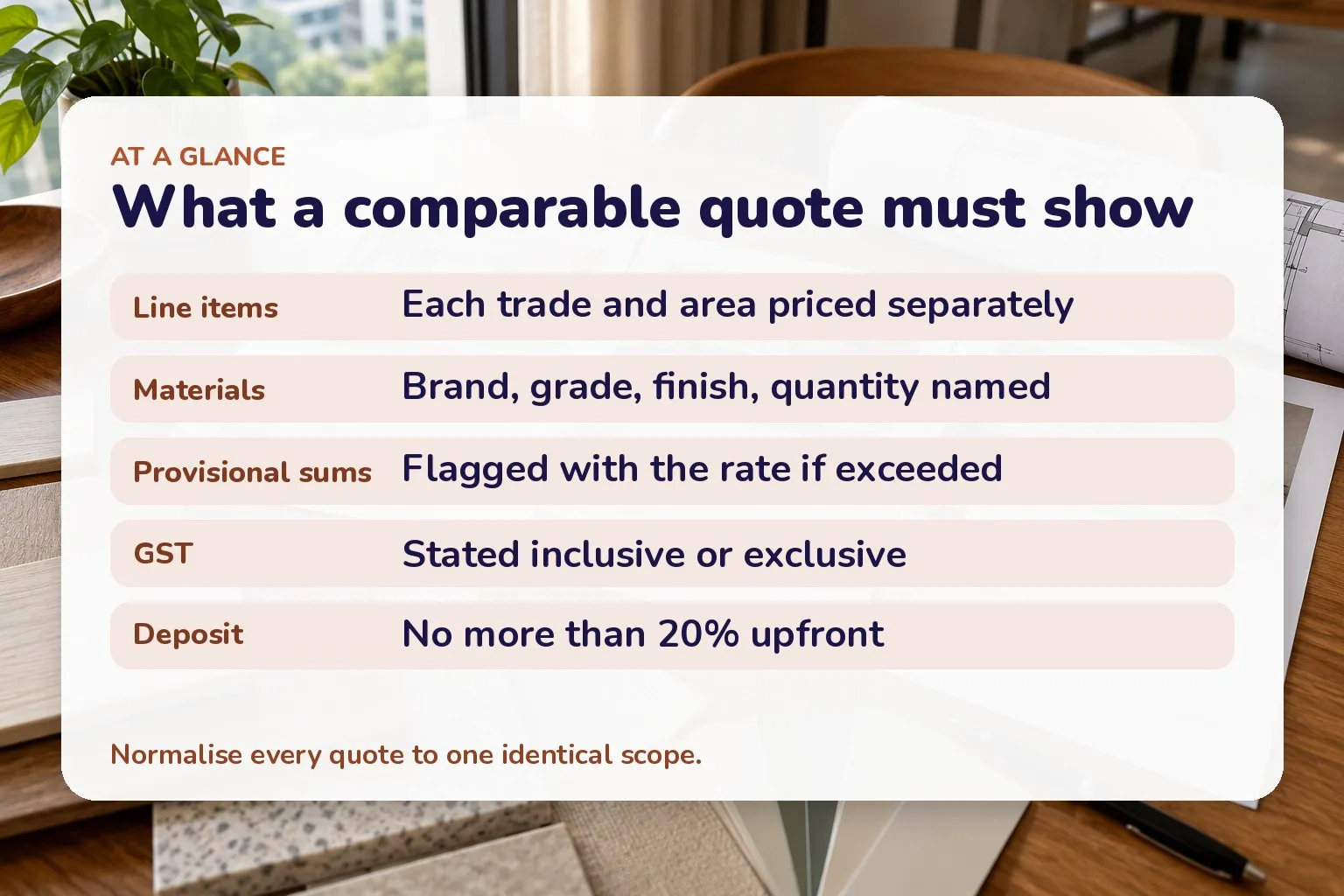
The items a comparable quote should spell out. Source: CCCS; CASE, 2026.
Why the cheapest quote is rarely the cheapest job
A quote dramatically below the rest almost always prices a thinner scope: a cheaper laminate, fewer coats of paint, excluded hacking, or generous provisional sums that balloon on site. Because the Government sets no minimum qualifications for renovation or interior-design firms — the Ministry of Trade and Industry has confirmed it “does not mandate minimum qualifications or experience levels for key personnel in renovation and interior design companies” — the quote and the firm’s accreditation, not a job title, are what protect you. Sense-check every quote against realistic figures in the HDB renovation cost guide and the list of commonly omitted costs.
Check the firm behind the quote
A low price from a firm you cannot verify is not a bargain. Before you shortlist a quote, check the firm itself:
- HDB Directory of Renovation Contractors (DRC). For an HDB flat, the Housing & Development (Renovation Control) Rules 2006 require that you only engage contractors from the Directory of Renovation Contractors to carry out renovations in your flat. Contractors must be listed in the DRC before they can carry out HDB renovations, so confirm the exact company name and UEN on the quote appears in the directory.
- CaseTrust accreditation. Accredited renovation businesses must adopt the CaseTrust Standard Renovation Contract and must purchase a deposit performance bond to safeguard deposit payments against closure, winding up and liquidation — real protection if the firm folds mid-job. For what accreditation does and does not cover, see CaseTrust renovation firms explained.
For the full vetting routine — references, showroom visits, licence checks — see how to choose a renovation firm and the HDB directory of renovation contractors guide.
Deposit and payment terms in the quote
A quote is also a payment proposal, and the payment terms matter as much as the total. Under the CaseTrust scheme, initial deposits are capped at a maximum of 20% of the total cost, and payments are collected progressively against agreed milestones rather than by the calendar. Read each quote for:
- The upfront deposit as a percentage — anything well above 20% is a red flag.
- Whether later payments are tied to completed, inspected stages (commencement, masonry, carpentry) or to dates.
- A retention of the final 5–10% until defects are cleared.
CaseTrust firms must also display pricing breakdowns clearly and communicate additional costs, with variations agreed in writing before work proceeds. A quote that is vague on staging is telling you how the project will be run. For a safe structure, see protecting your renovation deposit.
Timeline and warranty in the quote
Two more lines separate a serious quote from a sales sheet:
- Timeline. CCCS expects a mutually agreed work schedule with clear deadlines, including the projected start date and completion date, included in the renovation contract. A quote with no dated schedule makes “slow progress” impossible to pin down later.
- Warranty. Under CaseTrust, businesses provide a workmanship warranty for 12 months from the completion date of the works, rectifying defects that arise during that period. Twelve months of workmanship warranty is the benchmark to insist on; check each quote states it.
Red flags when comparing quotes
As you line the quotes up, watch for:
- A total far below the others with no obvious reason — usually a thinner scope.
- “Subject to selection”, “similar to” or open provisional sums instead of named materials.
- A deposit above 20%, or a request to pay a personal rather than a corporate bank account.
- No dated timeline, no written variation process, no warranty clause.
- A firm whose name or UEN you cannot find in the HDB DRC listing.
If a quote turns into a dispute
Even a carefully chosen quote can go wrong. HDB is clear that engaging a DRC contractor is a private arrangement, and disputes over pricing, schedule or quality are for the two parties to resolve; if you cannot, you can seek assistance through CASE, the Singapore Mediation Centre, the Small Claims Tribunals, or through court proceedings. The Small Claims Tribunals hear a contract for the provision of services up to $20,000 (or $30,000 if both parties sign a Memorandum of Consent), and you must file within 2 years of the cause of action. Keeping the itemised quote, the signed scope and every variation in writing is what makes such a claim winnable.
Frequently asked questions
How many quotes should I get? Three is a sensible number — enough to spot an outlier price or a dropped item, without stalling your timeline. What matters is that all three price the identical scope.
Is there an official renovation quote template? No. CaseTrust-accredited firms must use the CaseTrust Standard Renovation Contract, but its full text is not published publicly, so build your own one-page scope and require every firm to price it.
Should the cheapest compliant quote win? Once every quote covers the identical scope, named materials, a dated timeline, a capped deposit and a warranty, the lowest of those is a fair pick. The cheapest before normalising scope is not.
Does the quote have to show GST? A GST-registered contractor charges GST on its services, so confirm whether each quoted figure is inclusive or exclusive — otherwise you may be comparing a pre-GST price against a post-GST one.
Related
- Renovation contract: what to check before you sign
- How to choose a renovation firm
- CaseTrust renovation firms explained
- Protecting your renovation deposit
- Hidden renovation costs to expect
General information only, not legal advice. Verify the DRC listing and CaseTrust accreditation of the exact legal entity on your quote, and read every line, before you commit.
Sources
- CCCS Publishes Guide on Fair Trading Practices for Renovation Industry — Competition and Consumer Commission of Singapore (CCCS) (as of November 2026)
- CaseTrust Accreditation for Renovation Businesses — Consumers Association of Singapore (CASE) (as of November 2026)
- Important Information on Renovations (DRC requirement, penalties) — Housing & Development Board (HDB) (as of November 2026)
- Directory of Renovation Contractors (listing, demerit points, disputes) — Housing & Development Board (HDB) (as of November 2026)
- Written reply to PQs on disputes arising from renovation and ID firms — Ministry of Trade and Industry (MTI) (as of November 2026)
- Cases eligible for a small claim (Small Claims Tribunals) — Singapore Courts (State Courts) (as of November 2026)