Protecting Your Renovation Deposit in Singapore

Cap your upfront payment at 20%, release the rest in stages against completed milestones, and use a CaseTrust-accredited firm whose deposit performance bond refunds your deposit if the business is wound up. Pay the company, never a person.
On this page10 sections · tap to jump
- 01The real risk: prepayment loss
- 02The 20% rule — and why it is only a rule of thumb
- 03Progressive payments: your main shield
- 04The deposit performance bond, explained
- 05What the bond does not do
- 06Pay the company, never a person
- 07A worked example of your exposure
- 08If the firm stops work or collapses
- 09Before you pay a cent
- 10FAQ
The riskiest moment of any renovation is the start, when you hand over a deposit for work that has not begun. If the firm collapses, that money is often gone: from 2017 to 2023 the Consumers Association of Singapore (CASE) received about 120 complaints a year over prepayment losses on incomplete renovations, on contracts averaging roughly S$7,400, and managed to recover the money in only about half of the cases it negotiated. Protecting your deposit is less about trusting the firm and more about structuring the money so that you can never lose much at once.
The real risk: prepayment loss
Renovation is one of the highest-complaint industries in Singapore — CASE logged 1,300 complaints against contractors in 2021. The specific danger for your wallet is prepayment loss: you pay ahead, the firm stops work, winds up or disappears, and recovery is slow and partial. The Ministry of Trade and Industry’s own figures above show how often the money does not come back in full. The defence is built into how and when you pay, and into choosing a firm whose scheme actually backs the deposit.
The 20% rule — and why it is only a rule of thumb
CASE’s core guidance for any firm is simple: never pay more than 20% upfront before work begins, except for a minor single-task job such as building a wardrobe for one room. Under the CaseTrust accreditation scheme this becomes a hard requirement — accredited firms must cap the initial deposit at a maximum of 20% of the total cost and collect the rest progressively against agreed milestones.
The important nuance: for a firm that is not CaseTrust-accredited, there is no statutory cap forcing it to limit your deposit. The 20% figure is best practice, not law — which is exactly why you should insist on it in the contract and walk away if a firm demands a large front-loaded payment. See what to check in a renovation contract for where this clause lives.
Progressive payments: your main shield
Paying in stages is the mechanism that actually limits your loss. CASE explains that progressive payments do three things: they protect you from large upfront payments and the risk of losing a big sum if work stops; they incentivise the renovator to complete each stage satisfactorily to “unlock” the next payment; and they spread the cost over the project.
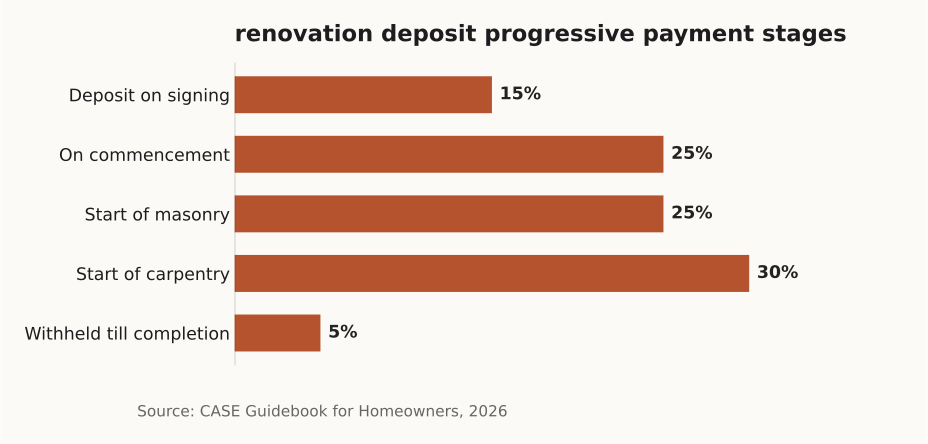
Releasing money in stages caps what you can lose at once.
CASE’s sample schedule for a typical renovation:
- 15% deposit on signing the contract
- 25% on commencement of renovation
- 25% at the start of masonry works
- 30% at the start of carpentry works
- 5% withheld until satisfactory completion and rectification of all work
On top of that structure, retain 5–10% of the final payment until every defect is fixed, and make the final payment only after all rectification is done and all documents are handed over. Build in a contingency fund of about 10–15% of your budget so an unexpected cost never pressures you into paying ahead of schedule.
The deposit performance bond, explained
This is where accreditation earns its keep. A CaseTrust-accredited renovation company must provide a deposit performance bond that safeguards your deposit payments against the business closing, winding up or being liquidated before the renovation is completed. CCCS confirms the same requirement: accredited contractors must protect a customer’s deposit via a deposit performance bond covering closure, winding up and/or liquidation.
In plain terms, if an accredited firm goes insolvent after taking your deposit, the bond is the mechanism that gets that prepayment back — a protection no amount of online reviews can offer. Ask the firm for proof that your payment is bonded, and confirm its CaseTrust accreditation is current and attached to the exact entity on your contract. You can check accredited businesses via the CaseTrust mark or the list on the CaseTrust website.
What the bond does not do
Read the protection narrowly, because it is narrower than most homeowners assume:
- It is not a workmanship guarantee. The bond returns your money if the firm collapses; it does nothing about poor tiling or a late job. Quality is covered — within limits — by the separate 12-month workmanship warranty.
- It protects the deposit, not everything you ever pay. The scheme bonds your prepayment. Money you have already released for completed stages has, in principle, bought work that was done. This is the deeper reason to keep the deposit small and pay the rest only against finished, inspected milestones — the progressive schedule, not the bond, is what limits your later exposure.
- It triggers on insolvency, not on a dispute. A bond responds to closure, winding up or liquidation — not to a disagreement over quality or delay, which goes to mediation or the Tribunals instead.
Pay the company, never a person
Deposits should flow to the firm’s corporate bank account, to the legal entity named in your contract. A request to pay a personal account, to pay in cash, or to pay sums not written into the contract is a red flag — frequently excused as a “cash-flow” problem. As one renovation-industry body puts it, a company’s cash flow has nothing to do with the customer. Keep a record of every transfer, invoice and message; if things go wrong, that paper trail is your evidence.
A worked example of your exposure
Suppose two firms both quote S$40,000. Firm A is CaseTrust-accredited, caps the deposit at 20% and bonds it. Firm B is not accredited and wants 50% — S$20,000 — upfront “for materials”. With Firm A, the most you can lose before any work is your S$6,000–S$8,000 deposit, and even that is backed by the bond if the company is wound up. With Firm B, you have put S$20,000 at risk with no bond behind it, recoverable only through negotiation, mediation or the Tribunals — the slow, half-success route the national figures describe. The quotes are identical; the risk is not.
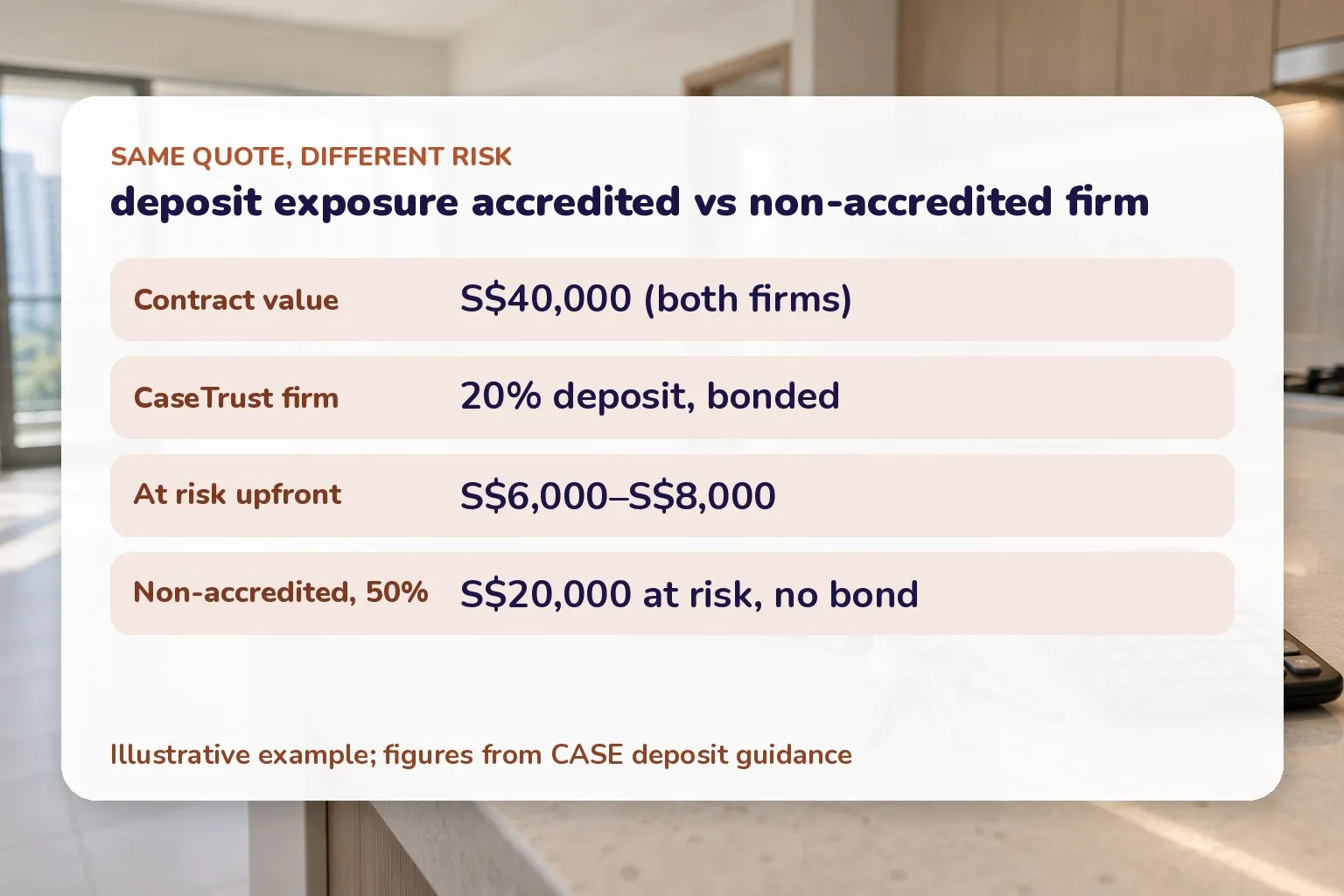
Illustrative: how the deposit cap and bond limit your exposure.
If the firm stops work or collapses
If work stalls, act on the contract first: put your concerns in writing and stop releasing further payments. Your routes from there:
- Claim on the bond if the firm has been wound up or liquidated and it was CaseTrust-accredited — this is what the deposit performance bond exists for.
- Request CASE mediation. A CaseTrust-accredited firm must attend mediation at CASE on your request.
- File at the Small Claims Tribunals. They hear a contract for the provision of services up to S$20,000 (or S$30,000 with a Memorandum of Consent from both parties), and a dispute against a supplier for an unfair practice under the Consumer Protection (Fair Trading) Act. File within two years of the cause of action. As MTI notes, some consumers recover their losses through this route.
Before you pay a cent
Run the checks while you still hold the money: confirm the exact entity’s CaseTrust accreditation and, for an HDB flat, its listing in HDB’s Directory of Renovation Contractors (the flat owner is responsible for compliance, with fines up to S$5,000 for engaging a non-listed contractor). Agree the progressive schedule and the deposit cap in the written contract, and get written proof the deposit is bonded. For the full firm-vetting checklist, see how to choose a renovation firm.
FAQ
Is my deposit automatically protected? No. Protection comes from the CaseTrust deposit performance bond, which only accredited firms carry. With a non-accredited firm, your deposit is unprotected — so keep it small and structure the rest progressively.
Does the bond cover a firm that just does bad work? No. The bond covers insolvency; workmanship is covered separately by the 12-month warranty, and quality disputes go to mediation or the Tribunals.
How much deposit is reasonable? No more than 20% of the contract value before work begins, per CASE guidance — less is better, and tied to a milestone schedule.
What if I already paid a large deposit to a non-accredited firm? Keep all records, stop further payments beyond completed work, request CASE mediation, and consider the Small Claims Tribunals within the two-year window.
Related
- Renovation contract: what to check before you sign
- How to choose a renovation firm
- Interior designer vs contractor
- HDB renovation cost guide
General information only, not legal or financial advice. Verify CaseTrust accreditation and DRC listing of the exact legal entity on your contract, and get written proof of deposit protection, before you pay.
Sources
- Guidebook for Homeowners (deposits, progressive payments, performance bond) — Consumers Association of Singapore (CASE) (as of October 2026)
- CaseTrust Accreditation for Renovation Businesses — Consumers Association of Singapore (CASE) (as of October 2026)
- CCCS Publishes Guide on Fair Trading Practices for Renovation Industry — Competition and Consumer Commission of Singapore (CCCS) (as of October 2026)
- Written reply to PQs on disputes arising from Interior Design and Renovation firms — Ministry of Trade and Industry (MTI) (as of October 2026)
- Cases eligible for a small claim (Small Claims Tribunals) — Singapore Courts (State Courts) (as of October 2026)