Renovation Timeline in Singapore: Week by Week
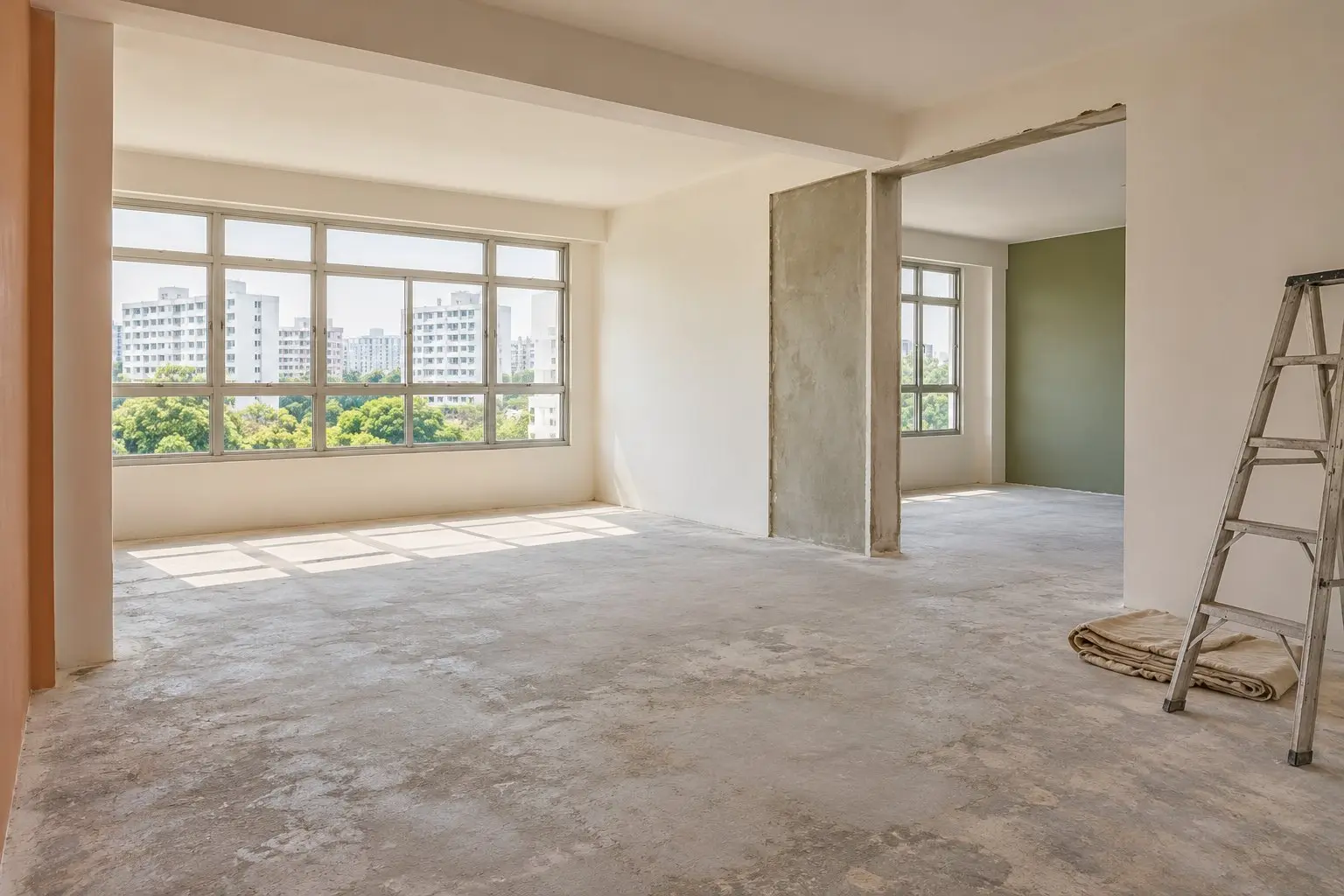
A typical HDB renovation runs about 6–11 weeks on site (Qanvast, 2026), but must fit HDB's permit window — 1 month for an existing block, 3 months for a newly completed block from the permit date — with planning starting months before your keys.
On this page10 sections · tap to jump
- 01How long a renovation really takes
- 02Before key collection: the planning months
- 03The permit clock: 1 month or 3 months
- 04Why the noisy phase controls the critical path
- 05The on-site sequence, phase by phase
- 06Inspect at these four milestones
- 07What throws a timeline off
- 08A sample week-by-week (illustrative)
- 09Handover and the defects period
- 10FAQ
People picture a renovation as the weeks the contractor is in the flat, but the clock really starts months earlier and keeps running into a defects period long after you move in. On site, a typical HDB renovation takes roughly 6–11 weeks depending on flat type and scope (Qanvast’s 2026 estimates), and the whole job has to fit inside HDB’s permit window. Below is how the time actually sequences — before your keys, phase by phase on site, and afterwards — and which single constraint, more than any other, sets the pace.
How long a renovation really takes
Qanvast’s 2026 estimates put a typical HDB renovation at about 6–8 weeks for a 3-room BTO, 8–10 weeks for a 4-room, and 9–11 weeks for a larger or resale flat. These are illustrative industry durations, not a promise — your schedule depends on scope, finishes and how clean the existing flat is. Resale flats sit at the longer end because demolition and repairs happen before the “nice” work starts. For where the money goes across that time, see the HDB renovation cost guide.
But that on-site figure is only the middle of the story. The Consumers Association of Singapore (CASE) frames the journey as starting around six months before you collect your keys and running through a post-handover warranty period. Treat the on-site weeks as the visible tip, not the whole project.
Before key collection: the planning months
The weeks you spend before the flat is even yours decide whether the on-site phase runs smoothly.
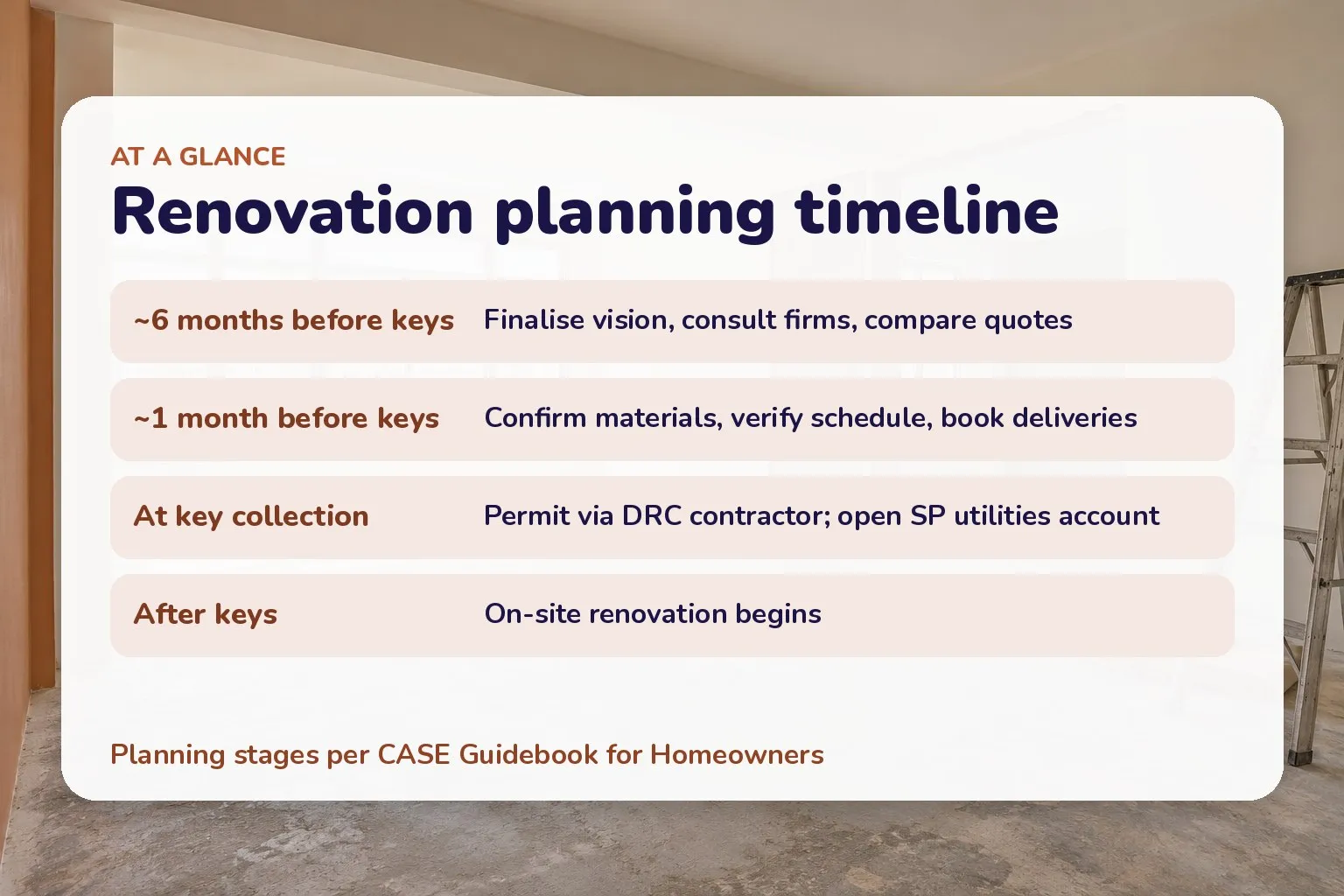
The planning months before renovation starts on site.
- About six months before key collection — finalise your vision. CASE advises using this window to schedule consultations with interior designers or contractors, review design proposals and get cost estimates, and use 3D tools and showrooms to visualise materials. This is also when you compare quotes and vet firms — see how to choose a renovation firm.
- About one month before key collection — confirm all details. Lock in every material, furnishing, fixture and fitting; review and verify the renovation schedule with your designer or contractor; and coordinate delivery dates for major items so they arrive in time for installation.
- At key collection — the permit and utilities. Your contractor, who must be on HDB’s Directory of Renovation Contractors, submits the renovation application electronically on your behalf; you sign an acknowledgement form and HDB sends you an SMS when the submission is received. For a new flat, you must open an SP Services utilities account first — HDB will not grant the permit until it is open, and SP asks for about a one-week lead time for a BTO turn-on.
The permit clock: 1 month or 3 months
The permit does not just authorise the work; it sets a hard deadline. HDB requires approved renovations to be completed within 1 month for an existing block and 3 months for a newly completed (BTO) block, from the date the permit is granted — and within 2 weeks if you are only doing window works. Because HDB does not publish a processing time for the application itself, treat the grant date as the moment your countdown begins.
That matters most for a resale flat, where a month is a tight window for hacking, tiling and carpentry. Have designs, measurements and material orders settled before the permit date, not after. For what needs a permit and how approval works, see the HDB renovation permit guide.
Why the noisy phase controls the critical path
Of all the HDB rules, the one that governs the calendar is the limit on noisy work. HDB restricts demolishing walls, removing wall or floor finishes, cutting tiles and heavy drilling to 9am–5pm on weekdays only — never Saturdays, Sundays, public holidays, or the eves of New Year’s Day, Chinese New Year, Deepavali, Hari Raya Puasa and Christmas Day. General trades (carpentry install, painting, wiring) get a wider 9am–6pm Monday-to-Saturday window.
On top of that, a contractor may use only two approved hand-held power tools at a time and cannot take more than three consecutive days to demolish walls or remove finishes. So the messy phase is both short and weekday-bound — you cannot compress it into a weekend, and a long stretch of public holidays can quietly erase working days. The renovation noise and timing rules cover the hours and the neighbour-notice duty in full.
The on-site sequence, phase by phase
Trades run in a fixed order because each depends on the one before. A typical sequence:
- Protection and setup — floor and lift protection, site clearing.
- Hacking and demolition — removing walls (with permit) and old finishes; the weekday-only, max-3-day noisy phase.
- Masonry, waterproofing and tiling — rebuilding walls, laying floor and wall tiles; wet areas are waterproofed and the waterproofing tested before tiling.
- Electrical and plumbing rough-in — wiring and pipe runs, done before they are concealed; HDB flats must use a DRC contractor and all wiring must be done or supervised by an EMA Licensed Electrical Worker.
- Carpentry and joinery — kitchen cabinets, wardrobes, feature walls; usually the longest single trade.
- Painting and finishing — after all dusty and wet work is done.
- Installation and cleaning — appliances, sanitary ware, lights, then a post-renovation clean.
- Handover — final walkthrough and snagging.
CASE and RCMA advise staying actively involved throughout: regular site visits, weekly progress updates and photo documentation of each milestone.
Inspect at these four milestones
Do not wait until the end to look closely. CASE recommends inspecting at four critical points, each chosen so a defect is caught while that trade is still on site and cheap to fix:
- Post-demolition / pre-tiling — before new finishes hide anything.
- After electrical and plumbing installations — before they are concealed behind walls and tiles.
- Pre-painting or finishing — surfaces still accessible.
- Final walkthrough before handover — the full snag list.
What throws a timeline off
CASE lists the usual culprits: delayed permit approvals, material-delivery issues (especially imported items), inadequate workforce or scheduling conflicts, and poor coordination. Older flats add their own surprises — hidden leaks, mould or faulty wiring that only appear once hacking starts. The defences are simple: order long-lead materials early, build buffer time into the schedule, and keep a clear, written scope so mid-project changes do not snowball.
A sample week-by-week (illustrative)
For a mid-scope 4-room renovation that fits Qanvast’s ~8–10-week band, a plausible on-site schedule might run: Week 1 protection, hacking and demolition; Weeks 2–3 masonry, waterproofing and tiling; Week 4 electrical and plumbing rough-in; Weeks 5–7 carpentry; Week 8 painting and finishing; Week 9 installation, cleaning and handover. This is illustrative only — HDB publishes no per-phase durations, your scope and flat will shift every line, and the whole run must still close within the permit window.
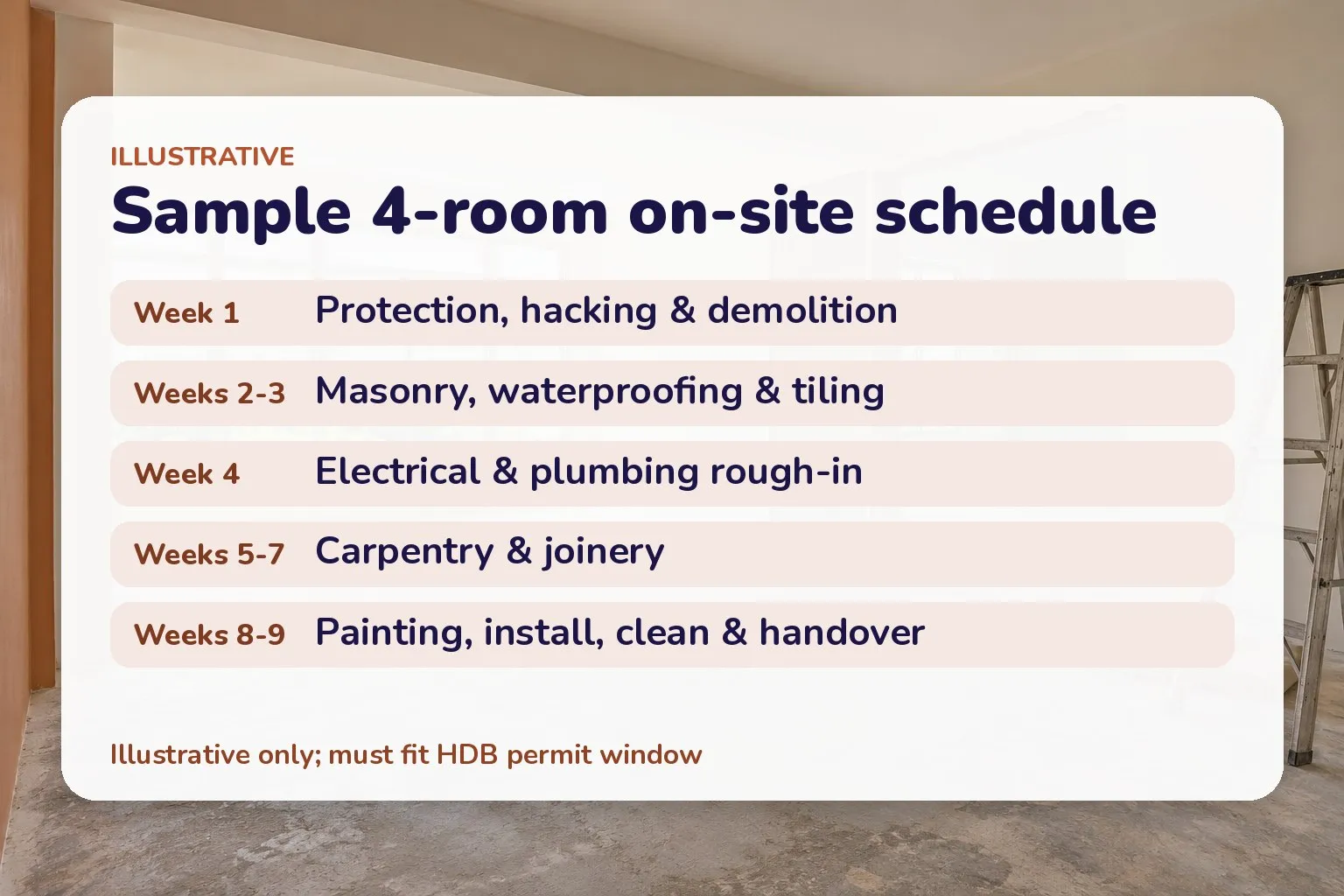
An illustrative on-site sequence for a mid-scope 4-room renovation — not official durations.
| Phase | Where it sits |
|---|---|
| Protection, hacking & demolition | Front of the job; noisy, weekday-only, max 3 consecutive days |
| Masonry, waterproofing & tiling | After demolition; waterproofing tested before tiling |
| Electrical & plumbing rough-in | Before concealment; LEW-certified wiring |
| Carpentry & joinery | Usually the longest trade |
| Painting, finishing, install & clean | Last, after dusty/wet work |
Phase order is typical; durations depend on scope. Overall durations: Qanvast 2026 (illustrative).
Handover and the defects period
Handover is not the finish line. Do a full final walkthrough, raise every defect, and make the final payment only after all rectification is done — this is what the withheld final 5–10% is for. Collect the completion documents, warranty cards and care guides, and inform the HDB branch managing your flat once the renovation is complete; the Notice of Renovation stays displayed outside the flat until then. After that, a 12-month workmanship warranty / defects-liability period is the benchmark, during which the firm rectifies workmanship defects at no cost.
FAQ
Can the noisy works run on a Saturday to save time? No. Demolishing walls, removing finishes, cutting tiles and heavy drilling are weekday-only, 9am–5pm. Saturday is for general trades such as carpentry installation and painting.
Who applies for the permit — me or my contractor? Your DRC-listed contractor submits the application electronically; you sign an acknowledgement form and HDB sends you an SMS. You remain responsible for keeping the work within the approved scope.
What if the work runs past the permit period? Approved works must finish within 1 month (existing blocks) or 3 months (newly completed blocks) of the permit date. Overrunning or doing unauthorised work can bring a fine of up to S$5,000 and an order to reinstate the flat.
Can I move in while renovation is still going? It is rarely practical — dust, no working kitchen or bathroom, and daily access for trades. Budget carrying costs (rent or a second mortgage) for the full on-site period, plus a buffer.
Related
- HDB renovation cost guide
- Renovation noise and timing rules
- HDB renovation permit guide
- First-time renovation: the full guide
- What to check in a renovation contract
General information only. Durations are illustrative industry estimates, not quotes; official rules (permit window, timings, penalties) are from HDB. Rules change — confirm current requirements with HDB and your contractor before you start.
Sources
- Important Information on Renovations (completion deadlines, timings, neighbour notice) — Housing & Development Board (HDB) (as of October 2026)
- Application for a Renovation Permit (who applies, utilities account) — Housing & Development Board (HDB) (as of October 2026)
- Guidebook for Homeowners (planning timeline, milestones, delays, warranty) — Consumers Association of Singapore (CASE) (as of October 2026)
- Fair Trading Practices for the Renovation Industry (agreed schedule in contract) — Competition and Consumer Commission of Singapore (CCCS) (as of October 2026)
- Residential Utilities Guide (turn-on lead time) — SP Group (as of October 2026)
- Expected Renovation Costs and Durations for HDB Flats in 2026 — Qanvast (as of October 2026)