CaseTrust Renovation Firms: What Accreditation Means

CaseTrust is CASE's voluntary accreditation for renovation businesses. An accredited firm caps your initial deposit at 20%, buys a deposit performance bond protecting prepayments if it closes, adopts the CaseTrust Standard Renovation Contract, and gives a 12-month workmanship warranty.
On this page11 sections · tap to jump
- 01What CaseTrust accreditation is
- 02Two schemes: CaseTrust and CaseTrust-RCMA
- 03What an accredited firm must offer you
- 04The deposit bond and prepayment protection
- 05The standard contract and 20% deposit cap
- 06Accreditation is not the DRC listing
- 07How a firm earns accreditation
- 08How to verify accreditation
- 09What accreditation does not cover
- 10If a dispute happens
- 11Frequently asked questions
Because “interior designer” and “renovation contractor” are not licensed professions in Singapore — the Ministry of Trade and Industry has told Parliament the Government “does not mandate minimum qualifications or experience levels for key personnel in renovation and interior design companies” — the job title on a quotation tells you little. CaseTrust is the voluntary accreditation that fills that gap, and the one that actually guards the money you hand over before any work is done. Here is exactly what it is, what an accredited firm has to give you, and how to check it is real.
What CaseTrust accreditation is
CaseTrust is the accreditation arm of the Consumers Association of Singapore (CASE). For renovation, CASE “introduced two accreditation schemes” because “home renovation is one of the biggest investments homeowners will make.” A business that wants the badge is “audited under a set of stringent and comprehensive criteria, covering various aspects of store policies, ethical advertising and dispute resolution procedures, staff capabilities as well as staff training.” Pass the audit and the firm may display the CaseTrust logo on its shopfront and marketing material.
It is important to be clear about what the scheme is and is not. It is a consumer-protection standard for how a firm contracts with and bills a homeowner. It is not a design-quality rating, and it is not the same thing as HDB’s licensing. For an HDB flat you separately need a contractor from the Directory of Renovation Contractors; CaseTrust sits on top of that.
Two schemes: CaseTrust and CaseTrust-RCMA
There are two routes to the same consumer protections. A firm that is not a member of the trade association can apply for the CaseTrust Accreditation Scheme for Renovation Businesses. In August 2014 CASE “collaborated with the Singapore Renovation Contractors and Material Suppliers Association (RCMA) to develop the CaseTrust-RCMA Joint Accreditation scheme,” for which “businesses must first be members of RCMA.” For a homeowner the practical protections are the same under either; the RCMA version simply routes through the association.
One eligibility detail matters when you judge a claim: CaseTrust “assessment criteria focuses on B2C businesses,” so a pure business-to-business outfit is not eligible. A genuine renovation firm selling to homeowners is.
What an accredited firm must offer you
This is the core of the scheme — four concrete commitments, each written into the accreditation criteria.
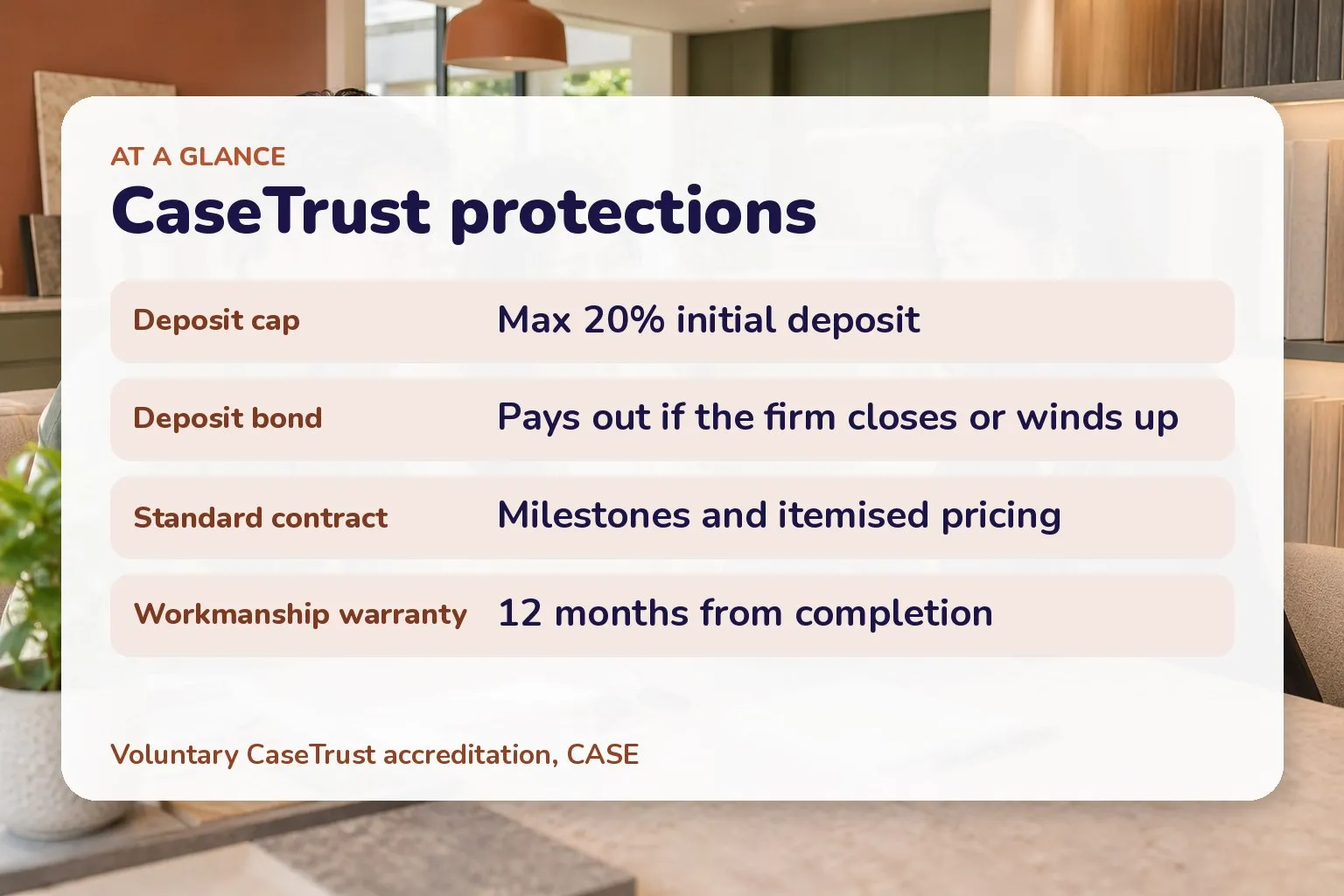
The four protections a CaseTrust-accredited renovation firm must give a homeowner. Source: CASE, 2026.
- A capped, progressive payment structure. “Payments are collected in phases upon agreed milestones,” and “initial deposits are also capped at maximum 20% of the total cost.” You should not be handing over half the contract value before work starts.
- A deposit performance bond. Accredited businesses “must purchase a deposit performance bond to safeguard deposit payments against closure, winding up and liquidation, among others.”
- The CaseTrust Standard Renovation Contract. Accredited businesses “must adopt the CaseTrust Standard Renovation Contract, which outlines each party’s obligations and specifies work and payment schedules,” including “progressive payments, service warranty and transparent pricing.”
- A 12-month workmanship warranty. Firms “shall provide Homeowners a workmanship warranty for a period of 12 months from completion date of the Works,” and will “conduct the necessary rectification works if defects arise.”
Pricing transparency runs through all of it: firms are “required to display pricing breakdowns clearly and communicate additional costs,” and variations have to be “agreed in writing between the business and consumer before any Works.” That written-variation rule is what stops a quote quietly inflating into a stack of verbal add-ons.
The deposit bond and prepayment protection
The deposit performance bond is the headline protection, so understand its scope precisely. It pays out against the firm’s insolvency events — “closure, winding up and liquidation” — not against workmanship you are unhappy with. Alongside it, accredited firms run prepayment protection: it “allows consumers to claim back the unused portion of the prepayment made following the closure of the accredited business.” After you pay, “you would receive proof of protection containing your details and the protected sum.”
This is a different and narrower thing from a quality guarantee, which is the most common misunderstanding about the scheme.
The standard contract and 20% deposit cap
The 20% figure is widely quoted, so be exact about where it bites: it is a CaseTrust accreditation requirement, not a law that binds every firm in Singapore. For a firm that is not accredited there is no statutory deposit cap. That is precisely why the badge is useful — it converts a general piece of consumer advice (don’t overpay up front) into a contractual rule the firm has agreed to be audited against. The standard contract pairs the cap with a milestone schedule, an itemised scope and the 12-month warranty, so the whole payment-and-protection package moves together rather than being negotiated line by line. If you want the detail on reading the document itself, see what to check in a renovation contract.
Accreditation is not the DRC listing
Keep the two registries straight. HDB’s DRC is a licensing list you legally need for HDB renovation; CaseTrust is a voluntary consumer-protection badge. They interact in one direction: a CaseTrust-accredited firm “enjoy[s] a longer listing validity of 3 years instead of 2” on the DRC and needs “only 1 year of experience in renovation works to qualify, compared to the usual 3 years for non-accredited contractors.” So accreditation is a plus on top of a DRC listing, and it lowers one of the DRC’s own bars — but a firm can be DRC-listed without being CaseTrust-accredited. For how the DRC itself works, read the HDB Directory of Renovation Contractors explainer.
How a firm earns accreditation
Knowing the bar helps you read the badge. Accreditation runs on a four-year cycle: a “full-term assessment (Desktop & Site) is conducted every 4 years,” with an “interim assessment (Site only)” in the third year, and the accreditation is “renewable every year, subject to payment of the Annual Management Fee, passing all Assessments,” and satisfying any investigation or public complaints. In other words it is a live, audited status that a firm has to keep earning — not a one-off certificate.
How to verify accreditation
Two checks, both free, both on the CASE website.
The CaseTrust Watchlist lists “Businesses Expelled from CaseTrust” and “Unauthorized usage of CaseTrust Logo.” Read it with one caveat the page itself states: “Businesses which were suspended and/or expelled more than two (2) years ago will not be listed here.” So a clean Watchlist is reassuring but not a complete history. If a firm claims accreditation yet does not appear in the accredited-business directory, treat the claim with caution.
What accreditation does not cover
The scheme also only helps while the firm is accredited and solvent. If a firm drops out of CaseTrust, the standard-contract obligations in a contract you already signed still stand, but new protections do not attach.
If a dispute happens
HDB treats the engagement between you and your contractor as a private arrangement; where there is “disagreement on the pricing, schedule or quality of the renovation works, both parties are advised to” resolve it between themselves first. CaseTrust adds a route here too: its redress system includes “mediation by the CASE Centre if disputes cannot be resolved,” which an accredited firm has agreed to attend on your request. If that fails, the Small Claims Tribunals hear a “contract for the provision of services” — the page gives “Renovation contract” as the example — up to “$20,000 (or $30,000 if there is a Memorandum of Consent signed by both parties).”
Frequently asked questions
Is the 20% deposit cap the law? No. It is a CaseTrust accreditation requirement. A non-accredited firm is not bound by it, which is the main reason to favour an accredited one.
Does CaseTrust guarantee good workmanship? No. It caps the deposit, protects prepayments against the firm’s insolvency, enforces fair contracting and provides a 12-month workmanship warranty — but it is not a quality rating.
Is CaseTrust the same as being HDB DRC-listed? No. The DRC is HDB’s licensing list for HDB renovation; CaseTrust is a separate, voluntary consumer-protection scheme. Accredited firms get a 3-year DRC listing instead of 2.
How do I check a firm is really accredited? Search CASE’s accredited-business directory by the exact registered company name, and check the CaseTrust Watchlist, on the day you sign.
What does the deposit bond actually cover? Your deposit payments against the firm’s closure, winding up or liquidation — not disputes over quality or timing.
Related
- How to choose a renovation firm
- Interior designer vs contractor
- HDB Directory of Renovation Contractors
- Renovation deposit protection
- What to check in a renovation contract
General information only. We do not endorse specific firms; verify CaseTrust accreditation and HDB DRC listing of the exact legal entity on your contract before committing.
Sources
- CaseTrust Accreditation for Renovation Businesses — Consumers Association of Singapore (CASE) (as of November 2026)
- CaseTrust Watchlist — Consumers Association of Singapore (CASE) (as of November 2026)
- CaseTrust-RCMA Joint Accreditation Scheme Information Kit — Consumers Association of Singapore (CASE) (as of November 2026)
- Important Information on Renovations (disputes are a private matter) — Housing & Development Board (HDB) (as of November 2026)
- Written reply to PQs on disputes from interior design and renovation firms — Ministry of Trade and Industry (MTI) (as of November 2026)
- Cases eligible for a small claim (Small Claims Tribunals) — Singapore Courts (State Courts) (as of November 2026)