Renovation Contract in Singapore: What to Check Before You Sign

A renovation contract should set out the full scope room by room, named materials, an itemised price, a progressive payment schedule, the work timeline, a written variation-order process, a 12-month workmanship warranty and the firm's registered entity. Read every clause before signing.
On this page11 sections · tap to jump
- 01Why the paperwork is your real protection
- 021. Scope of works: room by room, named materials
- 032. Pricing: itemised, with provisional sums flagged
- 043. Payment schedule: progressive, deposit capped
- 054. Variation orders: agreed in writing, before work
- 065. Timeline: start, completion and delay handling
- 076. Warranty and defects liability: what is and isn’t covered
- 087. Handover: documents, final walkthrough, last payment
- 098. Dispute resolution: mediation and the Small Claims Tribunals
- 109. Check the entity you are signing with
- 11FAQ
A renovation contract is the one document that decides what happens when something goes wrong — and in Singapore, something going wrong is common. The renovation trade is one of the highest-complaint sectors: the Consumers Association of Singapore (CASE) received 1,300 complaints against contractors in 2021 alone, and the Competition and Consumer Commission of Singapore (CCCS) notes most of them involve poor workmanship, poor materials, slow progress or jobs never finished on time. Because the Government sets no minimum qualifications for renovation or interior-design firms, the contract — not the firm’s reputation — is your enforceable protection. Here is how to read it, clause by clause, before you sign.
Why the paperwork is your real protection
The money leaves your account long before the work is done, and the title on the quotation guarantees nothing. The Ministry of Trade and Industry has confirmed the Government “does not mandate minimum qualifications or experience levels for key personnel in renovation and interior design companies.” So the written contract is the thing a mediator, the Small Claims Tribunals or a court will actually read.
CASE is blunt about this: document every verbal promise in writing and avoid relying solely on verbal agreements. The easiest way to start from a sound base is to use a firm accredited under CaseTrust, because accredited businesses must adopt the CaseTrust Standard Renovation Contract, which already spells out each party’s obligations, the work schedule, a progressive payment schedule, the service warranty and itemised pricing. If your firm is not accredited, use that structure as your checklist and insist the same items appear in writing. For how to vet the firm itself, see how to choose a renovation firm.
1. Scope of works: room by room, named materials
The scope clause is where most disputes are really born. It should describe the works area by area — not a single lump headline — and name materials by brand, grade, finish and quantity rather than “subject to selection” or “similar to”. Vague descriptions let a cheaper tile or a thinner laminate replace what you pictured, with no breach of contract.
Be explicit about the small details CASE flags: the placement of electrical outlets, the swing direction of doors, and acceptable colour or texture variation in tiles and laminates. Set these expectations before signing, and align the contractual terms, work schedule and quality standards in the document itself.
2. Pricing: itemised, with provisional sums flagged
CCCS’s Guide on Fair Trading Practices for the Renovation Industry expects pricing that is “transparent, accurate, clear and itemised.” Mandatory charges must be stated in the quotation or contract at the outset; where a charge genuinely cannot be fixed in advance, the firm should disclose that it exists and give an estimate before you sign.
Read the price list for three traps:
- Provisional sums — items quoted as estimates (extra electrical points, hacking, plumbing diversions) that can balloon. Ask what happens, and at what rate, if a provisional sum is exceeded.
- Exclusions — hacking, disposal, haulage, protection works and reinstatement are routinely left out and reappear as variations.
- Headline lump sums — a single “turnkey” figure with no breakdown is impossible to compare or to argue over later. Insist on line items.
3. Payment schedule: progressive, deposit capped
The payment clause is your single biggest financial safeguard. Payments should be progressive — released in stages against completed, inspected milestones, not against the calendar. CASE’s rule of thumb for any firm is to never pay more than 20% upfront before work begins (minor single-task jobs aside), and to retain 5–10% of the final payment until all work is done and defects fixed. Under the CaseTrust scheme that 20% deposit cap is a formal accreditation requirement.
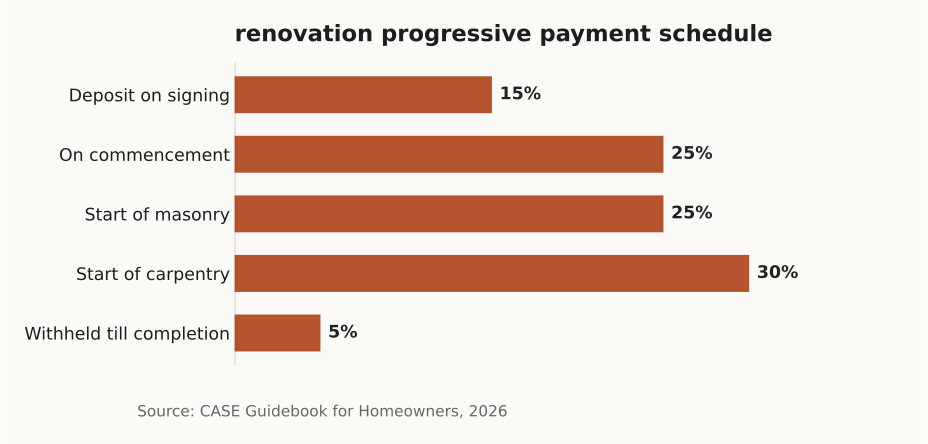
A sample progressive payment schedule — stages, not the calendar.
CASE’s own sample schedule looks like this:
- 15% deposit on signing the contract
- 25% on commencement of renovation
- 25% at the start of masonry works
- 30% at the start of carpentry works
- 5% withheld until satisfactory completion and rectification of all work
The deposit money you do pay upfront deserves its own protection — a deposit performance bond — which we cover in protecting your renovation deposit.
4. Variation orders: agreed in writing, before work
Changes are inevitable; disputes over changes are not. The contract must set out a variation-order (VO) process: every change priced and signed off in writing before the work is carried out, using agreed unit rates, with its effect on the timeline recorded at the time. A contract with no VO clause means every scope change becomes a negotiation after the fact, when you have the least leverage.
Review each variation order and invoice promptly rather than letting them pile up — small, unchallenged VOs are a leading cause of budget overruns.
5. Timeline: start, completion and delay handling
CCCS expects a mutually agreed work schedule with clear deadlines, including the projected start and completion dates, written into the contract, plus agreement on how delays and contingencies are handled. CASE adds a practical tip: the schedule should outline each major stage with its expected start and end dates, and you should buffer at least one to three weeks for unforeseen delays. Without dated milestones, “slow progress” is almost impossible to pin on the firm.
6. Warranty and defects liability: what is and isn’t covered
Most renovation contracts include a 12-month Defect Liability Period, during which the contractor must rectify workmanship defects at no cost; at least 12 months of workmanship warranty is the benchmark to insist on. But read what the warranty excludes, because homeowners routinely assume more than it gives:
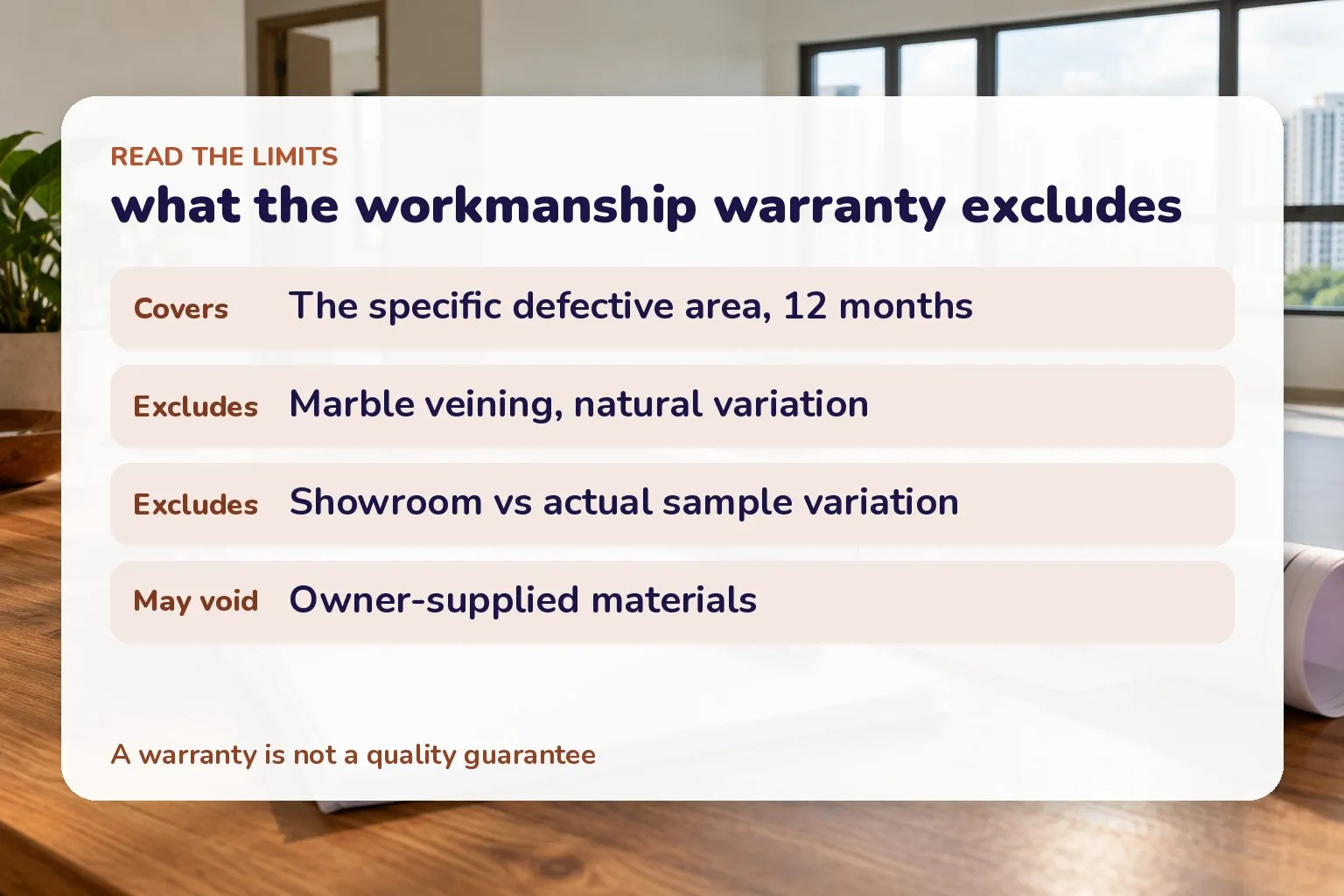
Workmanship warranty coverage and its common exclusions.
- It generally covers only the specific defective area, not full replacement of an item.
- Natural characteristics — vein lines in marble, for example — are not workmanship defects and are excluded.
- Reasonable variation between showroom samples and the actual product is not covered.
- If you supply your own materials, the firm may void the warranty for works involving them.
7. Handover: documents, final walkthrough, last payment
The completion clause should require a proper handover. CASE says the contractor should provide, on completion: a Completion Certificate, warranty cards for installed appliances and materials, user manuals and care guides, and after-sales contact details. Do a comprehensive final walkthrough, raise every defect for rectification, and make the final payment only after all rectification works are done and all documentation has been received — this is exactly what the withheld 5–10% is for.
8. Dispute resolution: mediation and the Small Claims Tribunals
Check how the contract routes a dispute. If your firm is CaseTrust-accredited, it must attend mediation at CASE on your request — a genuine reason to favour accreditation. If mediation fails, the Small Claims Tribunals hear a contract for the provision of services up to S$20,000, or up to S$30,000 if both parties sign a Memorandum of Consent, and you must file within two years of the cause of action. The Tribunals can also hear a dispute against a supplier for an unfair practice under the Consumer Protection (Fair Trading) Act — a faster, cheaper channel than a full court claim.
9. Check the entity you are signing with
Accreditation, DRC listing and the bond all attach to a specific legal entity, not a brand. Confirm the exact company name and UEN on the contract, that payment goes to that corporate account, and — for an HDB flat — that the contracting entity is listed in HDB’s Directory of Renovation Contractors. The flat owner, not just the firm, is responsible for compliance, and engaging a non-DRC contractor or breaching HDB’s renovation rules can draw a fine of up to S$5,000 on conviction.
FAQ
Is there an official renovation contract template? CaseTrust-accredited firms must use the CaseTrust Standard Renovation Contract, which covers obligations, schedules, warranty and itemised pricing. The full clause text is not published publicly, so for a non-accredited firm, use these nine areas as your checklist.
Is the 20% deposit cap the law? No. It is a CaseTrust accreditation requirement. For any firm, CASE still advises never paying more than 20% upfront.
Who should handle the HDB permit — me or the firm? The contract should name who submits permits and by when, but the flat owner remains legally responsible for compliance. See the HDB renovation permit guide.
Can I change the contract after signing? Only through a written, signed variation order agreed before the work is done. Retroactive changes are where disputes start.
Related
- Protecting your renovation deposit
- How to choose a renovation firm
- Interior designer vs contractor
- HDB renovation cost guide
General information only, not legal advice. Verify the DRC listing and CaseTrust accreditation of the exact legal entity on your contract, and read every clause, before you sign.
Sources
- Guidebook for Homeowners (contract terms, progressive payments, warranty, handover) — Consumers Association of Singapore (CASE) (as of October 2026)
- CaseTrust Accreditation for Renovation Businesses — Consumers Association of Singapore (CASE) (as of October 2026)
- CCCS Publishes Guide on Fair Trading Practices for Renovation Industry — Competition and Consumer Commission of Singapore (CCCS) (as of October 2026)
- Written reply to PQs on disputes arising from Interior Design and Renovation firms — Ministry of Trade and Industry (MTI) (as of October 2026)
- Cases eligible for a small claim (Small Claims Tribunals) — Singapore Courts (State Courts) (as of October 2026)
- Important Information on Renovations (owner duties, DRC requirement) — Housing & Development Board (HDB) (as of October 2026)