HDB Directory of Renovation Contractors (DRC)
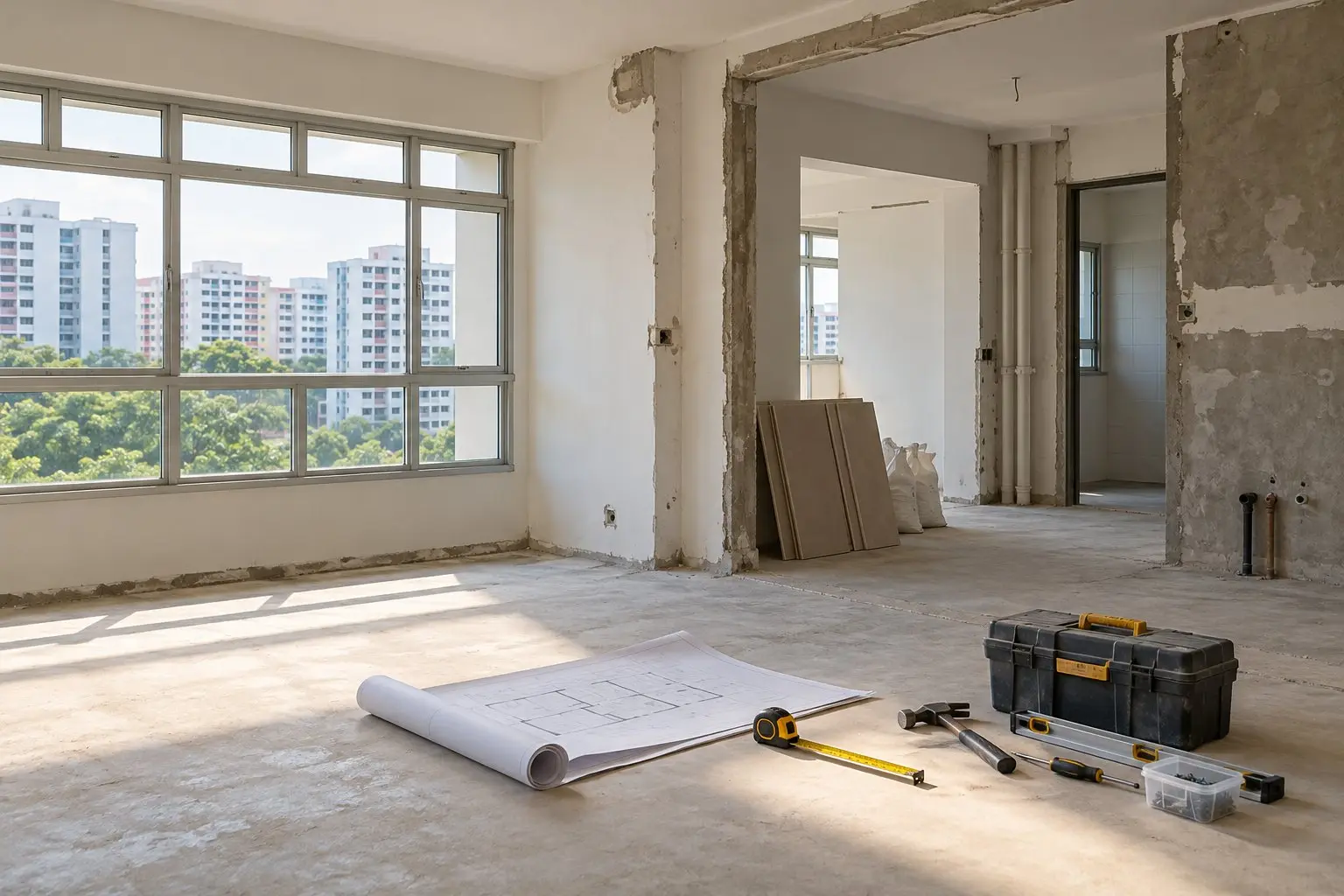
The DRC is HDB's register of contractors allowed to renovate HDB flats. Under the Renovation Control Rules you must engage a DRC-listed firm — even for works needing no permit — and a firm that reaches 24 demerit points in 24 months is suspended for a year.
If you are renovating an HDB flat, the single most important box to tick is that your contractor is listed in HDB’s Directory of Renovation Contractors (DRC). HDB states plainly that “contractors must be listed in the DRC before they can carry out renovations in HDB flats.” This guide explains what the DRC is, why you have no choice about using it, what the listing actually certifies, and how to check a firm yourself before any money changes hands.
What the DRC is
The DRC is HDB’s register of firms permitted to carry out renovation works in HDB flats. A “renovation permit,” in the words of the Housing and Development (Renovation Control) Rules, “means the written approval by the Board to carry out such renovation works in an HDB flat as are specified in that approval” — and only a registered renovation contractor may do that approved work. The directory is the public expression of that registration: if a firm is on it, HDB has assessed its experience, finances and training; if it is not, it cannot legally renovate your flat.
Why you must use a DRC-listed contractor
This is not a recommendation. HDB’s Important Information states that “the Housing & Development (Renovation Control) Rules 2006 require that you only engage contractors from the Directory of Renovation” Contractors. The duty is wide: it applies even to works that do not themselves need a permit. You still need separate HDB approval for certain jobs — HDB states that “all demolition and hacking of walls (be it partial or complete) require HDB’s prior written approval” — but the DRC rule covers the whole renovation, permit or not. For which specific works trigger a permit, see the HDB renovation permit guide.
How a firm gets listed
Listing is a genuine bar, which is what makes it worth checking. To be listed, HDB requires that the applicant:
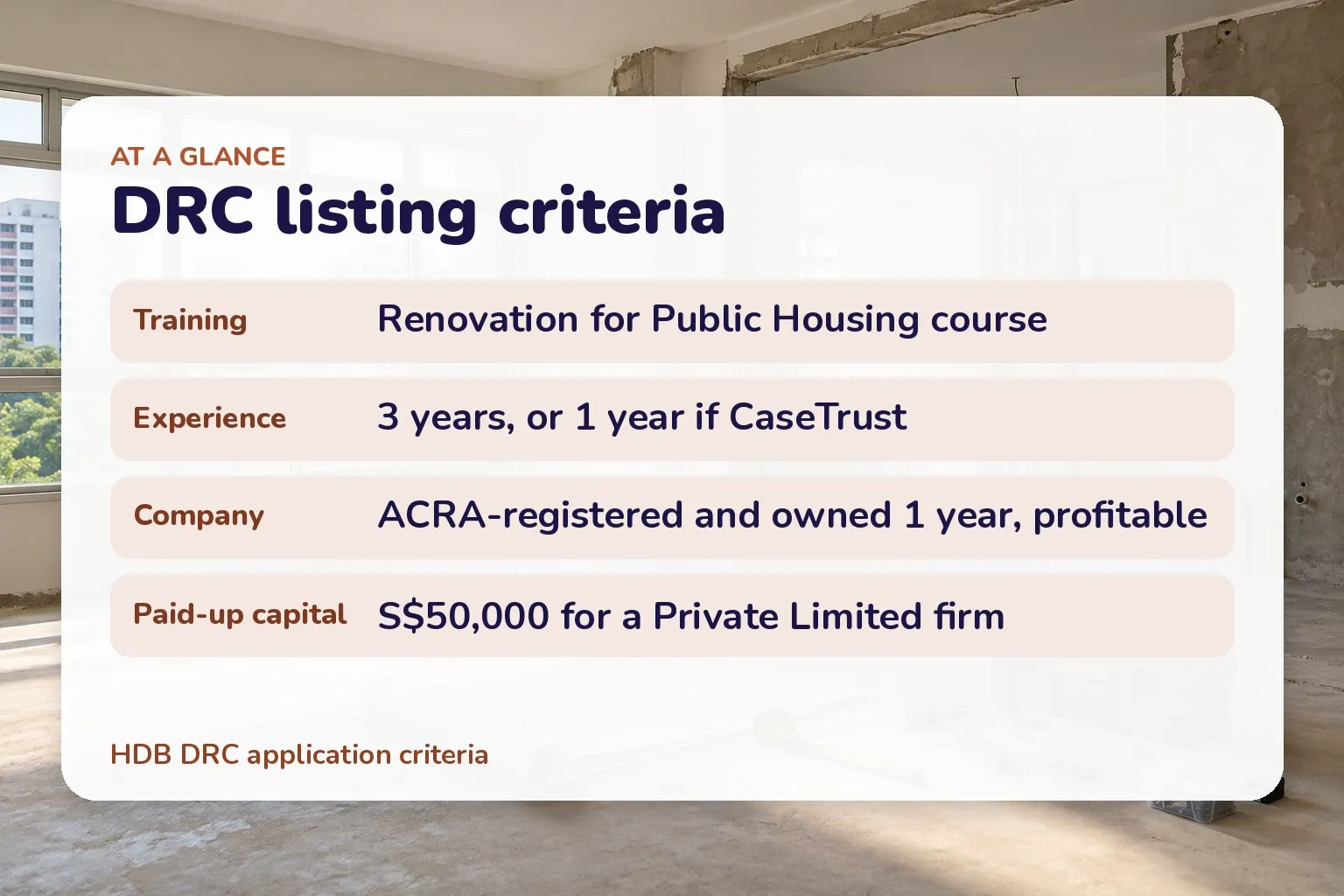
The main criteria a firm must meet to be listed in the DRC. Source: HDB, 2026.
- is “a Singaporean or Singapore Permanent Resident” and has “attended and successfully completed the ‘Renovation for Public Housing’ training course”;
- has “at least 3 years of experience in renovation works” — reduced to “only 1 year of experience in renovation works is required” if the firm has CaseTrust accreditation;
- runs a company “registered with the Accounting and Corporate Regulatory Authority for at least a year,” owned for at least a year, with “a good track record,” which has “been profitable in the past one year” and has “at least one full-time staff”;
- holds “a minimum paid up capital of $50,000 if it is a Private Limited company”; and
- has directors who “are not undischarged bankrupts” and have no “criminal records, or record of any offences involving fraud and dishonesty.”
HDB “notify[s] you of the results within 21 working days” of a complete application, against an application fee of “$100.” A standard listing is renewed periodically — a firm “must renew [its] application to be listed in the DRC at least 3 months before its expiry” — and “CaseTrust accredited contractors will be listed on the Directory of Renovation Contractors for 3 years, instead of 2 years.” That interaction with CaseTrust accreditation is worth knowing: the badge both shortens the experience bar and lengthens the listing.
The Demerit Points System
Being listed is a live status a firm has to keep. HDB runs a Demerit Points System (DPS) that it describes as “a transparent system, which helps to remind contractors to self-regulate and maintain good performance.” The thresholds are specific:
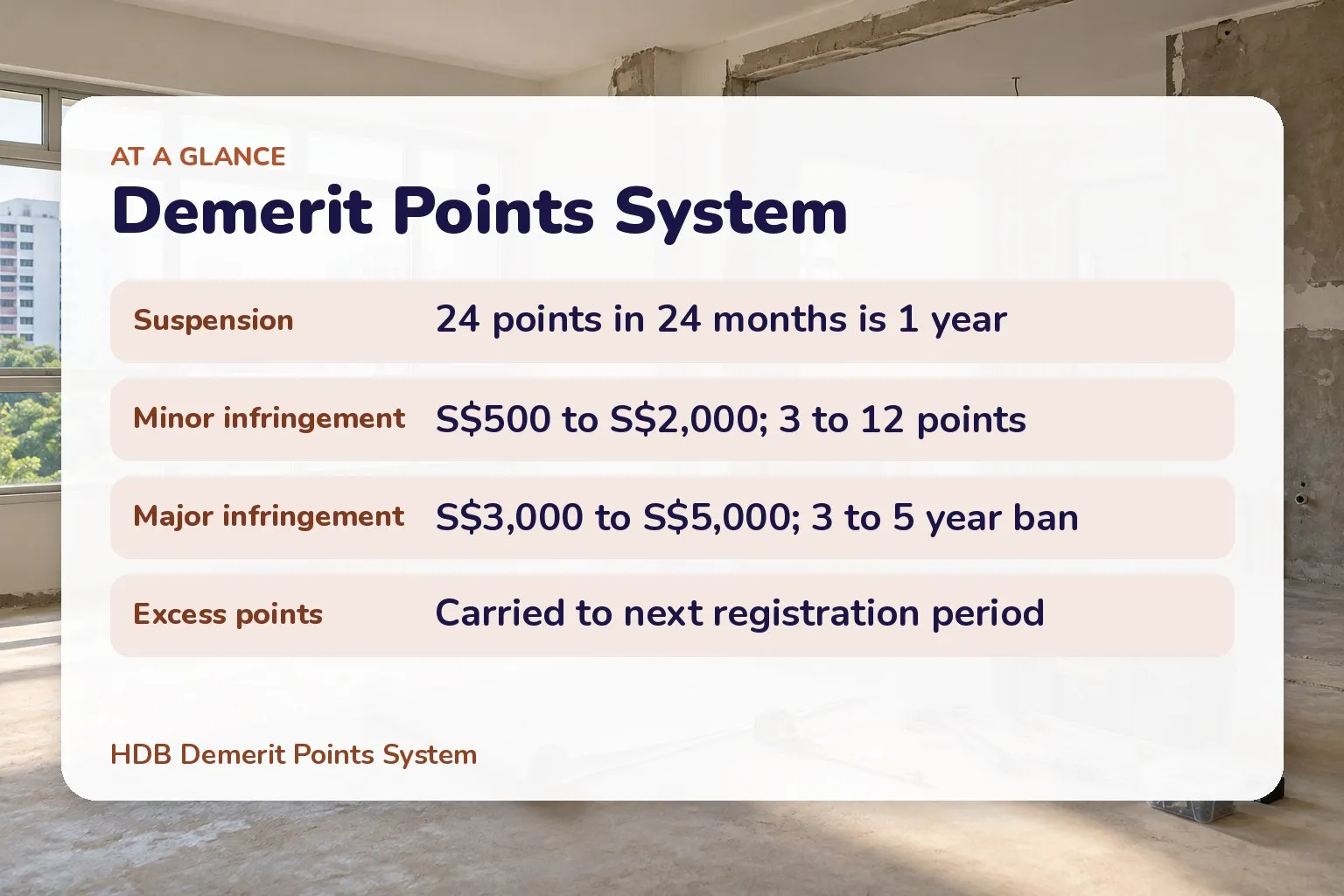
How the Demerit Points System suspends or disqualifies a contractor. Source: HDB, 2026.
- A firm is “delisted from the DRC if you receive a total of at least 24 demerit points within 24 months,” which brings a “1-year suspension.”
- If a firm goes past that, “excess demerit points are carried over to the next registration period.”
- A minor infringement draws a “$500 to $2,000 fine” and “3 to 12 demerit points.”
- A major infringement draws a “$3,000 to $5,000 fine” and “3 to 5-year disqualification in serious cases,” which applies “regardless of demerit points.”
This is not theoretical enforcement. HDB told Parliament that “in the past three years, HDB has penalised about 200 errant contractors,” with infringements including “working beyond permitted hours, failing to send written notices to neighbours to inform them of renovation work and dirtying the common area.” For a homeowner, the DPS is a stronger quality signal than any single online review, because it reflects HDB’s own record of a firm’s conduct.
How to verify a contractor
Because listings expire and can be suspended, verify on or near the day you sign rather than relying on a certificate the firm shows you. Cross-check the firm’s own claims: if it says it is CaseTrust-accredited, confirm that separately, because that status changes its DRC listing length and is a meaningful extra protection.
If you use a non-listed contractor
The consequences run in two directions. The firm faces the Demerit Points System consequences set out above. You, the owner, risk prosecution: the acknowledgement form warns that “any failure to engage contractor listed in the DRC or any contravention of the Housing and Development (Renovation Control) Rules… such as carrying out unauthorised demolition/hacking of walls may result in prosecution action by HDB,” on top of an order to reinstate the flat at your own cost. An unlisted firm also cannot pull your renovation permit, so your hacking and noisy works would proceed without approval — see what that means in the HDB hacking and wall rules.
Disputes are a private matter
One thing the DRC listing does not do is make HDB a referee for your renovation. HDB states that “the engagement of contractor listed in the DRC is strictly on a private basis between the flat owners and the contractors,” and that for “disagreement on the pricing, schedule or quality of the renovation works, both parties are advised to” resolve it themselves. Your written, itemised contract is therefore your real protection; the listing certifies the firm’s standing, not the outcome of your job.
If a dispute cannot be settled, the Small Claims Tribunals hear a “contract for the provision of services” — with “Renovation contract” given as the example — up to “$20,000 (or $30,000 if there is a Memorandum of Consent signed by both parties).” A faster, cheaper route than a full court claim, though it depends on the firm still existing.
Frequently asked questions
Do I legally have to use a DRC contractor for my HDB flat? Yes. The Renovation Control Rules require you to engage a DRC-listed contractor for renovations in your flat, including works that need no permit.
Does DRC listing mean the firm is good? It means the firm met HDB’s experience, financial and training bar and is in good standing under the Demerit Points System. It is a strong baseline, not a guarantee of workmanship; vetting still matters.
How long is a listing valid? Two years for a standard firm, three years for a CaseTrust-accredited one, and a firm must renew at least three months before expiry.
What happens to a firm with too many demerit points? At 24 or more points within 24 months it is suspended for a year; excess points carry to the next registration period, and serious cases bring disqualification of three to five years.
Can I check the DRC myself? Yes — look the firm up by its exact registered company name on HDB’s DRC search before you pay any deposit.
Related
- How to choose a renovation firm
- CaseTrust renovation firms explained
- Interior designer vs contractor
- HDB renovation permit guide
- HDB hacking and wall rules
General information only, not legal advice. Rules and penalties are from official HDB and AGC pages (November 2026) and change over time — verify a firm’s DRC listing on the HDB website before you commit.
Sources
- Directory of Renovation Contractors (DRC) and Demerit Points System — Housing & Development Board (HDB) (as of November 2026)
- DRC Application Process (criteria, paid-up capital, fee) — Housing & Development Board (HDB) (as of November 2026)
- Renewal of Application to be listed in the DRC (listing validity) — Housing & Development Board (HDB) (as of November 2026)
- Important Information (demolition approval, owner responsibilities) — Housing & Development Board (HDB) (as of November 2026)
- Important Information on Renovations (owner responsibilities, private arrangement) — Housing & Development Board (HDB) (as of November 2026)
- Housing and Development (Renovation Control) Rules — Singapore Statutes Online (AGC) (as of November 2026)
- Reply on renovation contractors and the Demerit Points System — Ministry of National Development (MND) / Parliament (as of November 2026)
- Cases eligible for a small claim (Small Claims Tribunals) — Singapore Courts (State Courts) (as of November 2026)