Common Renovation Mistakes to Avoid in Singapore
The costliest renovation mistakes in Singapore are choosing a firm on the lowest quote, paying too much upfront, skipping milestone inspections, hacking without HDB approval, and keeping no contingency. Each is avoidable with official rules and a staged, inspected payment plan.
On this page11 sections · tap to jump
- 01Mistake 1: Choosing a firm on the lowest quote
- 02Mistake 2: Budgeting only the headline quote
- 03Mistake 3: Paying too much upfront, holding nothing back
- 04Mistake 4: Skipping inspections at key milestones
- 05Mistake 5: Unauthorised hacking or a non-DRC contractor
- 06Mistake 6: Relying on verbal promises
- 07Mistake 7: Letting variation orders pile up
- 08Mistake 8: No contingency fund
- 09Mistake 9: Signing off before the defect check
- 10Mistake 10: Fixing carpentry before electrical and storage
- 11Frequently asked questions
Renovation is one of the biggest spends a Singapore household makes, and it is one of the most complained-about trades: CASE received about 120 complaints a year over prepayment losses on incomplete renovations between 2017 and 2023, on contracts averaging around S$7,400. Most renovation disasters are not bad luck — they are a handful of avoidable mistakes made before and during the job. Here are the ones that cost homeowners the most, and the official-backed fix for each.
Mistake 1: Choosing a firm on the lowest quote
The cheapest quote is almost never the cheapest job. A figure far below the rest usually leaves items out — hacking, haulage, protection works, provisional sums — and they return as variation orders once you are committed. CASE puts it plainly: “reliability should always take precedence over price considerations or personal rapport with the contractor.”
Because the Government “does not mandate minimum qualifications or experience levels for key personnel in renovation and interior design companies,” a glossy showroom tells you nothing. CASE recommends meeting at least five renovators so you can compare meaningfully, and warns that “fake reviews are rampant.” Give every firm the identical, itemised scope so you compare arithmetic, not sales pitches — the method is in how to compare renovation quotes.
Mistake 2: Budgeting only the headline quote
The quote is not the spend. CASE notes that renovation costs “usually exclude expenses from furniture and appliances,” and there are setup bills (a utilities deposit before HDB grants a new-flat permit), 9% GST if the firm is GST-registered, and post-hacking repairs that only surface once work starts. CPF cannot soften any of it — “CPF savings cannot be used for renovation, improvement or repair work for your property” — so the whole bill is cash or a cash-funded loan.
Budget the furniture, appliances, aircon and curtains as their own lines from the start. The full breakdown of what sits outside the quote is in hidden renovation costs.
Mistake 3: Paying too much upfront, holding nothing back
Hand over a big deposit and you have handed over your leverage. CASE’s rule of thumb for any firm is that “you should never pay more than 20% upfront before work begins,” and under the CaseTrust scheme that 20% ceiling is a formal requirement. At the other end, CASE advises “retaining 5-10% of the final payment until all work is satisfactorily completed.”
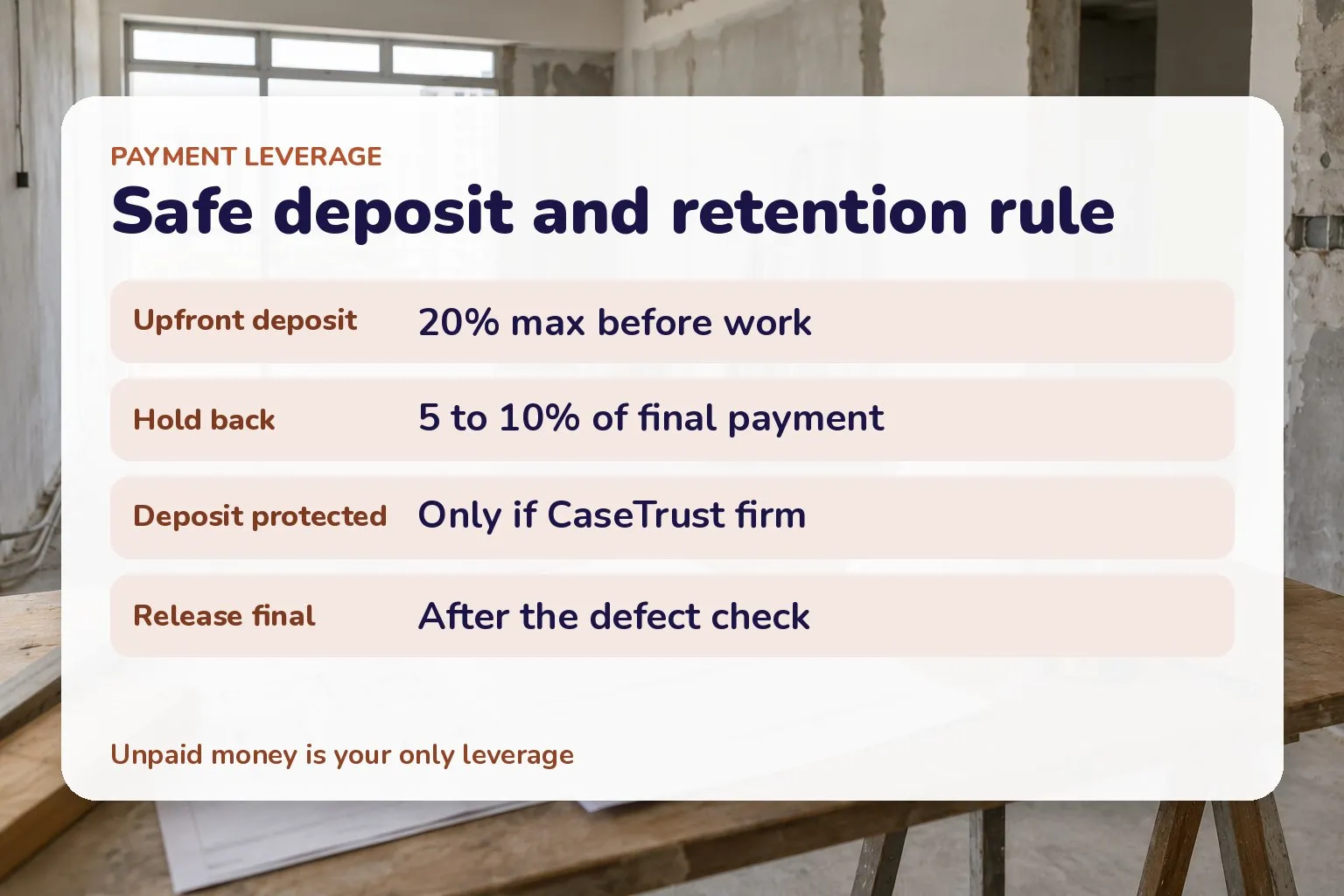
Keep the deposit small and the final payment withheld.
Pay in stages tied to inspected milestones, not dates. Only a CaseTrust-accredited firm’s deposit is protected by a performance bond if the business folds — with any other firm, a small deposit is your only protection. The full mechanics are in the renovation payment schedule guide.
Mistake 4: Skipping inspections at key milestones
Paying for a stage you have not checked defeats the point of a staged schedule. CASE recommends inspecting at the critical points — post-demolition / pre-tiling, on completion of electrical and plumbing, pre-painting or finishing, and the final walkthrough. Catch a defect while the trade is still on site and it is fixed for free; find it after handover and it is a warranty claim.
If you cannot judge the work yourself, CASE’s advice is to “engage a third-party inspector if you are unsure how to assess the work.”
Mistake 5: Unauthorised hacking or a non-DRC contractor
This is the one mistake with a statutory price tag. HDB requires that you “engage only contractors from the Directory of Renovation Contractor (DRC),” and that “all demolition and hacking of walls (be it partial or complete) require HDB’s prior written approval.” Breach either and, on conviction, you face a fine of up to S$5,000 — and HDB “can ask you to reinstate your flat to its original condition” at your own cost.
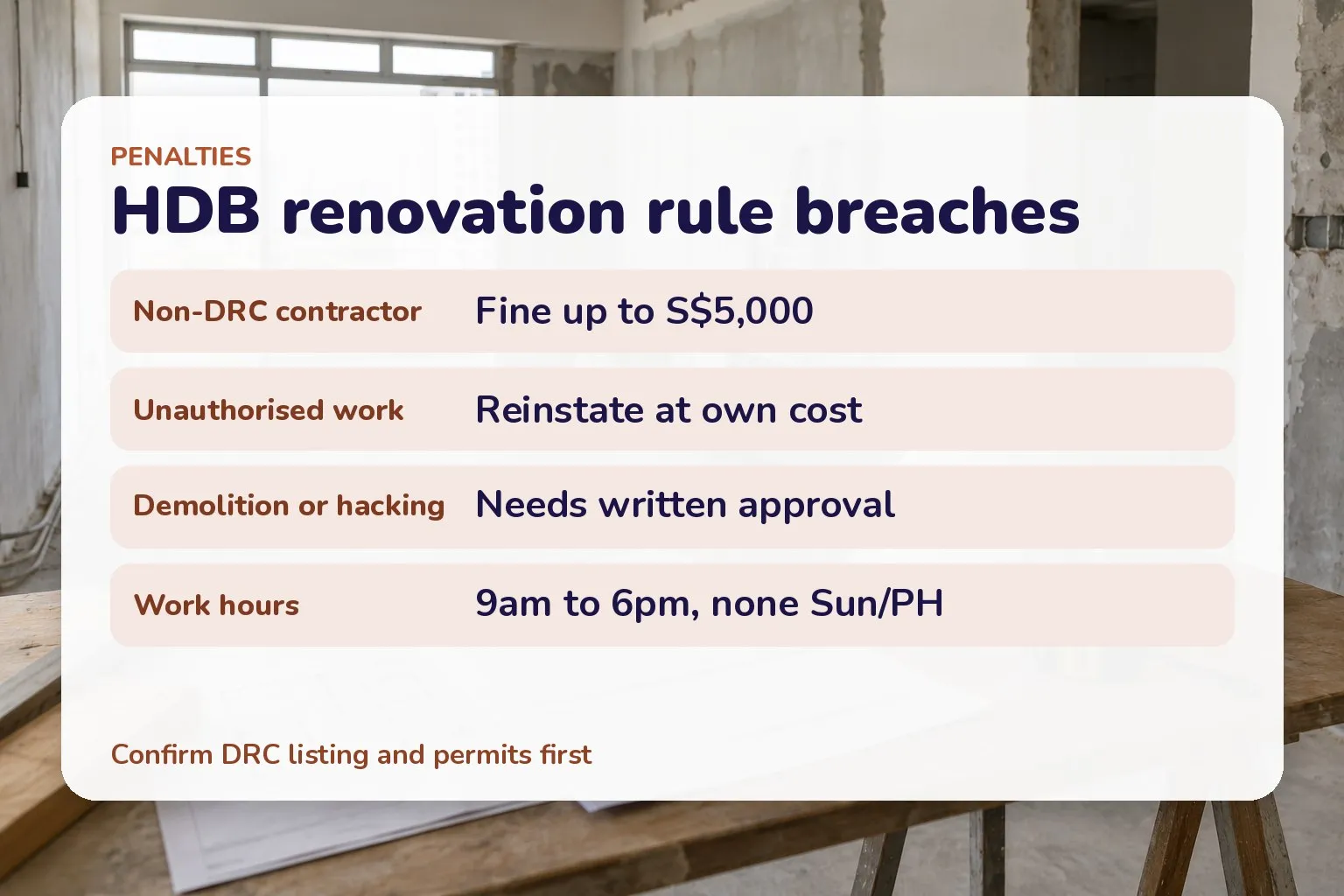
What HDB penalises on an HDB flat renovation.
So unauthorised work is the most expensive shortcut available: you pay to do it, pay the fine, then pay to undo it. Confirm your firm is DRC-listed and that every hacking line has a permit — see the HDB renovation permit guide.
Mistake 6: Relying on verbal promises
A price, a free upgrade, a brand of tile or a completion date agreed over WhatsApp or at the showroom counts for nothing unless it is written down. CCCS requires that “revisions to the contract or work order variations should be made only with the consumer’s express agreement,” and CASE’s guidance throughout is to document every agreement. Before you sign, read the contract against your own notes and add anything the salesperson promised that is missing — the clause-by-clause check is in what to check in a renovation contract.
Mistake 7: Letting variation orders pile up
Changes are inevitable; unpriced changes are where budgets explode. CASE advises you to “review invoices and variation orders promptly to avoid surprises,” and to “define a clear scope of work and avoid changes once the renovation begins.” Treat each variation as a mini-contract — scope, rate, timeline effect, signed before that trade starts. Small, unchallenged variations are a leading cause of overruns.
Mistake 8: No contingency fund
Even a well-planned job throws up surprises once hacking begins — hidden leaks, mould, old waterproofing, faulty wiring. CASE recommends setting aside a contingency fund of 10-15% of your total budget for unforeseen repairs, and notes budget overruns most often come from “discovering hidden issues… changing designs or materials mid-project… underestimating the cost of fittings, finishes, or labour.” Keep the contingency separate from your furniture money so it is actually there when a wall opens up. Older resale flats need a bigger buffer — see the resale flat renovation cost guide.
Mistake 9: Signing off before the defect check
The final payment is your last lever, and spending it early throws it away. Do the full final walkthrough, raise every defect, and make the final payment only after all rectification is done and you have received the handover documents — the Completion Certificate, warranty cards, user manuals and after-sales contacts. That is exactly what the withheld 5-10% is for. How defects are handled afterwards is covered in renovation defects and warranties.
Mistake 10: Fixing carpentry before electrical and storage
Many renovation regrets are not rule breaches but planning misses that are expensive to reverse. Homeowners routinely report too few power points, switches in awkward places and too little storage — decisions locked in once carpentry and tiling are done. The official angle is the money, not the taste: because CASE urges you to settle a clear scope and avoid changes once work begins, a layout rethink after the trade has started becomes a paid variation order, not a free edit. Walk your furniture plan, plug points and storage through room by room before carpentry starts. First-timers who want the whole sequence should start with the first-time renovation guide.
Frequently asked questions
What is the single most expensive renovation mistake? Unauthorised work — hacking without HDB approval or using a non-DRC contractor. On conviction it carries a fine of up to S$5,000, and HDB can order you to reinstate the flat at your own cost, on top of the renovation you already paid for.
How much deposit is safe to pay? No more than 20% upfront before work begins, per CASE’s rule of thumb and the CaseTrust cap. Keep the rest tied to inspected milestones and withhold 5-10% until the end.
Do I need a contingency even for a new BTO? Yes, though a new BTO usually needs less than a resale flat. CASE recommends 10-15% of the budget; a newer flat is less likely to hide leaks, old waterproofing or spalling concrete, but design changes and under-costed finishes still happen.
Are verbal agreements with my contractor binding? Treat them as unenforceable. Only what is in the signed contract or a dated, signed variation order can be relied on if a dispute reaches CASE mediation or the Small Claims Tribunals.
Related
- What to check in a renovation contract
- Renovation payment schedule explained
- Hidden renovation costs to expect
- How to choose a renovation firm
- HDB renovation permit guide
General information only, not legal advice. Official rules and penalties are from HDB, CCCS, MTI, CASE and CPF; cost figures mentioned elsewhere are illustrative industry ranges, not quotes. Rules and rates change — confirm current figures before you commit.
Sources
- Guidebook for Homeowners (reliability over price, contingency, inspections, deposit rules, handover) — Consumers Association of Singapore (CASE) (as of November 2026)
- Important Information on Renovations (DRC requirement, hacking approval, up to S$5,000 fine, timings, HFAD) — Housing & Development Board (HDB) (as of November 2026)
- Fair Trading Practices for the Renovation Industry (itemised pricing, agreed timeline, variations by express consent) — Competition and Consumer Commission of Singapore (CCCS) (as of November 2026)
- Written reply to PQs on disputes arising from Interior Design and Renovation firms (120 complaints/year, no minimum qualifications) — Ministry of Trade and Industry (MTI) (as of November 2026)
- CaseTrust Accreditation for Renovation Businesses (20% deposit cap, deposit performance bond) — Consumers Association of Singapore (CASE) (as of November 2026)
- Can I use my CPF savings for renovation and repairs of my property? — Central Provident Fund Board (CPF) (as of November 2026)