Renovation Defects, Warranties and Disputes

After handover the contractor fixes workmanship defects during the defects liability period, commonly a 12-month warranty. Record defects in writing with photos, hold back 5-10% of the final payment, and escalate unresolved cases through CASE mediation or the Small Claims Tribunals.
On this page8 sections · tap to jump
- 01Why the contract carries your rights
- 02Defects liability period and the 12-month warranty
- 03What the warranty does not cover
- 04Inspecting and recording defects at handover
- 05If the contractor will not fix the defects
- 06Small Claims Tribunals: limits and time bar
- 07If the firm has closed or gone insolvent
- 08Frequently asked questions
The riskiest moment of a renovation is the start, when you pay a deposit for work not yet done. The second-riskiest is the end — when the work is finished, the money is nearly all paid, and a hairline crack, a drummy tile or a door that will not shut turns up. This guide is about that second phase: what counts as a defect, how long the contractor stays on the hook, what the warranty does and does not cover, and the escalation ladder when a firm goes quiet. For reading the contract before you sign, see what to check in a renovation contract; this is its post-handover companion.
Why the contract carries your rights
Renovation is a high-complaint trade, and the state does not stand between you and a bad job. The Ministry of Trade and Industry has confirmed the Government does not mandate minimum qualifications or experience levels for key personnel in renovation and interior-design companies. The scale of disputes is real: from 2017 to 2023 the Consumers Association of Singapore (CASE) received about 120 complaints a year over prepayment losses on incomplete renovations, on contracts averaging about S$7,400, and recovered the money in only about half of the negotiated cases — though CASE did observe a 19% drop in renovation-contractor complaints in 2023.
Because no regulator guarantees workmanship, your rights after handover live in the contract and in general consumer law. The Competition and Consumer Commission of Singapore (CCCS) sets the expectation plainly in its fair-trading guide: agreed warranties should be honoured, and contractors should state consumers’ rights and remedies — exchanges, repairs and refunds — clearly in the contract.
Defects liability period and the 12-month warranty
Two overlapping ideas protect your finished home. The defects liability period is the window in your contract during which the contractor must put right faults that appear; the State Courts’ renovation guide says a defects liability period should be provided in the contract. The workmanship warranty is the promise of quality that sits alongside it.
For accredited firms, CASE’s benchmark is concrete: at least 12 months of workmanship warranty is provided, and CASE recommends every homeowner request a workmanship warranty of at least 12 months, during which the renovator rectifies poor-workmanship defects at no additional cost. Most renovation contracts, CASE notes, include a 12-month Defect Liability Period during which the contractor addresses workmanship issues. A non-accredited firm can offer different terms, so read the warranty period and the defects liability period in your own contract rather than assuming the 12-month norm.
What the warranty does not cover
Homeowners routinely assume the warranty is broader than it is. Per CASE’s guidance, it generally applies only to the specific defective area, not to full replacement of the item or fixture. Three common exclusions catch people out: natural imperfections such as vein lines in marble are not workmanship defects and are excluded; reasonable variation between showroom samples and the actual product is not covered; and if you supply your own materials, the renovator may void the warranty for works involving them.
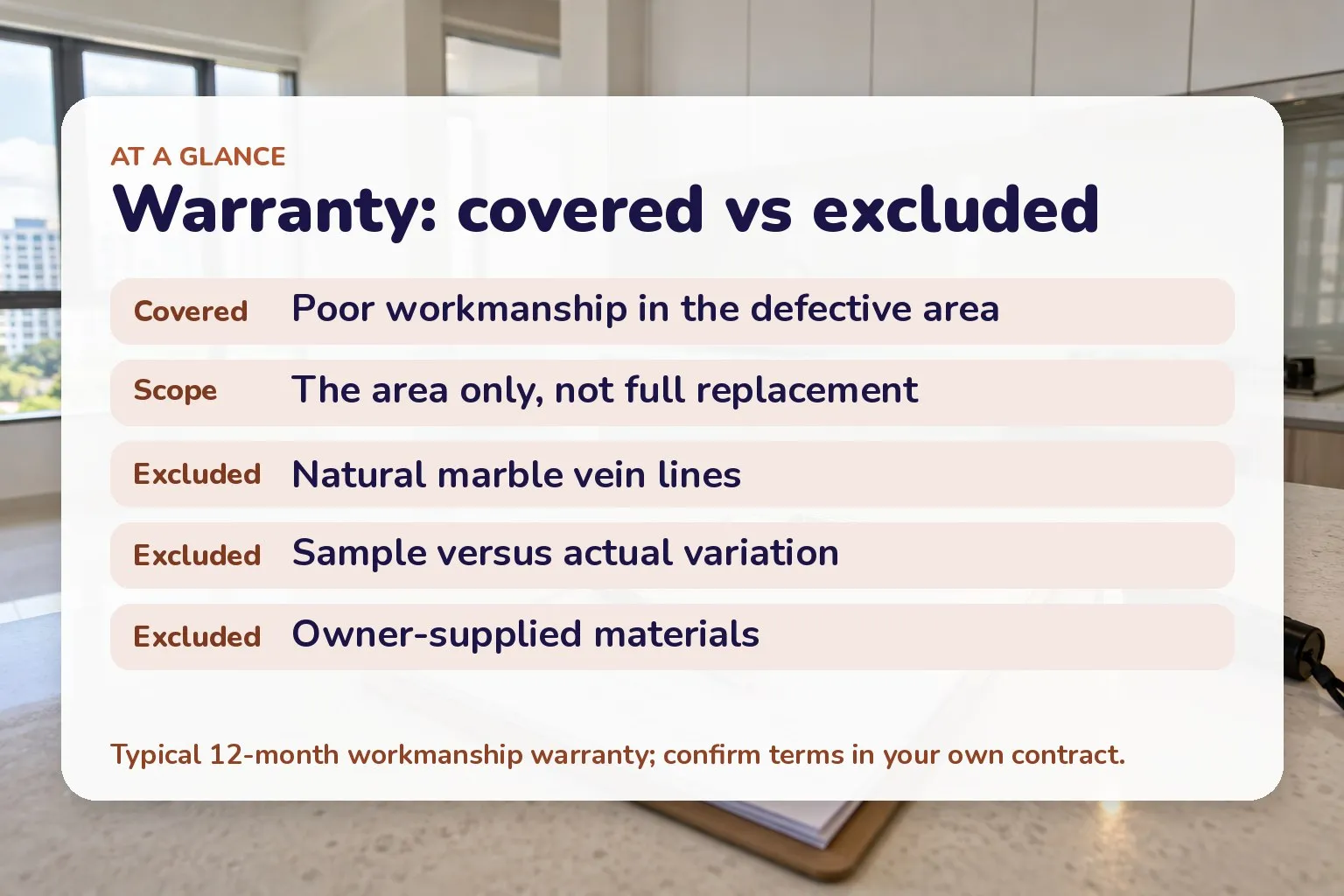
What a 12-month workmanship warranty typically covers and excludes — Source: CASE Guidebook for Homeowners, 2026
The State Courts add a drafting point worth insisting on: warranties should be clear, in plain language, with limitations such as wear-and-tear exclusions stated clearly. A warranty you cannot read is one you cannot enforce.
Inspecting and recording defects at handover
Defects are easiest to fix while the trade is still on site and the money is not yet paid, so inspect throughout, not just at the end. CASE recommends checking at key milestones — post-demolition and pre-tiling, after the electrical and plumbing installations, before painting or finishing, and at the final walk-through before handover. That final walk-through, CASE warns, is your last opportunity to raise concerns before closure.
How you record a defect decides whether you can enforce it. The State Courts’ renovation guide is specific: take photos of the premises after handover, record each defect in writing as a list with photos, and ask the contractor to rectify them within the defects liability period. After rectification, the contractor should obtain your acknowledgement that the defects have been satisfactorily attended to — so keep that paper trail on both sides.
If the contractor will not fix the defects
When a contractor stalls, work the ladder in order. First, put the defect list in writing and give the firm a fair chance to rectify within the defects liability period — a documented request is also the evidence you will rely on later. If the firm is CaseTrust-accredited, you have a stronger lever: homeowners working with a CaseTrust renovator can request mediation at CASE, which accredited renovators must attend. CCCS also confirms that consumers who encounter unfair practices can approach CASE for assistance.
Mediation is faster and cheaper than court and keeps a working relationship alive long enough to finish the job. Approach it with your dated defect list, photos, the contract and your payment records. For vetting a firm’s accreditation and track record in the first place — the best defence against ever reaching this point — see how to choose a renovation firm.
Small Claims Tribunals: limits and time bar
If mediation fails, the Small Claims Tribunals (SCT) are the usual next step for a renovation dispute. The SCT can hear a contract for the provision of services, and a dispute against a supplier for an unfair practice under the Consumer Protection (Fair Trading) Act. The claim limit is S$20,000, which can be raised to S$30,000 if both parties sign a Memorandum of Consent. Crucially, you must file within 2 years of the event that creates your cause of action — miss that window and the Tribunals cannot help.
The MTI has noted that some consumers recover their losses through avenues such as the Small Claims Tribunal, so it is a realistic route for the typical renovation sum. Prepare the same bundle you took to mediation, and quantify your loss — the cost of engaging another firm to complete or redo the work is the figure that usually matters.
If the firm has closed or gone insolvent
A closed firm is the hardest case, because there may be no one left to sue. If the respondent is a corporate entity in liquidation or winding up, you cannot proceed with an SCT claim against it without the High Court’s permission — so chasing an insolvent firm through the Tribunals is rarely straightforward. This is where accreditation earns its keep before anything goes wrong: CaseTrust-accredited renovation businesses are required to protect prepayments, and consumers can claim back the unused portion of the prepayment following the firm’s closure. For how that protection and your staged payments limit exposure, see protecting your renovation deposit.
The practical lesson runs backwards into how you paid: the less you have paid ahead of completed work, and the better your records, the less a collapse can cost you. A tidy file of the contract, the defect list, photos and every receipt is what turns a dispute from “your word against theirs” into a claim you can actually run.
Frequently asked questions
How long is a renovation warranty in Singapore? CASE’s benchmark is at least 12 months of workmanship warranty, and most contracts carry a 12-month defects liability period. A non-accredited firm may offer different terms, so confirm the period written in your own contract.
Does the warranty cover cracked marble or tiles that differ from the showroom sample? Usually not. Natural marble veining is excluded as a non-defect, and reasonable variation between samples and the actual product is not covered. The warranty targets poor workmanship on the specific defective area.
What if I supplied my own tiles or fittings? If you supply materials independently, the renovator may void the warranty for works involving those materials. Agree responsibility in writing before installation if you are buying your own finishes.
Can I go straight to the Small Claims Tribunals? You can, within two years of the cause of action, for a services dispute up to S$20,000 (S$30,000 with mutual consent). In practice, try the contractor and CASE mediation first — it is faster, and for an accredited firm the mediation is compulsory on request.
The firm has shut down. What now? Pursuing a wound-up company at the SCT needs the High Court’s permission. If the firm was CaseTrust-accredited, use its prepayment protection to claim back the unused prepayment; otherwise your recovery depends on how little you paid ahead of completed work.
Related
- Renovation contract: what to check before you sign
- Protecting your renovation deposit
- How to choose a renovation firm
- Renovating a landed house: permits and rules
General information only, not legal advice. Confirm your warranty and defects liability period in your own contract, and check current dispute-resolution limits with CASE and the Singapore Courts before you act.
Sources
- Guidebook for Homeowners (warranty, handover, defects) — Consumers Association of Singapore (CASE) (as of November 2026)
- CaseTrust Accreditation for Renovation Businesses — Consumers Association of Singapore (CASE) (as of November 2026)
- CCCS Publishes Guide on Fair Trading Practices for Renovation Industry — Competition and Consumer Commission of Singapore (CCCS) (as of November 2026)
- Written reply to PQs on disputes arising from Interior Design and Renovation firms — Ministry of Trade and Industry (MTI) (as of November 2026)
- Cases eligible for a small claim (Small Claims Tribunals) — Singapore Courts (State Courts) (as of November 2026)
- Best Practices to Avoid Pitfalls in Renovation Contracts (info guide) — Singapore Courts (State Courts) (as of November 2026)