Built-in Carpentry vs Loose Furniture Cost in Singapore
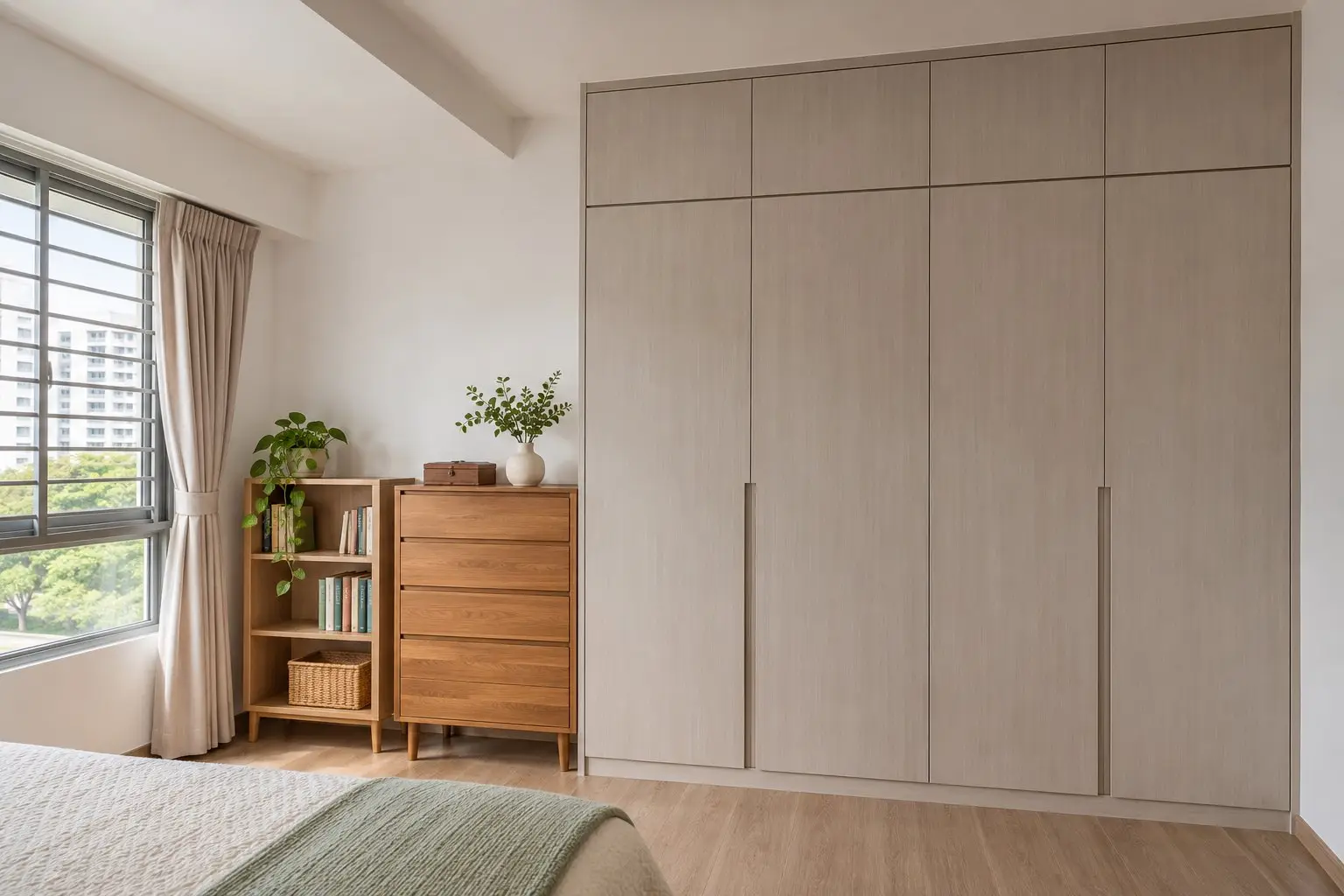
Built-in carpentry costs more — custom work is priced per foot run (wardrobes about S$250–380/ft run), while modular runs 20–50% cheaper and loose furniture cheaper still. Built-in wins for kitchens and fitted wardrobe walls; loose or modular wins almost everywhere else.
On this page10 sections · tap to jump
- 01Quick verdict: which to pick, room by room
- 02Three ways to furnish a flat
- 03How built-in carpentry is priced
- 04The cost gap
- 05The HDB rules that shape the choice
- 06Built-ins and resale value
- 07A worked example (illustrative)
- 08When built-in carpentry wins
- 09When loose furniture wins
- 10Frequently asked questions
Nearly every renovation quote assumes built-in carpentry, because that is how interior firms work and price. But fixed carpentry is the most expensive way to furnish a flat, and for many rooms it is the wrong default. The honest comparison is cost against flexibility: custom built-in carpentry is priced per foot run and costs the most; modular (ready-made) carpentry runs roughly 20–50% cheaper; and loose furniture — IKEA at one end, custom freestanding joinery at the other — is usually cheaper still and leaves with you. The figures here are illustrative November 2026 industry ranges compiled from Singapore carpentry price guides, not quotes.
Quick verdict: which to pick, room by room
There is no single winner — the right choice changes by room and by how long you will stay.
- Kitchen: build in. Worktop, sink, hob and cabinets must be integrated and sealed as a continuous run, so loose kitchen furniture is a niche look, not a practical option. Budget by foot run — see the kitchen renovation cost breakdown for the full kitchen build-up.
- Wardrobes: it depends. A floor-to-ceiling fitted wardrobe wall (no dust gap, top shelf usable) justifies built-in at about S$250–380 per foot run. A single reach-in wardrobe does not — a modular or loose wardrobe at a fraction of the cost does the same job.
- TV console, shoe cabinet, study desk, shelving: lean loose or modular. These are the pieces where freestanding saves the most and costs nothing to reconfigure later.
- Awkward corners (under a stair, into a bay, around a column) and very tight bedrooms: build in. No freestanding piece follows an irregular wall, and the 20–40mm of air around a loose piece is space you feel in a small room.
- Short stay, rental, or a layout you are unsure about: loose, every time. Built-ins cannot move and cannot be reconfigured.
Overall default: build in the kitchen and any genuine floor-to-ceiling wardrobe wall; furnish everything else loose or modular unless a specific room geometry forces your hand.
Three ways to furnish a flat
The choice is not simply “custom or IKEA” — there are three tiers, and the price gaps between them are large:
- Custom built-in carpentry. Made to measure on site, scribed to your walls and permanently fixed. Most expensive, best fit, cannot move.
- Modular carpentry. Mass-produced carcasses in standard sizes, assembled to suit. Industry guides put it at 20–50% cheaper than full custom.
- Loose furniture. Freestanding pieces, from mass-market (IKEA) to custom furniture-grade joinery. Cheapest per piece, fully portable, no fit to the wall.
How built-in carpentry is priced
Custom carpentry in Singapore is quoted per foot run (pfr) — the length of cabinetry in feet, multiplied by a rate that depends on material, finish and hardware. A standard HDB wardrobe is 8 ft tall, which is the height most per-foot-run rates assume. These are illustrative 2026 ranges from published price guides and direct-carpenter rate cards:
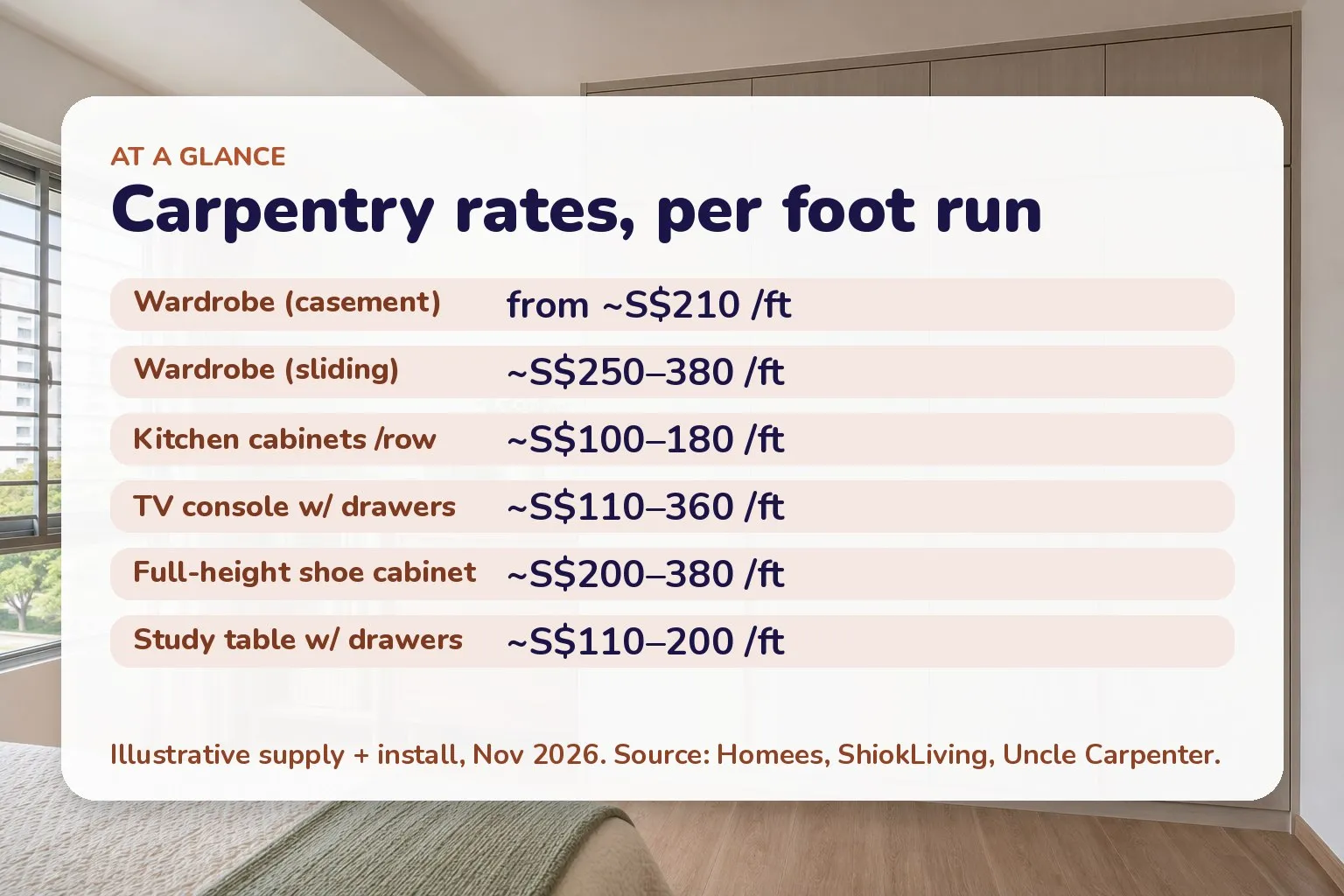
Illustrative per-foot-run carpentry rates, Nov 2026 — not quotes.
| Built-in piece | Illustrative rate |
|---|---|
| Wardrobe (casement doors) | from ~S$210 / ft run |
| Wardrobe (soft-close sliding) | ~S$250 – S$380 / ft run |
| Kitchen cabinets (per row) | ~S$100 – S$180 / ft run |
| TV console with drawers | ~S$110 – S$360 / ft run |
| Full-height shoe cabinet | ~S$200 – S$380 / ft run |
| Study table with drawers | ~S$110 – S$200 / ft run |
| Platform bed with storage | ~S$1,500 – S$2,500 per unit |
| Feature / TV wall | ~S$20 – S$45 per sq ft |
Approximate supply-and-install ranges (Nov 2026) from Homees, ShiokLiving and Uncle Carpenter rate cards. Not quotes.
The material and finish of the carcass and fronts move the rate: laminate roughly S$75–200 per foot run, wood veneer S$90–190, solid wood S$115–165. Soft-close hardware, more top-hung units and a taller run all push the figure up. The trap in per-foot-run pricing is that a rate quoted “per row” for kitchen cabinets doubles once you have both top and bottom runs — always confirm what the rate covers.
The cost gap
For the same footprint, industry guides put freestanding at roughly 15–30% less than built-in, and mass-market loose furniture far below that. The clearest illustration comes from bookshelves: a built-in carpentry bookshelf typically runs S$2,500–8,000, while a freestanding solid-wood bookshelf is S$300–1,200 per unit — and two or three freestanding units side by side often still cost less than one built-in wall, delivered in one to two weeks rather than built over days on site.
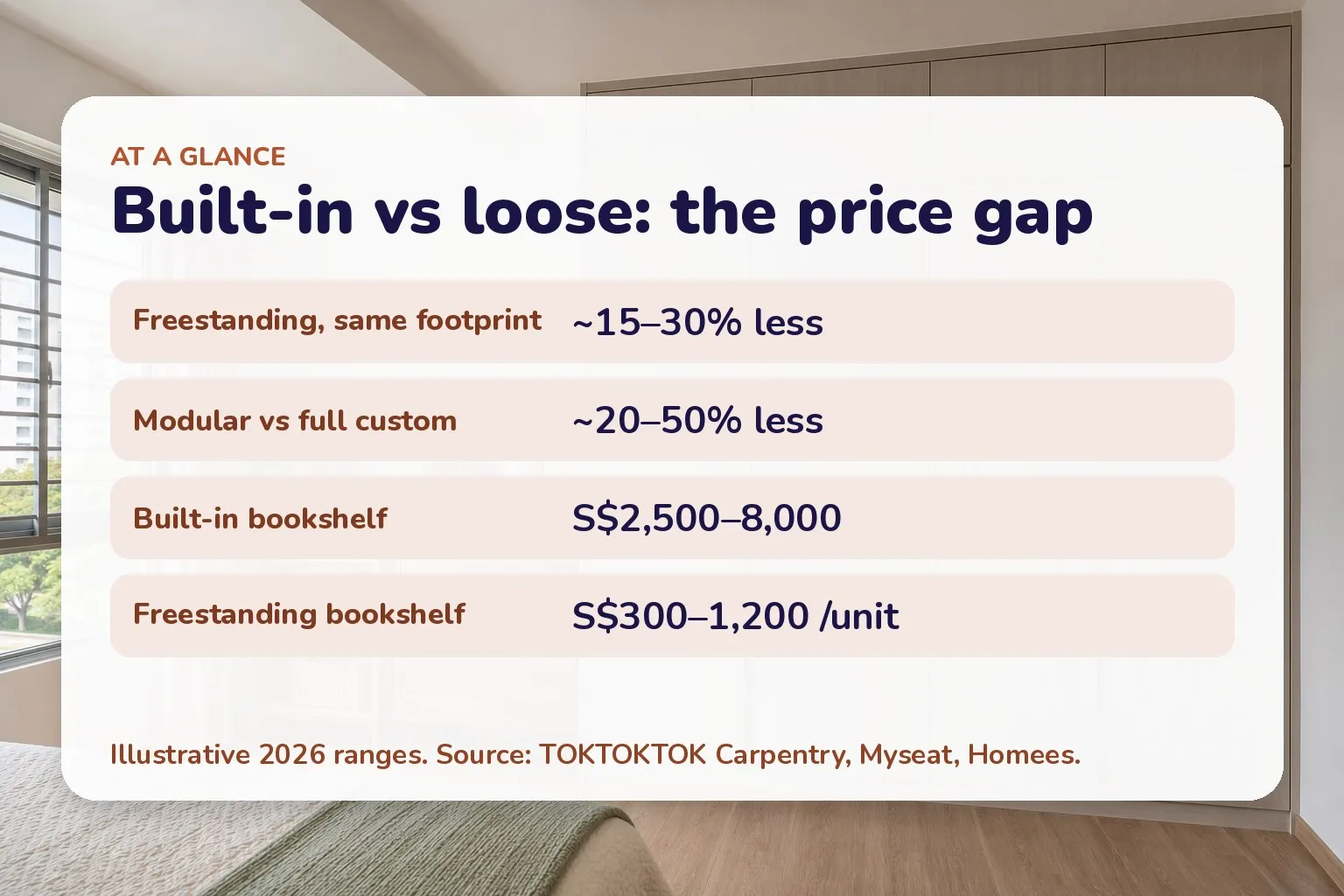
How much less loose and modular furniture costs than custom built-in. Illustrative, not quotes.
One documented freestanding commission for an HDB flat came to S$3,130 for five pieces (a service-yard cabinet, an open bookshelf, a six-drawer chest, a two-door cabinet and a bedside unit); the carpenter noted that equivalent built-ins would have cost meaningfully more and could not have moved house. For how carpentry sits inside a whole-flat budget, see the resale flat renovation cost guide and the common renovation hidden costs that catch first-timers.
The HDB rules that shape the choice
A few official rules change where and how carpentry can be fixed — and they quietly favour loose furniture in one specific place.
- Cabinets need no permit, but a registered contractor is still required. HDB lists the “installation of built-in cupboard/cabinet” as needing no permit, and a kitchen countertop on a cement-mortar base also needs none — provided no concrete shelf is built and the base plus tile finishes stay within 50mm. But HDB requires you to engage a contractor from its Directory of Renovation Contractors (DRC) for the renovation, including works that do not require HDB’s approval. So even a permit-free cabinet must be installed by a registered contractor, not a casual handyman.
- Noisy fixing is weekday-only. Drilling and cutting for built-ins count as renovation work; noisy renovation is allowed Monday to Friday, 9am to 5pm only, with general works until 6pm and including Saturdays. Plan the carpentry schedule around that.
Built-ins and resale value
This is the argument most quotes skip. A built-in is a fixture: when you sell the flat, it belongs to the buyer and stays behind — it does not come back to you, and HDB valuation convention treats fixed carpentry as part of the flat, so a seller cannot simply strip it out after agreeing the sale. Renovation guides and property agents note that buyers price a flat on location, size, lease remaining and condition; your wardrobe wall is a bonus only if they happen to like it. Worse, agents report that too many existing built-ins can be “more of a liability than a convenience,” because younger buyers often prefer a blank slate and factor in the cost of hacking old carpentry out.
A worked example (illustrative)
Take one bedroom that needs a wardrobe, a study desk and some shelving, labelled illustrative:
- Built-in route: a 7 ft floor-to-ceiling wardrobe at ~S$300/ft run (~S$2,100), a built-in study desk with drawers at ~S$150/ft run over 5 ft (~S$750), and a built-in shelf wall (~S$1,500). Roughly S$4,000–4,500, permanently fixed, staying with the flat.
- Loose / modular route: a modular or IKEA wardrobe (~S$600–1,200), a freestanding desk (~S$300), and freestanding shelving (~S$400–600). Roughly S$1,300–2,100, fully portable.
Same room, same storage: the built-in route costs roughly double and cannot move, buying a flush, floor-to-ceiling fit. In a kitchen that fit is non-negotiable; in a bedroom it rarely is. These are planning numbers only — get itemised quotes before committing.
When built-in carpentry wins
Build in when fit or permanence genuinely pays off:
- Kitchens — integration of worktop, sink, hob and appliances is essential.
- Floor-to-ceiling wardrobe walls — no dust gap, and the top shelf becomes usable long-term storage.
- Awkward geometry — under a stair, into a bay, around a structural column, or a recess no freestanding piece fits.
- Very tight rooms — you reclaim the 20–40mm of air a freestanding piece concedes on each side.
- A settled, long-term home — layout resolved, no plans to move, so permanence is not a cost.
When loose furniture wins
Choose loose or modular when flexibility, budget or resale matter more than a seamless look:
- Tight budget — mass-market loose furniture is the cheapest route by far.
- You may move, or it is a rental — furniture that leaves with you keeps its value.
- Rooms whose use may change — a study that may become a nursery; reconfiguring a built-in means hacking, disposal and touch-ups, not just new carpentry.
- Standard reach-in wardrobes, consoles, chests and shelving — a freestanding or modular piece does the same job for 15–30% less.
Frequently asked questions
Is built-in carpentry always more expensive than loose furniture? Generally yes: industry price guides put freestanding at roughly 15–30% cheaper, and modular at 20–50% cheaper, than full custom for the same footprint, with mass-market loose furniture cheaper still. You pay the built-in premium for fit and permanence, not for extra storage.
Do I need an HDB permit to install built-in cabinets? No — HDB lists installing a built-in cupboard or cabinet, and a countertop on a cement base within 50mm, as not needing a permit. But you must still use a contractor from HDB’s Directory of Renovation Contractors, even for permit-free work.
Can I fix a wardrobe or shelves inside my bomb shelter? Only with removable screws on non-metallic inserts no deeper than 50mm, and the fixture must be removable within 48 hours if HDB or SCDF asks. The shelter walls cannot be hacked, drilled deeply or fixed with power-driven nails internally — loose storage is the safe option there.
Do built-ins stay when I sell my flat? Yes. Built-in carpentry is a fixture that stays with the flat, and valuation convention treats it as part of the property, so a seller cannot remove it after the sale without the buyer’s agreement. It rarely returns its cost, and excess carpentry can even put buyers off.
What is “per foot run”? The pricing unit for custom carpentry — the length of the cabinetry in feet times a rate set by material, finish and hardware. A standard HDB wardrobe is 8 ft tall, which is the height most rates assume; confirm whether a kitchen rate is “per row” or for both runs.
Related
- Kitchen renovation cost for an HDB flat
- Countertop material cost comparison
- Resale flat renovation cost
- HDB household shelter rules
- Renovation hidden costs
Cost figures are illustrative ranges compiled from published Singapore carpentry price guides (Homees, ShiokLiving, Uncle Carpenter, TOKTOKTOK), as of November 2026 — not quotes. Confirm current prices with an HDB-registered contractor and current rules on the HDB and SCDF websites before you commit.
Sources
- Renovation Guidelines for Building Works (built-in cabinet, countertop, 50mm) — Housing & Development Board (HDB) (as of November 2026)
- Important Information on Renovations (DRC contractor for all works) — Housing & Development Board (HDB) (as of November 2026)
- Permitted and Not Permitted Works for Household Shelters — Singapore Civil Defence Force (SCDF) (as of November 2026)
- How to Renovate Your HDB Flat (household shelter, renovation hours) — MyNiceHome, Housing & Development Board (HDB) (as of November 2026)
- Carpentry & Wardrobe Cost in Singapore (2026) — per foot run — Homees (as of November 2026)
- Carpentry Cost Singapore 2026 — per-item price table — ShiokLiving (as of November 2026)
- Carpentry Pricing (starting rates per foot run) — Uncle Carpenter (as of November 2026)
- Freestanding vs Built-In Carpentry in Singapore — TOKTOKTOK Carpentry (as of November 2026)