HDB Bomb Shelter Rules: What You Can and Cannot Do
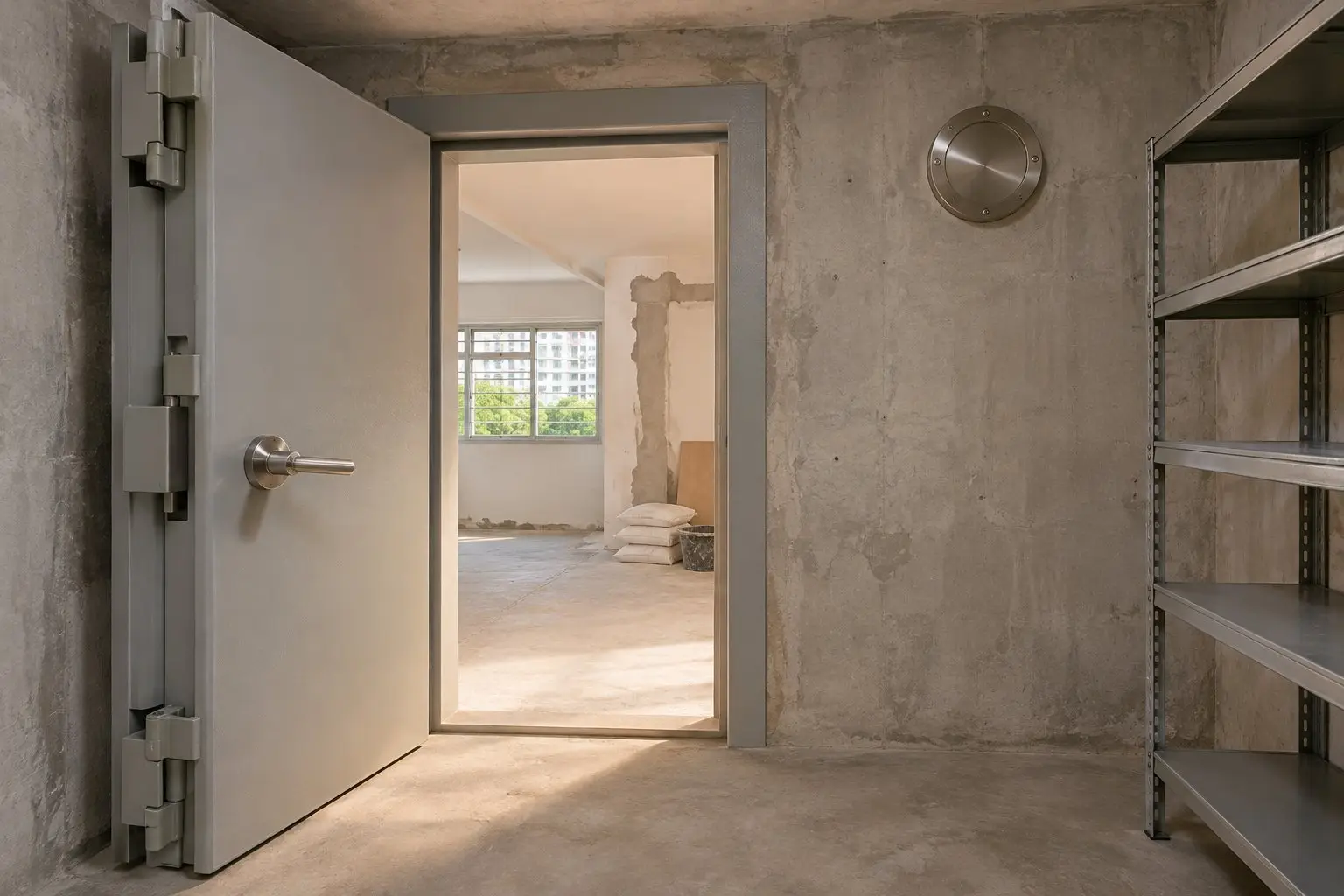
You can use an HDB household (bomb) shelter as a store and fit it out: paint it, lay vinyl or tiles, and drill the inside walls up to 50mm deep for removable shelves. You cannot hack it, tamper with the steel door or vents, or seal the ventilation openings.
On this page9 sections · tap to jump
- 01What a household shelter actually is
- 02What you are allowed to do
- 03The door, the vents and the 25% rule
- 04Works that are never allowed
- 05Using the shelter as a room
- 06What happens if you damage a shelter
- 07Renovation, approval and handover
- 08Keeping the shelter in working order
- 09Frequently asked questions
Almost every HDB flat built since the late 1990s has one: the household shelter, better known as the bomb shelter. Most owners use it as a storeroom and shut the door — and are told they “cannot touch” it. That is only half right. The Singapore Civil Defence Force (SCDF) publishes a precise list of what you may do inside a shelter and what you may not, and the permitted list is longer than most people expect. You can paint it, tile or lay vinyl, and drill the inside walls for shelving — within limits. What you can never do is weaken the structure, tamper with the steel door or seal up the vents. This guide sets out both lists, what it costs to get it wrong, and how the shelter fits into a renovation. For the wider demolition rules, see the HDB hacking and wall rules.
What a household shelter actually is
A household shelter (HS) is a reinforced room designed to protect occupants during a wartime emergency. In SCDF’s words, it “gives protection to residents against weapon effects such as blast and fragments,” and it “has its walls, floor and ceiling strengthened with increased thickness,” with “two ventilation sleeve openings and a light protective steel door approved by SCDF.” The requirement comes from the Civil Defence Shelter Act 1997, in force since 1 May 1998: “Every new house must be provided with a household shelter in accordance with the specifications.” That is why resale flats built before the mid-1990s often have none — check the floor plan if you are not sure your flat has one.
The shelter is more than four thick walls. SCDF’s owner guide describes a specially designed door that gives “an air-tight closure,” a rubber gasket on the door and ventilation sleeve to “prevent seepage of toxic gases,” a dual-position door handle (down to open in peacetime, lifted and swung up to seal in an emergency), and a ventilation sleeve whose steel fragmentation plate is tightened against an O-ring to seal the room. The flat’s builder also runs lighting, a power point, a telephone point and a TV/radio outlet into the shelter so occupants can stay in contact. Every part has an emergency job, which is why the rules protect each one.
What you are allowed to do
SCDF’s Technical Requirements for Household Shelters (2023), Clause 7.2.1, lists the works that are permitted. You may:
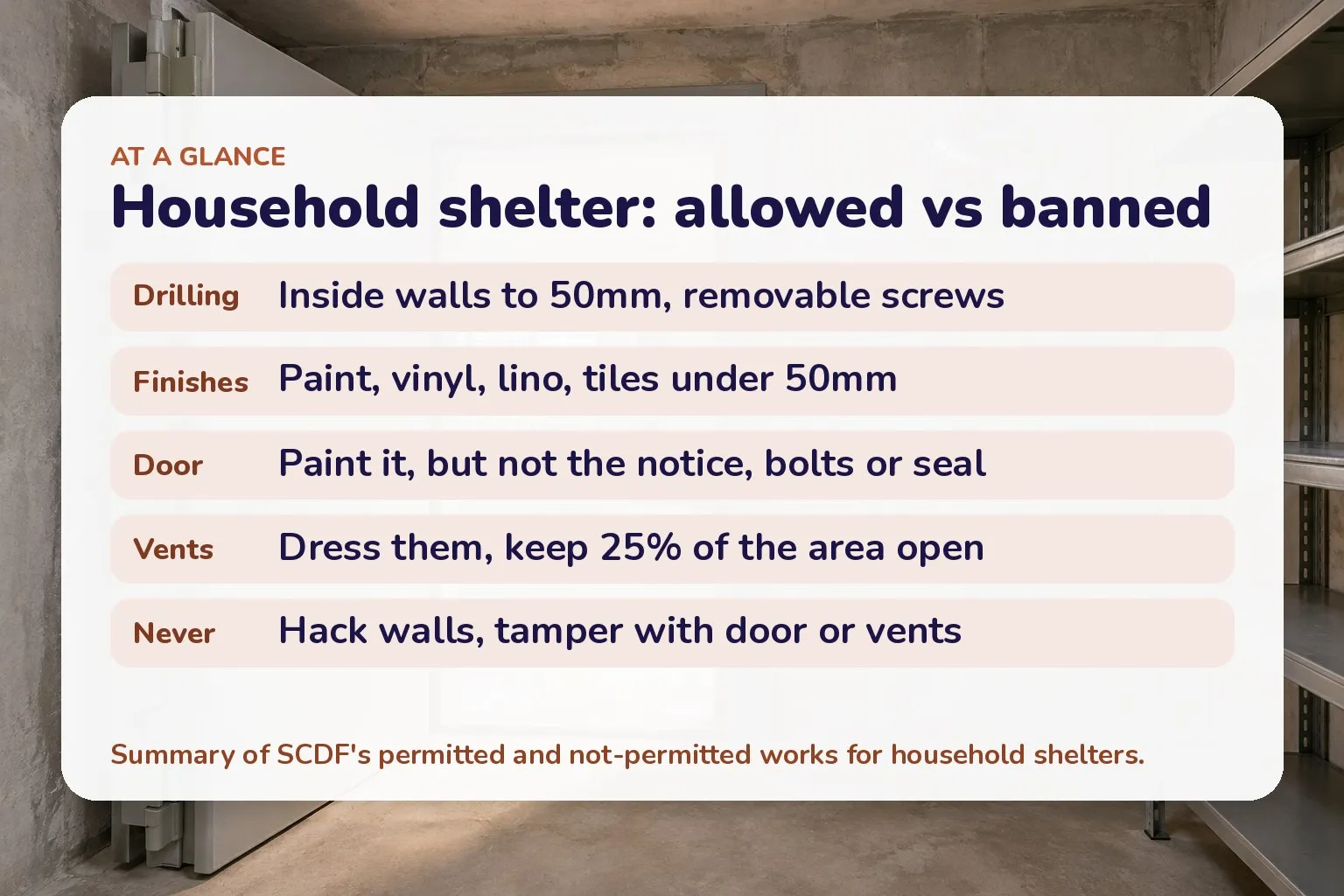
What SCDF permits inside a household shelter, and what is banned. Source: SCDF Technical Requirements for Household Shelters 2023, Clause 7.2.
- Lay floor tiles bonded with wet cement mortar — the total thickness of floor finishes and screed “shall not exceed 50mm.”
- Lay floor skirting tiles up to a maximum of 100mm high, bonded to the walls with wet cement mortar.
- Lay vinyl or linoleum flooring.
- Paint the walls, ceiling and door (with door conditions below).
- Drill the inside face of the walls and ceiling slab “to a depth of not more than 50mm to affix inserts and removable screws.” There is no limit on the diameter of a non-metallic insert, as long as it is no more than 50mm long.
That drilling rule is the one that surprises people: you can mount shelves and cabinets inside the shelter. The catch is in the same clause — fixtures “such as pictures, posters, cabinets or shelves on internal face of HS walls will have to be removed by the owners within 48 hours upon notification.” In other words, fix what you like, but keep it demountable.
The door, the vents and the 25% rule
The steel door and the two ventilation sleeves are the shelter’s working parts, and they have their own conditions. You may paint the door, but SCDF states owners “shall not cover up or paint over the HS door notice, locking bolts or door seal.” You must also remove the old paint coat first so layers do not build up and jam the door, and let the new coat dry completely before closing it, “as wet or damp paint will cause the door/ rubber gasket to stick onto the door frame.”
For the vents, you may cover them with removable decorative finishes — but only partly. SCDF requires that “at least 25% of the total area of the two openings shall be left uncovered for ventilation purposes during peacetime.” You may paint only the exterior face of the 6mm stainless-steel fragmentation plate. The plate itself may be removed “provided that the fragmentation plates and its bolts and nuts are mounted or kept together for use when needed” — so if you take a plate off to tidy the look, keep it and its hardware on hand.
Works that are never allowed
Clause 7.2.2 and the Act draw a hard line around anything that weakens the structure or the seal. Not permitted:
- Hacking or drilling the walls, floor slab or ceiling slab beyond the shallow 50mm drilling above — no chasing, no exploratory holes.
- Hacking either wall face to “form key” for tiling, or hacking the external face to mount feature panels or wall tiles.
- Modifying, changing, removing or tampering with the shelter door.
- Modifying, altering or tampering with any part of the ventilation openings, plates, bolts or nuts.
- Painting the interior face of the fragmentation plate, the sleeves, the O-ring gaskets or the steel bolts.
SCDF’s leaflet puts the principle plainly: the strengthened walls, floor, ceiling and door “must not be hacked or drilled,” and “any repair or alteration or renovation works, which are likely to weaken or damage any structural elements of the household shelter… are not permitted.” Knocking the shelter down to win back floor space — the thing many owners most want — is squarely on this list.
Using the shelter as a room
In peacetime the shelter is yours to use, and most households make it a storeroom or pantry. You can line it with removable shelving, lay a floor finish, paint it and dress the door with wallpaper or a light decorative panel so it blends in. What you cannot do is change it in a way that stops it working as a shelter: no sealing the vents, no removing the door, no wet-area conversion that would need the slab or walls hacked for falls and drainage. If you want a tiled, waterproofed wet space, build it elsewhere — the HDB bathroom waterproofing rules explain why wet works need the right substrate. And if you plan to lay a proper floor finish in the shelter, the flooring cost in Singapore guide covers tile and vinyl options and prices.
What happens if you damage a shelter
The rules have statutory teeth. Under the Civil Defence Shelter Act, the flat’s owner or occupier “must not carry out or permit another person to carry out therein, any repair or alteration, or anything else, which is likely to damage or otherwise impair the efficient use of the household or storey shelter as such, except with the written permission of the Commissioner.” Breaching that duty is an offence: the Act sets “a fine not exceeding $5,000 and, in the case of a continuing offence, to a further fine not exceeding $250 for every day or part of a day during which the offence continues after conviction.”
Renovation, approval and handover
For most fit-outs — painting, tiling, removable shelving — you are working within the permitted list and need no special approval, though you still use a contractor from HDB’s Directory of Renovation Contractors for the renovation as a whole. Larger building works are different. For addition and alteration or reconstruction works involving a house with an existing shelter, BCA has the shelter’s architectural and structural plans reviewed, so the shelter still meets the technical requirements after the new works — a step your appointed professional handles. BCA sums up the duty for owners simply: do not hack or drill the shelter structure indiscriminately, and avoid finishes or fixtures that could be hazardous to shelter occupants.
If you are renting, the same limits bind whoever owns or occupies the unit, and an undamaged shelter is part of handing the flat back. First time managing all this? The first-time renovation guide walks through how shelter, permits and contractor rules fit together.
Keeping the shelter in working order
Maintenance matters because the door and vents have to seal on demand. SCDF’s guide notes that the O-ring gasket can loosen over time as its adhesive dries, and advises you to “glue the ‘O’ ring rubber gasket to the recessed space of the ventilation sleeve if you notice a slight debonding.” It also reminds owners to keep the door and sleeves operating smoothly and “free of rust,” and to keep the fragmentation plate’s screws oiled so the plate can be tightened quickly in an emergency. None of this is costly — it is mostly a yearly check that the door swings, the plate still seats, and nothing has rusted shut.
Frequently asked questions
Can I hack my bomb shelter to make a room bigger? No. Hacking or removing the shelter’s walls, floor or ceiling is never permitted — they are structural and civil-defence elements. The only shallow work allowed is drilling the inside walls up to 50mm deep for removable fixtures.
Can I drill the shelter walls to put up shelves? Yes, into the internal face, up to 50mm deep, for non-metallic inserts and removable screws. Whatever you mount must be removable within 48 hours of notification, so keep it demountable.
Can I cover the ugly round vent and the steel door? You may dress them with removable finishes, but at least 25% of the combined vent area must stay open, and you must not cover the door notice, locking bolts or door seal, or paint the inside of the vent plate.
Is there a penalty for illegally altering a shelter? Yes. Under the Civil Defence Shelter Act it is an offence, with a fine of up to S$5,000, plus up to S$250 for each day a continuing breach is left unrectified after conviction.
Do I need approval to tile or paint the shelter? Tiling, painting and removable shelving are on SCDF’s permitted list and need no special shelter approval, but addition and alteration building works on a flat with a shelter require the shelter plans to be submitted to BCA.
Related
- HDB hacking and wall rules
- HDB renovation permit guide
- HDB bathroom waterproofing rules
- Flooring cost in Singapore
- First-time renovation: the full guide
General information only, not legal advice. Shelter rules are set by SCDF and BCA under the Civil Defence Shelter Act and can change — confirm the current requirements with SCDF and your contractor before you start work.
Sources
- Technical Requirements for Household Shelters 2023 — Clause 7.2 Permitted and Not Permitted Works — Singapore Civil Defence Force (SCDF) (as of November 2026)
- Permitted and Not Permitted Works for Household Shelters (SCDF leaflet) — Singapore Civil Defence Force (SCDF) (as of November 2026)
- Types of Shelter (Household and Storey Shelters) — Singapore Civil Defence Force (SCDF) (as of November 2026)
- Guide to Household and Storey Shelter for Owner / Managing Corporation — Singapore Civil Defence Force (SCDF) (as of November 2026)
- Civil Defence Shelter Act 1997 (sections 3 and 4) — Singapore Statutes Online (AGC) (as of November 2026)
- Household and Storey Shelters (building plan submission) — Building and Construction Authority (BCA) (as of November 2026)