Countertop Cost: Quartz vs Sintered Stone vs Laminate
For most Singapore kitchens quartz is the best-value countertop at about S$90–S$150 per running foot installed — non-porous and hard-wearing. Sintered stone (S$120–S$220) suits heavy wok cooks; laminate (S$40–S$90) fits tight budgets.
The countertop is the surface you touch every day, and the one most people pick in a rushed showroom conversation. For a Singapore kitchen the sensible choice for most homes is quartz, at roughly S$90–S$150 per running foot installed — non-porous, hard-wearing and available in almost any finish. Sintered stone (about S$120–S$220) is the premium pick for heavy wok cooking, and laminate (about S$40–S$90) is the budget option that still works. These are illustrative 2026 market ranges compiled from Singapore contractor and carpentry price lists, not quotes, and not official rates.
Quick verdict
The right material depends far more on how you cook than on how your kitchen looks. Here is the short version before the detail.
Cost by material
Countertops in Singapore are usually quoted per running foot (also called “per foot run”) — one linear foot of counter, supplied and installed at a standard depth of about 600mm. The ranges below are supply-and-install figures for the slab itself, before edges, backsplash or extra cut-outs.
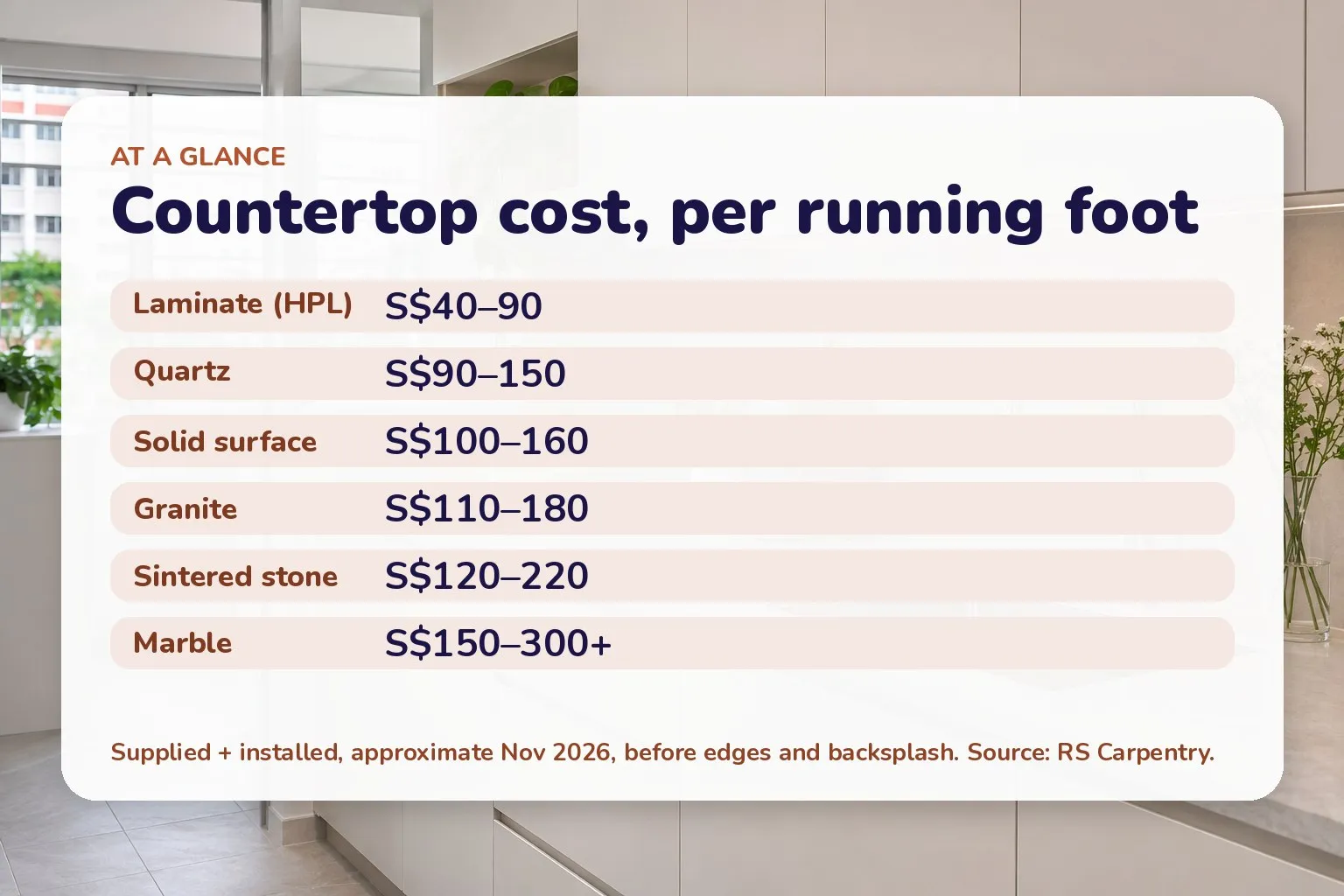
Illustrative per-running-foot countertop ranges (Nov 2026), supplied and installed. Not quotes.
| Material | Illustrative cost (per running foot, installed) | Everyday behaviour | Best for |
|---|---|---|---|
| Laminate (HPL) | S$40 – S$90 | Cheap and easy to clean; edges swell if water gets in | Rentals, tight budgets, dry pantry |
| Quartz (engineered stone) | S$90 – S$150 | Tough and non-porous; use a trivet for a hot wok | Most HDB and condo kitchens |
| Solid surface (Corian-type) | S$100 – S$160 | Seamless joins; scratches sand out; heat-sensitive | A clean, joint-free look |
| Granite | S$110 – S$180 | Hard, heat-tolerant; needs occasional sealing | Natural stone without marble’s upkeep |
| Sintered stone | S$120 – S$220 | Near-indestructible; no sealing; UV-stable | Heavy wok cooks, sunny kitchens |
| Marble | S$150 – S$300+ | Stains and etches; reseal every 12–18 months | Dry areas and bathrooms, not wet kitchens |
Approximate supply-and-install ranges, November 2026, from RS Carpentry’s Singapore price list. Per-square-foot quotes exist too — one contractor lists quartz at about S$80–S$180 psf, sintered stone S$120–S$250 psf and laminate S$30–S$80 psf. Not quotes.
Prices overlap between tiers because brand and slab grade move the number as much as the material does. Design firms quote higher: one puts quartz at S$150–S$300 per linear foot and sintered stone at S$250–S$500, so treat every figure here as a market range, not a price. For where the worktop sits inside a whole kitchen budget, see the kitchen renovation cost guide.
Quartz vs sintered stone vs laminate up close
These three cover the vast majority of Singapore kitchens, so it is worth knowing exactly where each wins.
Quartz is crushed natural quartz bound with resin. It is non-porous, hard-wearing and comes in a huge range of colours including convincing marble looks. Its one real weakness is heat: the resin binder softens under sustained high heat, so a scalding wok straight off the flame needs a trivet. One point for sun-facing HDB kitchens — industry guides note quartz can yellow under prolonged UV, while sintered stone stays UV-stable.
Sintered stone — sold as Dekton, Neolith or Lapitec — is made by compressing and firing natural minerals. It is essentially indestructible in normal use: a hot wok is no problem, it is non-porous, and it never needs sealing. The trade-offs are cost (40–60% more than quartz, by one contractor’s reckoning) and weight, which means the cabinet carcass underneath has to be built to carry it.
Laminate (HPL) has a worse reputation than it deserves. Quality high-pressure laminate from brands such as Admira or Formica is durable, easy to clean and comes in hundreds of finishes. Its vulnerability is moisture at the edges: if the edge banding lifts near the sink, water gets into the substrate and it swells. One contractor estimates laminate needs replacing every 5–8 years versus 15–25 years for engineered stone, so it is a genuine budget tool rather than a lifetime surface.
The other three: solid surface, granite, marble
Solid surface (Corian, HI-MACS, Staron) is resin-based. Its draw is seamless fabrication — no visible joins at corners or around the sink, and minor scratches can be sanded out on site. It is softer and, like quartz, heat-sensitive, so it suits moderate cooking and a clean, uninterrupted look.
Granite is harder and more heat-resistant than marble and sits between quartz and sintered stone on price. It needs periodic sealing and offers fewer colours than engineered stone, but it is an unfussy natural-stone choice.
Marble is the material everyone wants until they learn the upkeep. It is porous, so tamarind and turmeric stain it; it is soft, so knives mark it; and it etches with acids like lime juice and vinegar. It needs resealing every 12–18 months. In a wet Singapore kitchen most homeowners regret it within two years — keep it for a bathroom vanity or a dry display counter.
How countertops are quoted
A worktop quote is built from a few parts, and mixing up the units is where comparisons go wrong:
- The slab, priced per running foot (or sometimes per square foot) of counter.
- Edges, priced per linear foot for a profile (bevel, ogee, dupont add roughly S$15–S$30 per foot) or as a lump sum for a mitred/waterfall edge.
- Cut-outs — an undermount sink cut-out is usually included, but a hob cut-out for a gas range can add S$80–S$150.
- Backsplash, if you carry the same stone up the wall.
Because the slab is only one line in a larger kitchen quote, judge it alongside cabinetry and appliances rather than on its own. Our guide on how to read a renovation quotation explains how foot-run pricing and provisional sums work so you can compare two quotes fairly.
A worked example (illustrative)
Take a typical L-shaped HDB kitchen with about 12 running feet of counter, labelled illustrative:
- Laminate (HPL): 12 ft × S$40–S$90 ≈ S$480–S$1,080.
- Quartz: 12 ft × S$90–S$150 ≈ S$1,080–S$1,800.
- Sintered stone: 12 ft × S$120–S$220 ≈ S$1,440–S$2,640.
The gap between the cheapest laminate and a sintered-stone top is roughly S$1,500–S$2,500 on the countertop alone — worth it for a serious cooking household, harder to justify for one home-cooked meal a week. Add a waterfall end or a stone backsplash and any of these climbs further. These are planning numbers; get an itemised quote before you commit. If you are weighing the worktop against everything else, the save-on-renovation guide suggests spending on surfaces you use daily and economising where you do not, and the renovation cost per square foot page shows how the kitchen fits a whole-flat budget.
The one HDB rule that applies
Most countertop work is not permit-controlled. Replacing only the worktop, without touching plumbing or structural elements, needs no HDB approval, according to a licensed renovation contractor. The HDB rule that does bite is about how the base is built.
Stone, quartz and laminate tops are fabricated off-site and fixed onto the cabinet carcass, so they sit outside this rule — it matters mainly for a built-in masonry counter.
Frequently asked questions
Which countertop is cheapest? Laminate (HPL), at about S$40–S$90 per running foot installed. It is the lowest-cost option that still performs, provided the edges are properly sealed.
Is quartz heat-resistant? It handles normal cooking, but its resin binder softens under sustained high heat — one contractor rates it to about 150°C versus roughly 300°C for sintered stone — so use a trivet for a hot wok.
Does quartz yellow? Industry guides report quartz can yellow under prolonged direct UV, which is a consideration for sun-facing or open kitchens; sintered stone is UV-stable and does not.
Do I need to seal my countertop? Quartz, sintered stone and laminate need no sealing. Granite needs periodic sealing, and marble needs resealing every 12–18 months.
Does a new worktop need an HDB permit? Not on its own, if no plumbing or structure changes. A built-in cement-mortar base must stay within 50mm, and a concrete shelf is not allowed.
Related
- Kitchen renovation cost
- 4-Room BTO renovation cost breakdown
- How to read a renovation quotation
- Renovation cost per square foot
Cost figures are illustrative market ranges compiled from published Singapore contractor and carpentry price lists (RS Carpentry, Larry Contractors, Perimeter Studio, Ace’s Design, RCS), as of November 2026 — not quotes. Confirm current prices with your contractor and current rules on the HDB website before you start.
Sources
- Kitchen Countertop Singapore: Sintered Stone, Quartz, Marble and What Holds Up — RS Carpentry (as of November 2026)
- Kitchen Countertop Materials Compared: Quartz vs Sintered Stone vs Laminate — Larry Contractors (as of November 2026)
- Sintered Stone vs Quartz Countertops — Perimeter Studio (as of November 2026)
- Quartz vs Sintered Stone vs Granite Countertop (Singapore 2026) — Renovation Contractor Singapore (as of November 2026)
- Choosing the Right Materials for Your Singapore Home in 2026 — Ace's Design (as of November 2026)
- Renovation Guidelines for Building Works (countertop on cement base, 50mm) — Housing & Development Board (HDB) (as of November 2026)