HDB Air-Conditioner Installation Rules
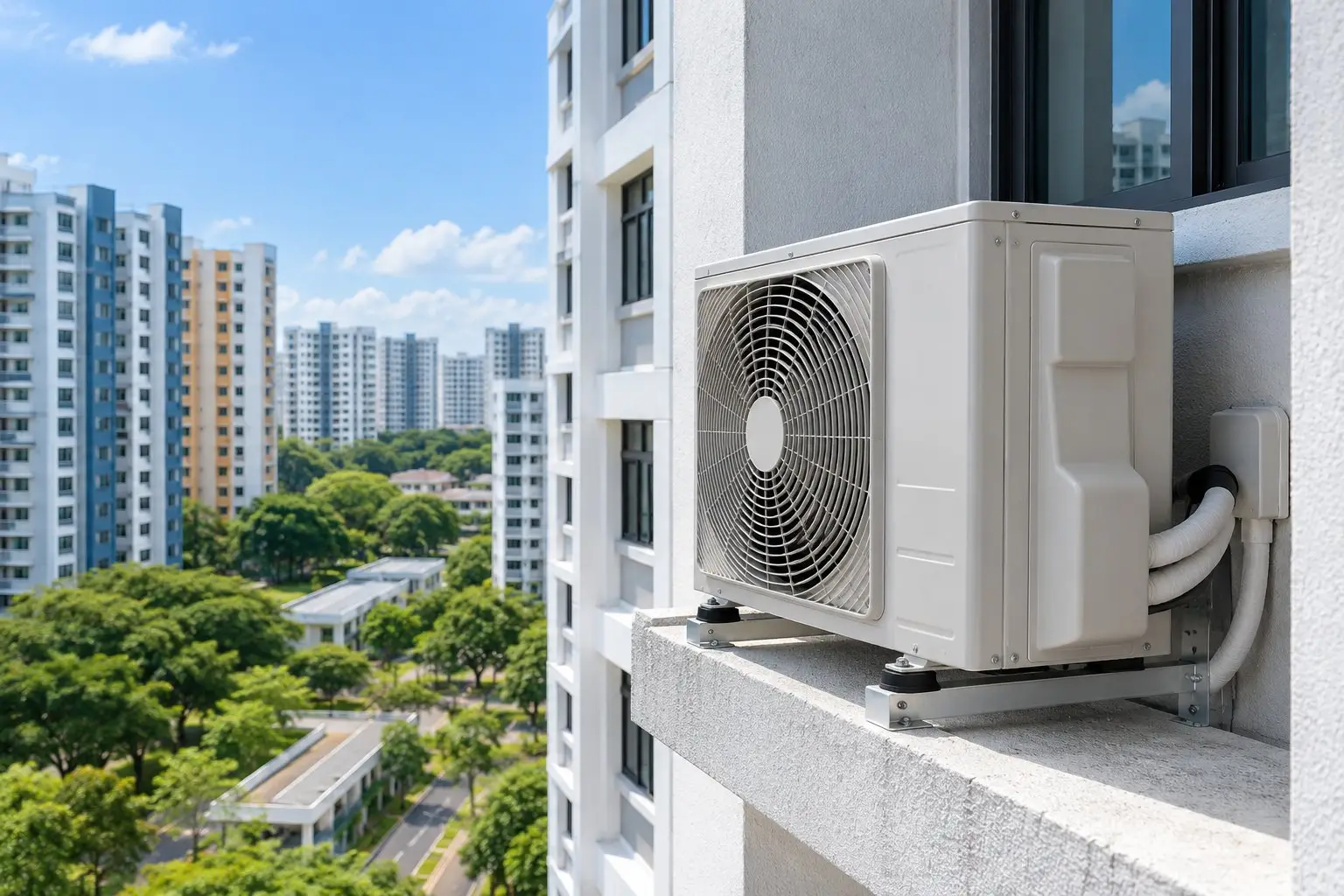
In an HDB flat, air-conditioners must be installed by a BCA-trained installer at approved locations. Flats with higher electrical loading (40amp) need no permit; flats without it need an HDB permit for a new 15amp power point, and you submit an installation report within 14 days.
On this page10 sections · tap to jump
- 01Only a BCA-trained installer
- 02When you need an electrical permit
- 03Running current and weight limits
- 04Where the unit and piping may go
- 05The air-conditioner ledge
- 06Drainage, vibration and no dripping
- 07A gas pipe behind the unit
- 08The installation report
- 09The process in order
- 10Frequently asked questions
Installing an air-conditioner in an HDB flat looks like a simple appliance job, but it sits inside a tight set of HDB rules about who may do it, where units and pipes may go, and what the electrical supply can carry. The core position is straightforward: air-conditioners must be installed by a BCA-trained installer at HDB-approved locations, and you are responsible for the installation’s safety and stability. Whether you also need a permit depends on one thing — your flat’s electrical loading.
Only a BCA-trained installer
HDB is explicit that “you are responsible for the proper installation, safety, and stability of your air-conditioner (casement/ window unit/ split type),” and that “air-conditioners must be installed by a BCA trained air-conditioner installer.” This is not a job for a general handyman or your renovation crew unless that person holds the BCA training. The method and location, including the condensed water discharge pipe, “must be according to the approved location and method of installation” — HDB publishes installation drawings for each flat type, and the approved location for your flat can be verified with the HDB Branch managing it.
When you need an electrical permit
The permit question turns entirely on your block’s electrical loading. HDB states that “blocks completed on/ after 1 January 1994 or have undergone the Main Upgrading Programme (MUP)/ Home Improvement Programme (HIP) are provided with higher electrical loading of 40amps main switch,” and for those flats “you need not apply for a permit from HDB to install an air-conditioner.”
For older flats without that higher loading, a permit is tied to the wiring you add: “flats without higher electrical loading will require an HDB permit to install new 15amps power points for air-conditioners.” On HDB’s own table, installing an aircon on an “existing approved 15 amps power point or 20 amps isolator” needs no permit, but using a “new 15 amps power point or new 20 amps isolator” does — “you need to apply for an electrical permit” first.
The new wiring also has a testing step: you “submit the SP Services Ltd (SPSL) Form CS/5H endorsed by HDB to SPSL for testing of any new wiring.”
Running current and weight limits
Even where no permit is needed, hard limits still apply — this is where an oversized system quietly breaks the rules. HDB caps the total running current by flat type and the weight of each condensing unit.
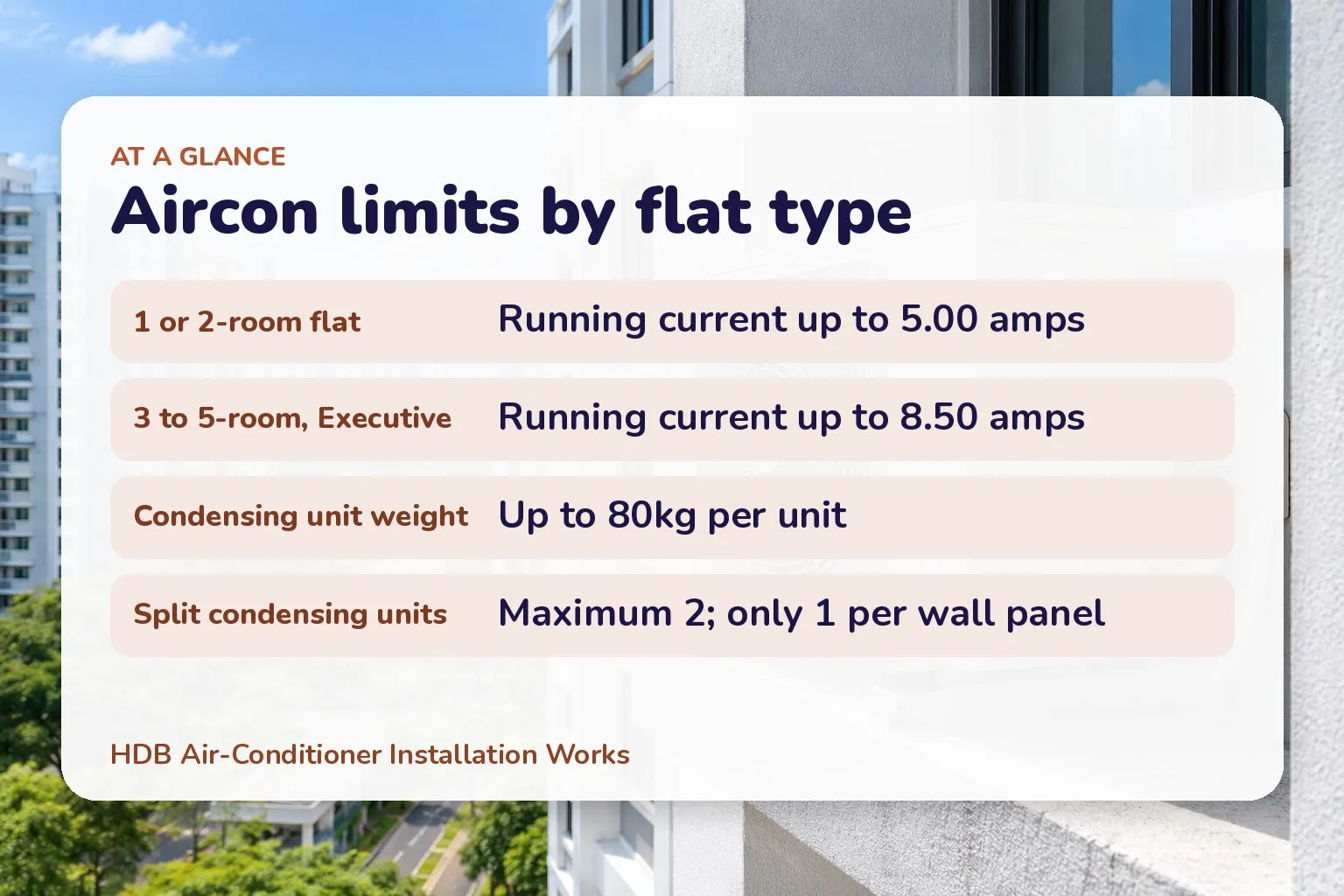
HDB running-current and condensing-unit limits by flat type. Source: HDB, Air-Conditioner Installation Works, 2026.
| Item | HDB limit |
|---|---|
| 1 / 2-room flat | Running current up to 5.00 amps |
| 3 / 4 / 5-room, Executive Maisonette, Multi-Generation | Running current up to 8.50 amps |
| Condensing unit weight | Up to 80kg per condensing unit (all flat types) |
| Split-type condensing units | Maximum of 2; only 1 per wall panel |
Source: HDB, Air-Conditioner Installation Works, 2026.
The running current “should be restricted by a 20 amps double pole (DP) isolator or 15 amps power point,” and “a maximum of 2 split-type air-conditioner condensing units can be installed,” with “each wall panel… allowed to have only 1 air-conditioner condensing unit.” Before switching on, “you and your installer must verify that the total running current of your air-conditioner units do not exceed the approved electrical rating.”
Where the unit and piping may go
Placement is governed down to the pipe route:
- “All piping for the air-conditioner must be run internally.”
- “Air-conditioner units (casement/ window unit/ split type) cannot be located along the common corridor.”
- “No hacking of holes or openings through existing reinforced concrete structures within the unit,” and “no embedment of air-conditioner pipe in reinforced concrete slabs, columns or beams.”
- “For pre-cast facade with tiles, a single opening of 50mm x 50mm per panel for the running of refrigerant pipe is allowed.”
These rules protect both the building’s structure and the look of the block facade, which is why external trunking along a common corridor is not an option.
The air-conditioner ledge
The external ledge has its own rule, and it is stricter than most owners expect: “the air-conditioner ledge is to be used strictly for placing the air condensing unit only.” HDB lists as disallowed air-conditioner installation works any “partial or total enclosure including installation of external grilles on air-conditioner ledge” and any “change of use of air-conditioner ledge.”
Drainage, vibration and no dripping
A badly drained unit is the classic source of a neighbour dispute, and HDB frames it as an installation requirement. You are “to ensure the air-conditioner installer insulates all air-conditioner pipes joints to prevent condensation/ dripping of water,” and “condensation water must be properly discharged into a nearby floor trap in your flat” — not onto the facade, the ledge or the unit below. HDB also requires that units “must not cause any vibration in the building,” and that “rubber padding should be provided at the base of the air-conditioner condensing unit.”
A gas pipe behind the unit
One niche but important rule catches owners of flats with piped gas. HDB states that “if you wish to have an air-conditioner unit installed in your living room where an existing gas pipe passes through, you must engage a licensed gas service technician to check that the gas pipes/ installation complies with the Code of Practice (CP) 51, clause 7.2.7, ‘pipes in enclosed or unventilated areas’ before proceeding with the installation.” If you are also opening up that space, the gas question is bigger still — see the HDB open-concept kitchen rules.
The installation report
For an externally mounted unit there is a paperwork step at the end: “you need to submit an installation report to the HDB Branch managing your flat within 14 days after installation.” A professional installer usually handles this as part of the service, but it is the flat owner’s obligation, so confirm it is included and keep a copy. Budget-wise, the appliance and installation sit alongside the other items that fall outside a headline renovation quote — see the hidden renovation costs guide.
The process in order
- Check your block’s electrical loading on HDB’s e-Service.
- If your flat lacks higher loading and needs a new power point, apply for the HDB electrical permit first.
- Engage a BCA-trained air-conditioner installer and, for new wiring, a Licensed Electrical Worker.
- Install at the approved location and method, piping run internally, condensate to an internal floor trap, within the running-current and weight limits.
- Submit the SPSL Form CS/5H for testing of new wiring, and the installation report to your HDB Branch within 14 days.
Frequently asked questions
Do I need an HDB permit to install an aircon? Not if your flat has higher electrical loading (a 40amp main switch — generally blocks completed from 1 January 1994 or upgraded under MUP/HIP). Flats without it need a permit to install a new 15amp power point.
Can my renovation contractor install the aircon? Only if the person doing it is a BCA-trained air-conditioner installer. New electrical wiring must be done by a Licensed Electrical Worker.
Can I enclose or build over the aircon ledge? No. The ledge is strictly for the condensing unit; partial or total enclosure, external grilles and change of use are disallowed works, and the ledge is Town Council-managed common property.
How many condensing units can I install? A maximum of two split-type condensing units, with only one per wall panel; each condensing unit may weigh up to 80kg.
What do I do after installation? Submit the installation report to your HDB Branch within 14 days (for an externally mounted unit) and the SPSL Form CS/5H for testing of any new wiring.
Related
- Electrical works: rules and costs
- Electrical rewiring cost in Singapore
- HDB renovation permit guide
- HDB open-concept kitchen rules
- Hidden renovation costs
General information only, not technical advice. Rules are from official HDB pages (approximate, November 2026) and change over time — confirm the approved location, method and permit for your flat with your HDB Branch and a BCA-trained installer before you start.
Sources
- Air-Conditioner Installation Works (general conditions, technical requirements, permits) — Housing & Development Board (HDB) (as of November 2026)
- Housing and Development (Renovation Control) Rules — Singapore Statutes Online (AGC) (as of November 2026)
- Electrical Works (permit for new power points, LEW) — Housing & Development Board (HDB) (as of November 2026)
- Important Information (disallowed air-conditioner works) — Housing & Development Board (HDB) (as of November 2026)