Electrical Works: Rules and Costs in Singapore
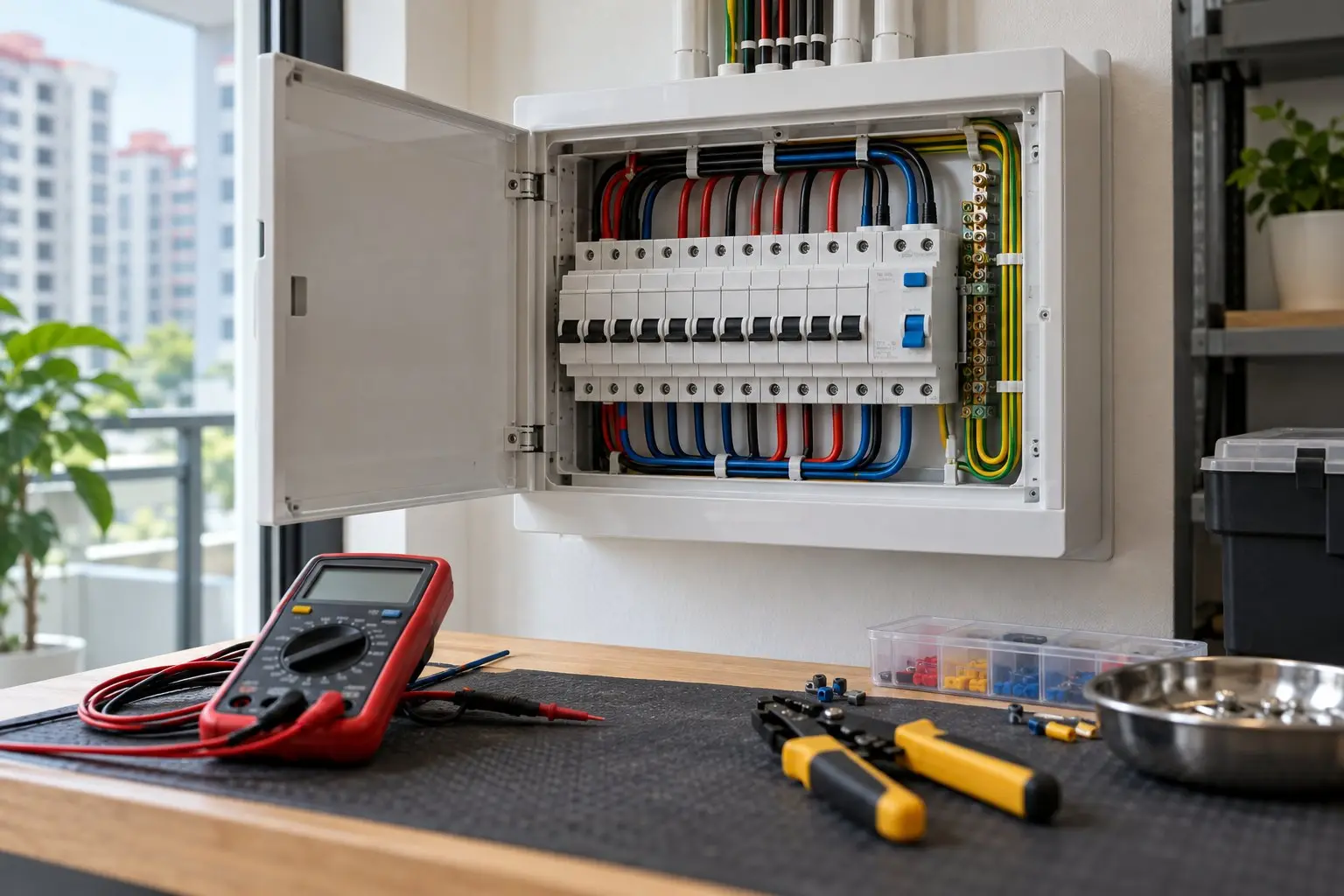
By law, home electrical work in Singapore — wiring, new power points, switches, lighting, or anything inside the distribution board — must be carried out or supervised by an EMA Licensed Electrical Worker, who also tests and certifies the installation safe before supply is turned on.
On this page9 sections · tap to jump
Almost every renovation moves power around — new sockets for the kitchen island, lighting circuits for a false ceiling, an isolator for the aircon. In Singapore that work is regulated. The Energy Market Authority (EMA) requires electrical work at home to be carried out or supervised by a Licensed Electrical Worker (LEW), who must also inspect, test and certify the installation before electricity supply is turned on. A handyman or your contractor’s general crew cannot legally do it.
You must use a Licensed Electrical Worker
EMA is explicit that “electrical work, whether at home or the office, should be carried out or supervised by a Licensed Electrical Worker.” That covers more than rewiring. The official list of electrical work includes:
- Installation, repair or modification of electrical wiring
- Addition, extension or replacement of power points — socket-outlets, switches or lighting points
- Repair or replacement of consumer control units or circuit breakers
In other words, adding a single power point or swapping a breaker is LEW work, not DIY. The only genuinely homeowner-safe tasks are things like changing a bulb or resetting a tripped breaker.
The three classes of LEW
Not every LEW can take on every job. EMA licenses three classes by the load and voltage they may handle:
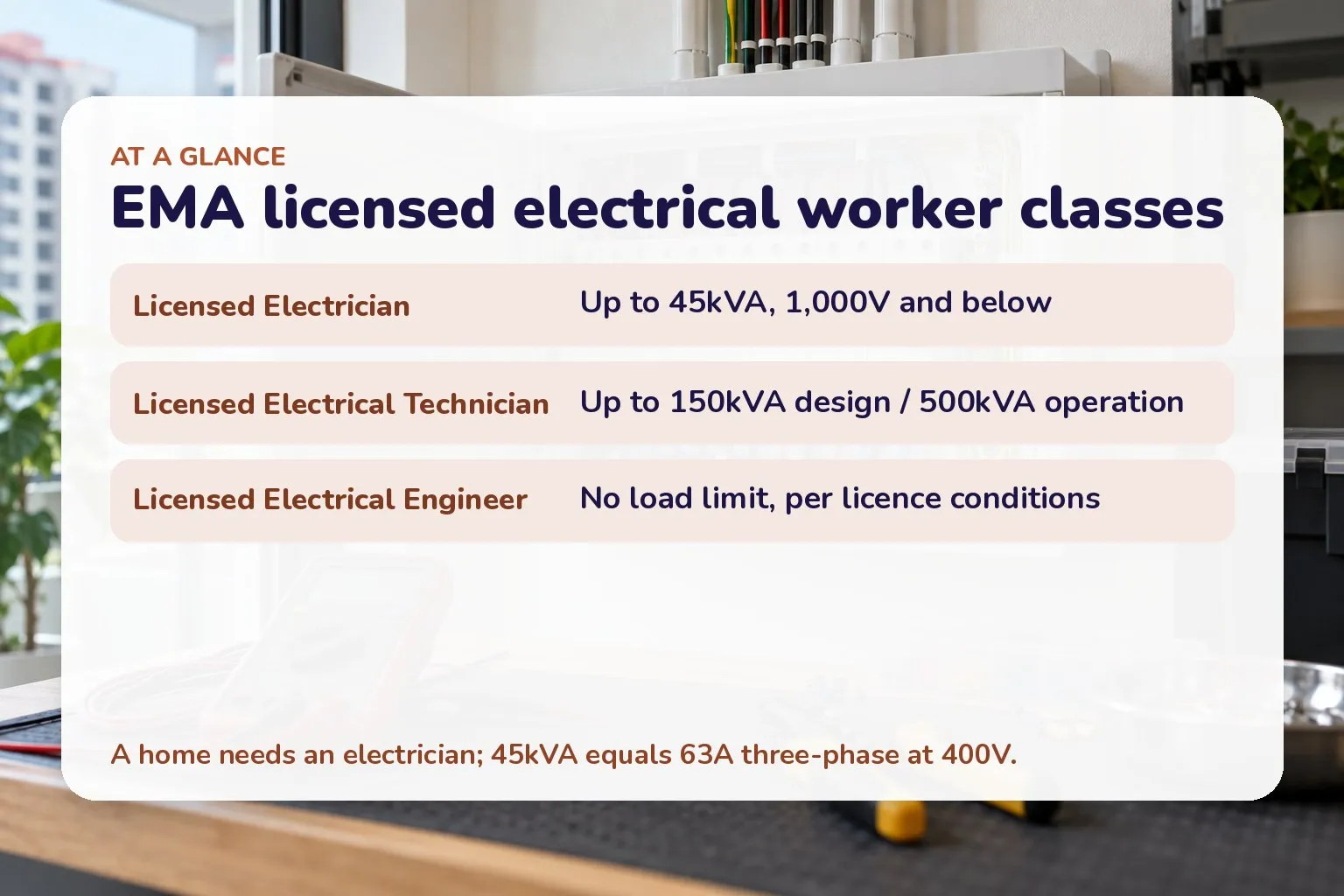
The three EMA LEW classes by load and voltage — Source: EMA, Engaging Licensed Electrical Workers, 2026
| Class | Approved load | Voltage |
|---|---|---|
| Licensed Electrician | Not exceeding 45kVA | 1,000V and below |
| Licensed Electrical Technician | ≤150kVA (design) / ≤500kVA (operation) | 1,000V and below |
| Licensed Electrical Engineer | No limit | Subject to licence conditions |
Source: EMA, Engaging Licensed Electrical Workers.
For a home, an electrician is the right class — EMA says “electrical work in a HDB flat will require the services of an electrician.” (For scale, 45kVA is equivalent to 63A three-phase at 400 volts, far beyond a flat’s single-phase supply.) Technicians and engineers are for larger commercial or industrial installations. An electrician’s licence itself is inexpensive to hold — EMA charges a $50 application fee plus a $30 licence fee — but the qualifying experience and assessments are substantial.
Do homes need an electrical installation licence?
A common worry is whether you, the homeowner, must hold an electrical installation licence. For a normal home, no. EMA’s handbook states that “all electrical and supply installations used exclusively for domestic purposes are exempted from the electrical installation licensing requirement.” The licence is required only for hazardous trades, non-domestic installations above 45kVA, or non-domestic supply installations.
Testing, certification and turn-on
Doing the wiring is only half the job; it has to be signed off. EMA requires that “new wiring, rewiring and extensions … have to be tested by an authorised officer from SP Services Ltd before supply can be turned on,” and the LEW “will also inspect and certify that your electrical installation is safe before electricity supply is turned on.”
In an HDB flat this is a concrete step: you submit the SP Services Form CS/5H, endorsed by HDB, to SPSL for testing of any new wiring or extension. Build the submission and testing window into your schedule — power does not come back on the moment the electrician packs up.
The RCCB is mandatory
The single most important safety rule for every home is the Residual Current Circuit Breaker (RCCB). Under the Electricity (Electrical Installations) Regulations, all residential premises must have an RCCB or Earth Leakage Circuit Breaker (ELCB) “with a rated residual operating current not exceeding 30mA sensitivity.” It cuts power the instant it detects current leakage that could cause a shock.
The deadlines have now passed: RCCBs became required by 1 July 2023, and flats without one were given a grace period to 1 July 2025. Since then, “homeowners without an RCCB or ELCB installed in their premises may face a fine of up to $5,000,” with random enforcement checks.
HDB flat rules: permits, loading and limits
HDB layers its own conditions on top of the EMA rules, and they are worth knowing before you plan points. All wiring installation work “must be carried out by an EMA licensed electrical worker,” and a few technical limits apply:
- No embedding of wiring (in metal/high-impact PVC conduit) in RC slabs, beams, columns, walls or wall plaster.
- Power-driven nails and screws must not exceed 6mm diameter and 40mm penetration.
- No power points in bathrooms or toilets, which are wet areas under Singapore Standard SS 638.
- PVC cables have an estimated average life of about 25 years — HDB advises replacing wiring once it is past its lifespan.
On permits, the trigger is your flat’s electrical loading. Flats “provided with higher electrical loading” (a 40amp main switch — blocks completed on or after 1 January 1994, or upgraded under MUP/HIP) need no permit to install an air-conditioner or higher-capacity appliance. Flats without higher loading “will require an HDB permit to install new 15amps power points” for an aircon or similar.
What electrical work costs
Treat these as illustrative industry ranges for 2026, not quotes or official figures — EMA does not regulate LEW charges, noting rates “vary from case to case.” Published electrician price guides collected for 2026 suggest:
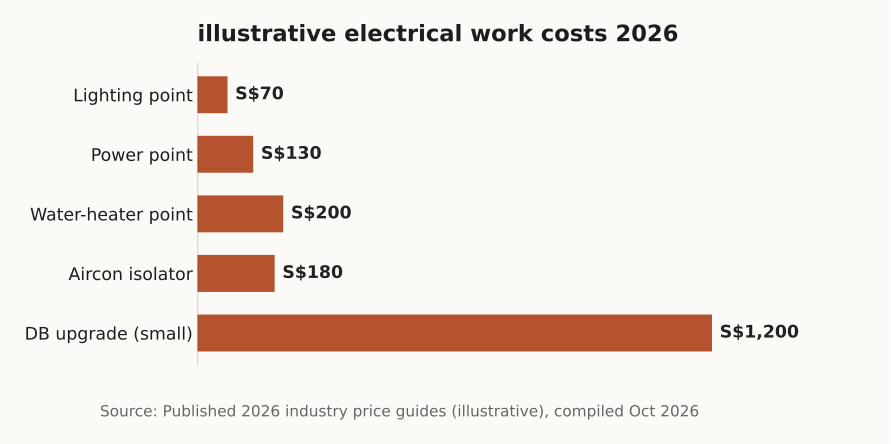
Illustrative upper-end per-item electrical costs (2026) — Source: published industry price guides, not quotes
| Work | Illustrative 2026 range (SGD) |
|---|---|
| Lighting point | S$30 – S$70 each |
| 13A power point (surface) | S$60 – S$130 each |
| Water-heater point (with isolator & MCB) | S$120 – S$200 |
| Aircon isolator | S$120 – S$180 |
| Distribution board upgrade | S$350 – S$1,200 (small); S$3,000 – S$7,000 (full) |
| Full 4-room HDB rewiring | S$1,800 – S$3,500 |
| 3-bedroom condo rewiring | ~S$5,500 – S$6,500 |
Illustrative ranges compiled from published 2026 industry price guides, not quotes.
Concealed wiring (chased into walls and plastered over) costs more than surface trunking because of the hacking and making-good; “making good” — the plastering and repainting afterwards — is the line most often left out of a quote. For how electrical fits into the bigger picture, see the condo renovation rules and costs guide and the resale flat renovation cost guide, where ageing circuits drive the budget.
How to check and protect yourself
Before anyone touches your wiring, verify the licence. All LEWs carry a licence card with a photo, name, NRIC and licence number; EMA says to “verify the Licensed Electrical Worker’s card before commencing any electrical work.” You can confirm a licence on the ELISE portal or by calling EMA on 6835 8075.
A clean electrical quote should itemise three things: the point count room by room (and the rate for each extra point), the distribution board (whether it is replaced, how many ways, how many spare), and testing (insulation resistance, earth continuity and RCCB operation, with results provided). A number without those is an opening position, not a quote. For vetting the firm behind the LEW, see how to choose a renovation firm.
FAQ
Can I install my own power point or ceiling fan? No. Adding or replacing power points, switches and lighting points is electrical work that must be done or supervised by a Licensed Electrical Worker under EMA rules. Only trivial tasks such as changing a bulb are homeowner work.
Do I need an electrical installation licence for my home? No. Domestic installations are exempt. The installation licence applies to non-domestic installations above 45kVA, supply installations and hazardous trades — not a normal flat or condo unit.
Is an RCCB really compulsory? Yes. Every residential premises must have a 30mA RCCB or ELCB. Enforcement began on 1 July 2025 and homes without one can be fined up to S$5,000. Test yours monthly using its ‘Test’ button.
How do I know if my flat needs rewiring? HDB estimates PVC cables last about 25 years. Signs include frequent tripping, warm or discoloured sockets, and a flat older than its cabling’s lifespan. Have an LEW inspect and advise — do not guess.
Who tests the work before power comes back on? Your LEW inspects and certifies the installation, and new wiring, rewiring or extensions must be tested by SP Services before supply is turned on. In an HDB flat this uses the SPSL Form CS/5H endorsed by HDB.
Related
- Condo renovation rules and costs
- Resale flat renovation cost
- HDB renovation permit guide
- Renovation noise and timing rules
- How to choose a renovation firm
General information only, not legal advice. Cost figures are illustrative industry ranges (approximate, 2026), not quotes. Safety rules and fees change; confirm current requirements with EMA, HDB and a Licensed Electrical Worker before you start.
Sources
- Engaging Licensed Electrical Workers — Energy Market Authority (EMA) (as of October 2026)
- Electrical Safety (Residual Current Circuit Breaker) — Energy Market Authority (EMA) (as of October 2026)
- Electrician Licence — Energy Market Authority (EMA) (as of October 2026)
- Handbook for Application of Electrical Installation Licence — Energy Market Authority (EMA) (as of October 2026)
- Renovation Guidelines for Electrical Works — Housing & Development Board (HDB) (as of October 2026)
- Electricity Act 2001 — Singapore Statutes Online (AGC) (as of October 2026)