How to Save on Your Renovation in Singapore
The biggest renovation savings come from keeping your flat's layout, trimming carpentry and choosing where to spend rather than slashing quality. Keeping existing wet areas and walls avoids hacking, permits and new plumbing — usually a far bigger saving than any material downgrade.
On this page10 sections · tap to jump
- 01Keep the layout — the biggest single saving
- 02Cut carpentry, the biggest line item
- 03Spend on what you touch, save on what you don’t
- 04BTO vs resale: buy the flat that needs less
- 05Get like-for-like itemised quotes
- 06Watch GST and variation orders
- 07Finance it the cheaper way
- 08Timing and self-sourcing
- 09Where cutting costs backfires
- 10FAQ
Most renovation savings are decided before a single tile is laid — in the layout you keep, the carpentry you leave out and the quote you actually compare. Cutting the headline number by squeezing your contractor rarely works; the items simply come back as variation orders. The homeowners who spend less make a few structural choices early and then protect those choices with a clear, itemised contract. For scale, Qanvast’s 2026 figures put a full BTO renovation at roughly S$40,800–S$52,500 for a 3-room, S$50,000–S$60,000 for a 4-room and S$60,600–S$76,500 for a 5-room; resale flats run higher. Those are illustrative industry estimates, not quotes — but they show how much room there is to plan the number down.
Keep the layout — the biggest single saving
The cheapest renovation is the one that moves nothing. Every wall you knock down and every sink, toilet or gas point you relocate triggers two costs: the demolition itself, and the new plumbing, waterproofing or gas runs that follow. In an HDB flat it also triggers paperwork — all demolition and hacking of walls, partial or complete, needs HDB’s prior written approval — and a professional engineer’s endorsement where a structural wall is involved.
Keeping the original kitchen and bathroom positions is where this pays off most, because wet-area works are among the most expensive and the most regulated. If the existing layout is liveable, a cosmetic refresh of the same footprint will almost always beat a reconfigured one. Qanvast’s renovation calculator illustrates the gap: hacking is a modest line on paper (roughly S$400–S$700 in its example), but the knock-on plumbing, tiling and making-good are not.
Cut carpentry, the biggest line item
Across Qanvast’s 2026 budgeting report of homeowners, carpentry took up the biggest chunk of overall renovation spend — more than any other trade. Custom cabinetry is priced by the running foot, so the length and complexity of your built-ins, not the appliances, usually decide the quote. That makes carpentry the richest place to trim without losing function:
- Shorten the run. Fewer top-hung cabinets, a shorter kitchen run and open shelving in place of full-height carpentry all cut foot-run cost directly.
- Choose simpler fronts. Plain laminate doors cost far less than fluted panels, profiled shaker fronts or spray-painted finishes.
- Buy freestanding where you can. Wardrobes, shoe cabinets and TV consoles bought ready-made are often cheaper than built-ins — and you take them with you.
Interior designers tell Qanvast the market is moving this way anyway: simpler designs with minimal carpentry are both cheaper and faster, and pre-fabricated features have replaced the hand-built panels that used to run up labour.
Spend on what you touch, save on what you don’t
Material choice is the second big lever, and the trick is to spend where you feel it daily and economise where you don’t. A sintered-stone worktop, good hinges and a solid tap earn their keep because you use them every day; the floor of a store room or the inside of a cabinet does not. See the kitchen renovation cost guide for how worktop material alone can swing a kitchen quote by several thousand dollars.
- Worktops: laminate is cheapest, quartz mid-range, sintered/natural stone premium — reserve stone for the island or the run you actually prep on.
- Flooring: vinyl and laminate cost far less than tiles or engineered timber and avoid hacking the existing floor; the flooring cost guide compares them.
- Finishes: overlay tiling (within HDB’s thickness limits) can avoid hacking off the old floor, saving both the removal and the disposal.
BTO vs resale: buy the flat that needs less
If you are still choosing a home, the flat itself sets your renovation floor. A BTO is handed over with basic tiling and fittings in place, so a light refresh is genuinely cheap. A resale flat often needs hacking, rewiring and new plumbing before the new design even begins — which is why Qanvast’s 2026 resale ranges (S$55,000–S$68,300 for a 3-room up to S$80,800–S$98,900 for a 5-room) sit well above BTO. An older resale unit can still be the right buy, but budget for the catch-up works; the resale flat renovation cost guide breaks them down.
Get like-for-like itemised quotes
The single most effective money-saving habit costs nothing: make firms compete on the same scope. The Competition and Consumer Commission of Singapore (CCCS) expects renovation prices to be “transparent, accurate, clear and itemised,” with mandatory charges stated in the quotation at the outset, and any charge that cannot be fixed in advance disclosed with an estimate before you sign. A quote that gives one lump sum is not comparable to one that lists every line.
- Write your own scope — room by room, with finishes named — and give the identical brief to every firm.
- Insist on an itemised quote; treat “miscellaneous works” lump sums as a red flag.
- Ask what is excluded: hacking, haulage, disposal, protection works and reinstatement are the items a cheap quote leaves out.
Watch GST and variation orders
Two things quietly inflate the final bill. The first is GST, now 9% since 1 January 2024. IRAS requires GST-registered firms to display GST-inclusive prices, but many smaller renovation outfits are not GST-registered — so one quote may be before tax and another after. Always confirm which, or you are comparing different numbers.
The second is variation orders. Qanvast’s interior designers say almost every project has some, so the saving is not in pretending they won’t happen — it is in pricing a detailed scope upfront so there are fewer of them, and refusing any verbal, unpriced change.
Finance it the cheaper way
How you pay changes what you pay. Two hard rules set the frame:
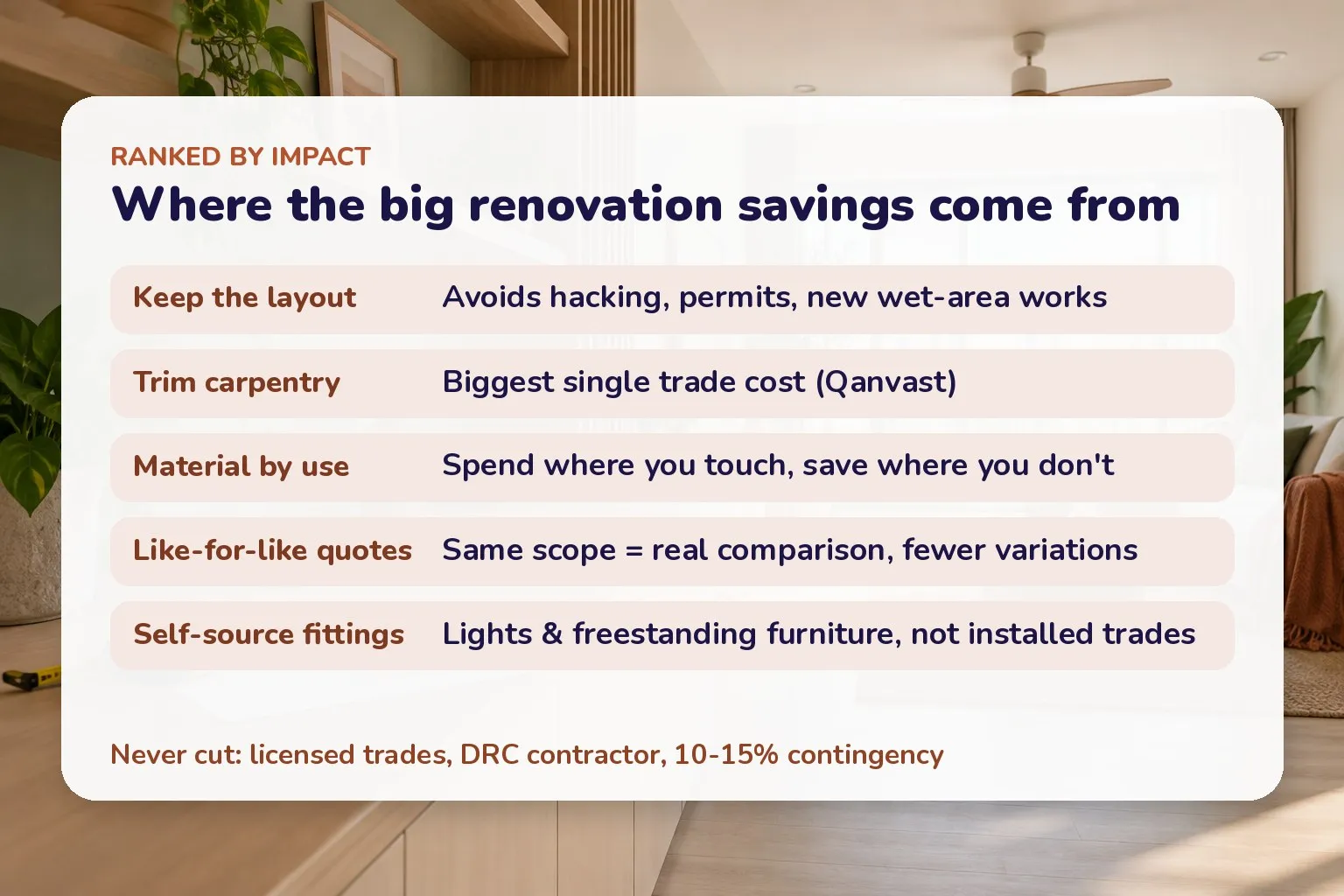
Illustrative ranking of the biggest savings levers.
- CPF cannot help. CPF savings cannot be used for renovation, improvement or repair work — that bill is cash or a loan.
- A renovation loan is capped and ring-fenced. A bank renovation loan is limited to the lower of 6× monthly income or S$30,000, and is for fixed works only — DBS, for example, lists electrical and wiring, built-in cabinets, painting, flooring and basic bathroom fittings as eligible, but not furnishings. It also carries fees: DBS deducts a 2% handling fee and 1% insurance premium, so a S$10,000 loan disburses S$9,700.
Because most renovations cost more than S$30,000 and furniture is never loanable, the cheapest approach is usually to borrow only for the fixed works where a loan’s rate beats your alternatives, and fund the rest — and all the furniture — from cash you have planned for. The renovation loan guide works through the sums.
Timing and self-sourcing
Two smaller levers can still move the needle:
- Timing. Demand is seasonal — the rush before Chinese New Year and after large BTO handovers tightens contractor availability and pricing. Booking in a quieter window gives you more negotiating room. Interior designers also note 2026’s crowded market has created a “price war” that is working in homeowners’ favour.
- Self-sourcing. Homeowners increasingly buy lighting, fixtures and even furniture themselves from retailers and online platforms rather than paying a firm’s markup. It works best for standalone items (lights, freestanding furniture, appliances); leave anything that must be installed by a licensed trade to the professional.
Where cutting costs backfires
Some “savings” cost far more than they save:
- Licensed trades. Electrical work must be done or supervised by an EMA Licensed Electrical Worker, and gas by a licensed gas service worker. A handyman is not a saving — see the electrical rewiring cost guide for why uncertified wiring is a false economy.
- Skipping HDB’s rules. Using a contractor not on HDB’s Directory of Renovation Contractors (DRC), or hacking without approval, can bring a fine of up to S$5,000 and an order to reinstate the flat at your own cost. You pay to do it, pay the fine, then pay to undo it.
- No contingency. CASE recommends keeping a 10–15% contingency for unforeseen repairs. Old leaks, pests and faulty wiring surface once hacking begins; a buffer absorbs them without derailing the job.
FAQ
What is the single biggest way to save? Keep the layout — don’t move walls, the kitchen or the bathroom. That avoids hacking approval, demolition, new wet-area works and often a longer schedule, which together dwarf most material savings.
Does a cheaper quote really cost more? Usually. A figure well below the others normally leaves scope out, and it returns as variation orders mid-project. Compare itemised quotes on an identical scope instead.
Can I use CPF to lower my cash outlay? No. CPF cannot be used for renovation at all. Only a renovation loan (capped at 6× income or S$30,000, fixed works only) or cash can fund it.
Is it cheaper to renovate a BTO or a resale flat? A BTO, generally — it comes with basic finishes, while a resale flat often needs hacking, rewiring and re-plumbing first. Factor that into the purchase decision.
Related
- HDB renovation cost guide
- Hidden renovation costs to expect
- Kitchen renovation cost
- Resale flat renovation cost
- Renovation loans in Singapore
- How to choose a renovation firm
General information only, not financial advice. Cost figures are illustrative industry ranges (Qanvast, 2026), not quotes; official rules and rates (GST, CPF, HDB penalties, renovation-loan cap) are from IRAS, CPF, HDB and the lender. Rules and prices change — confirm current figures before you commit.
Sources
- What are the Expected Renovation Costs for HDB Flats in 2026? — Qanvast (as of October 2026)
- 2026 Qanvast Renovation Budgeting Report (carpentry is the biggest cost) — Qanvast (as of October 2026)
- Fair Trading Practices for the Renovation Industry (transparent, itemised pricing; variations) — Competition and Consumer Commission of Singapore (CCCS) (as of October 2026)
- GST Rate Change for Consumers (9% from 1 Jan 2024, GST-inclusive display) — Inland Revenue Authority of Singapore (IRAS) (as of October 2026)
- Can I use my CPF savings for renovation and repairs? — Central Provident Fund Board (CPF) (as of October 2026)
- Renovation Loan (cap, fees, eligible works, disbursement) — DBS Bank (as of October 2026)
- Important Information on Renovations (DRC, penalties, reinstatement) — Housing & Development Board (HDB) (as of October 2026)
- Guidebook for Homeowners (contingency, progressive payments) — Consumers Association of Singapore (CASE) (as of October 2026)