False Ceiling and Cove Lighting Cost in Singapore
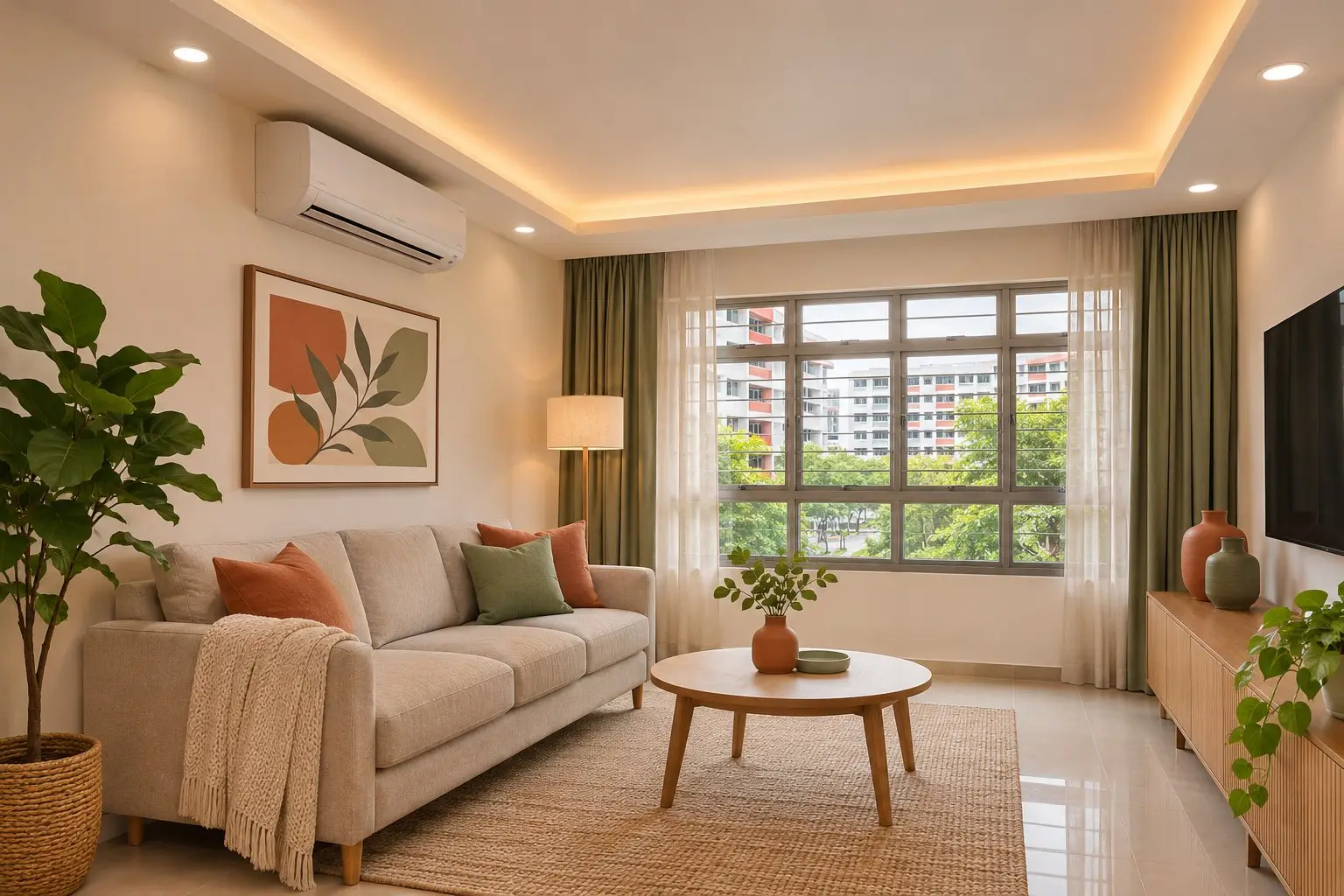
A false ceiling in a Singapore HDB flat runs roughly S$6–12 per square foot for a full plasterboard ceiling, or S$5–12 per foot run for an L-box; a living-room L-box with cove lighting is about S$800–2,000. These are illustrative 2026 ranges, not quotes.
On this page9 sections · tap to jump
- 01What a false ceiling costs in 2026
- 02L-box or full false ceiling?
- 03Cove lighting and downlights
- 04What drives the price
- 05The costs quotes leave out
- 06The HDB rules a false ceiling must meet
- 07Household shelter: the access-panel rule
- 08When a false ceiling is (and isn’t) worth it
- 09Frequently asked questions
A false ceiling is the quiet workhorse of an HDB renovation: it hides aircon trunking, pipes and wiring, and it gives cove lights and downlights somewhere to sit. As an illustrative 2026 industry figure, a full plasterboard false ceiling runs about S$6–12 per square foot installed, while an L-box around the room perimeter is about S$5–12 per foot run, and a typical living-room L-box with cove lighting lands around S$800–2,000. These are compiled market ranges, not quotes and not official prices — HDB sets the rules a false ceiling needs to follow, not what a contractor charges. This guide breaks down the price by scope, the L-box-versus-full decision, and the rules that quietly shape both.
What a false ceiling costs in 2026
Treat every figure here as an illustrative 2026 range, not a quote. False ceilings are priced two ways — per square foot for full coverage, per foot run for an L-box or box-up — so a like-for-like comparison means pinning down the method first.
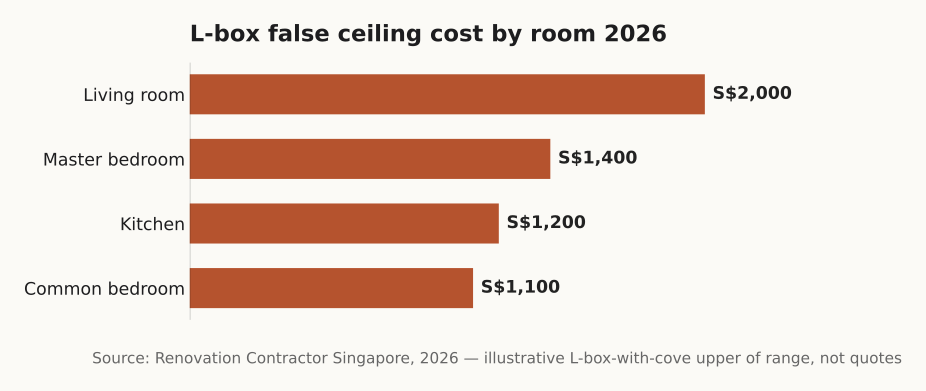
Illustrative L-box-with-cove cost per room (upper of 2026 range). Not quotes.
| Scope | Illustrative 2026 range | Notes |
|---|---|---|
| Full plasterboard false ceiling | S$6 – S$12 psf | Whole-room coverage |
| L-box (perimeter) | S$5 – S$12 per foot run | Keeps centre height |
| Living-room L-box + cove lighting | S$800 – S$2,000 | ~60 ft perimeter |
| Full living-room false ceiling | S$2,500 – S$5,000+ | Seamless surface |
| Cove lighting pelmet | S$130 – S$450 per room | On top of the ceiling |
| LED cove strip + driver | S$8 – S$20 per foot run | Confirm if included |
| Downlight (in false ceiling) | S$30 – S$80 each | Easy access |
| Downlight (bare concrete ceiling) | S$80 – S$150 each | Needs core drilling |
| Whole 4-room flat (L-box, cove) | S$2,500 – S$6,500 | Depends on rooms covered |
Illustrative ranges compiled from 2026 Singapore price guides (Homees, Renovation Contractor Singapore); figures usually exclude 9% GST. Confirm with written quotes.
The spread is wide because “false ceiling” covers everything from a slim perimeter box to a full seamless drop with dozens of downlights. Per room, an L-box is roughly S$500–2,000 and a full ceiling roughly S$1,200–5,000 or more, with the living room the most expensive and bedrooms the least. Use these to sanity-check a quotation, not to hold anyone to a number.
L-box or full false ceiling?
This single choice moves the budget more than the material does. A full false ceiling drops the entire ceiling for a flat, seamless surface and downlights anywhere — more board, more labour and the most lost height. An L-box runs only around the perimeter (or one edge), carrying the cove strip and edge downlights while the centre of the ceiling stays untouched.
Because it covers the perimeter only, an L-box uses roughly 30% less plasterboard and labour than a full ceiling for a very similar glowing-border effect — which is why it is the usual HDB choice and why the cove-lighting look you see in most flats is an L-box, not a full drop. Many flats use a hybrid: a deeper box only where the aircon fan-coil and its pipes cross, with a slim L-box across the rest.
Cove lighting and downlights
A false ceiling is what makes recessed and indirect lighting possible, so the two usually appear together in a quote. Cove lighting is a hidden LED strip in a recessed ledge that washes soft, indirect light across the ceiling — mood lighting, not task lighting. A cove pelmet is about S$130–450 per room, and the LED strip and driver add roughly S$8–20 per foot run on top of the boxing.
Downlights cost about S$30–80 each inside a false ceiling, where the cavity makes wiring and mounting easy, but S$80–150 each in a bare concrete HDB ceiling, because each one needs core-drilling and concealed wiring. Installing several at once lowers the per-light rate. The wiring itself is an electrician’s scope, not the ceiling installer’s — see the electrical works: rules and costs guide for how light points and circuits are priced.
What drives the price
A handful of factors explain most of the gap between quotes:
- Coverage and type — a full ceiling costs more than an L-box or a partial run over one zone.
- Material — moisture-resistant and timber-look boards cost more than standard plasterboard; wet and humid areas need the moisture-resistant grade.
- Lighting integration — cove detailing, the number of downlights and their cut-outs all add labour.
- Aircon trunking — a deeper box to house the fan-coil pipes and condensate drain uses more framing and board than a slim L-box.
- Trade sequencing — the correct order is aircon first-fix, then electrical first-fix wiring, then boarding and plastering, then lighting final-fix; getting it wrong forces the ceiling open again and generates rework charges.
The costs quotes leave out
Beyond the lighting ambiguity above, two line items catch people out. Painting of the new ceiling is usually quoted separately from the boards and plastering. And 9% GST is often excluded from a headline figure — IRAS requires GST-registered businesses to charge the prevailing rate of 9%, and all price displays since 1 January 2024 must be GST-inclusive, so a tax-exclusive quote is not comparable to a tax-inclusive one. For the wider list of line items most quotes omit, see hidden renovation costs to expect.
The HDB rules a false ceiling must meet
HDB sets out exactly what a false ceiling may be, and the rules shape your design more than most homeowners expect:
- No permit, but a registered contractor. HDB’s building-works table lists the installation of false ceilings, cornices and pelmet as not requiring a permit — but you must still engage a contractor listed in the Directory of Renovation Contractors (DRC) for all renovations, and comply with the conditions. Associated works such as rewiring or new lighting points may need their own approval; the HDB renovation permit guide sets out which.
- 2.4 metres clear. A false ceiling must leave a minimum clearance height of 2.4 metres measured from finished floor level — a limit that does not apply to toilets and bathrooms. Cornices and pelmet need at least 2.10 metres.
- Non-combustible materials; no gas pipe enclosed. Non-combustible materials must be used, and no gas pipe may be enclosed within a false ceiling.
- Fixings and reinstatement. Fasteners into the underside of the RC slab must not exceed 6mm in diameter and 40mm in penetration, and the flat owner is responsible for removing and reinstating the ceiling for inspection and maintenance.
Household shelter: the access-panel rule
The household shelter (bomb shelter) is the one ceiling you cannot treat like any other. Its walls, floor and ceiling slabs must not be hacked or drilled (beyond shallow removable fixings), and cornices are not permitted inside it. If you run a false ceiling outside the shelter and below its ventilation sleeves, SCDF requires a perforated access panel of at least 600mm × 600mm directly below each sleeve, so the vents stay reachable. Design the ceiling around that, not over it — the full set of do’s and don’ts is in the HDB household shelter rules guide.
When a false ceiling is (and isn’t) worth it
A false ceiling earns its cost where it genuinely hides overhead services or shapes light — typically the living room and master bedroom, where aircon trunking runs and layered lighting adds real value. It is usually not worth it in a study, storeroom or a bedroom served by a single ceiling light with nothing overhead to conceal: you are then paying for a lower plane alone, and the budget works harder elsewhere. A sealed ceiling also complicates future access to concealed pipes and aircon service valves, so plan access panels in from the start. If you are also redoing the floor, read the flooring cost guide alongside this one, and the HDB renovation cost guide for how the ceiling fits the whole-flat budget.
Frequently asked questions
How much does a false ceiling cost for an HDB living room in 2026? As an illustrative range, a living-room L-box with cove lighting is about S$800–2,000, and a full living-room false ceiling about S$2,500–5,000 or more. The figure depends on coverage area, board type, depth and downlight count. These are market ranges, not quotes.
Is an L-box cheaper than a full false ceiling? Yes, significantly. An L-box covers only the perimeter and uses roughly 30% less board and labour, while still delivering the cove-lighting effect. A full ceiling is only worth it when services cross the room centre or you want downlights placed anywhere.
Do I need an HDB permit for a false ceiling? No. HDB lists false ceiling installation as not requiring a permit, but it must be done by a DRC-registered contractor and meet HDB’s conditions. Any accompanying rewiring, new lighting points or aircon works may need their own approval.
What is the minimum ceiling height HDB allows? A false ceiling must leave at least 2.4 metres clear from the finished floor (toilets and bathrooms excepted). Watch this if you are also raising the floor with an overlay, because the gap shrinks from both ends.
Does the quote include painting and the LED strip? Often not. Painting is usually separate from the boarding, and the LED strip, driver and dimmer may sit outside the ceiling price. Confirm both in writing before comparing quotes.
Related
- Electrical works: rules and costs
- Electrical rewiring cost in Singapore
- Flooring cost: tiles vs vinyl vs laminate
- Hidden renovation costs to expect
- HDB household shelter rules
- HDB renovation permit guide
- HDB renovation cost guide
Cost figures are illustrative industry ranges (approximate, 2026), not quotes; rules and height limits are from HDB and SCDF. Rules and prices change — confirm current figures with HDB, SCDF and a DRC-registered contractor, and get at least three itemised written quotes, before you start.
Sources
- False Ceiling & Lighting Cost in Singapore (2026): psf, L-box, downlights, cove — Homees (industry price guide) (as of November 2026)
- False Ceiling & Cove Lighting Cost Singapore 2026 (per-room ranges, L-box vs full) — Renovation Contractor Singapore (industry price guide) (as of November 2026)
- Ultimate False Ceiling Installation Singapore Guide 2026 (licensed cove wiring) — Nextech Design Engineering (industry guide) (as of November 2026)
- Renovation Guidelines for Building Works (false ceiling: 2.4m, non-combustible, no gas pipe) — Housing & Development Board (HDB) (as of November 2026)
- Applying for Approval (DRC contractor, unauthorised works, licensed persons) — Housing & Development Board (HDB) (as of November 2026)
- Technical Requirements for Household Shelters 2023, Clause 7.2 (access panel below vent sleeve) — Singapore Civil Defence Force (SCDF) (as of November 2026)
- Prevailing GST rate (9% from 1 Jan 2024) — Inland Revenue Authority of Singapore (IRAS) (as of November 2026)