HDB Hacking and Wall Rules Explained
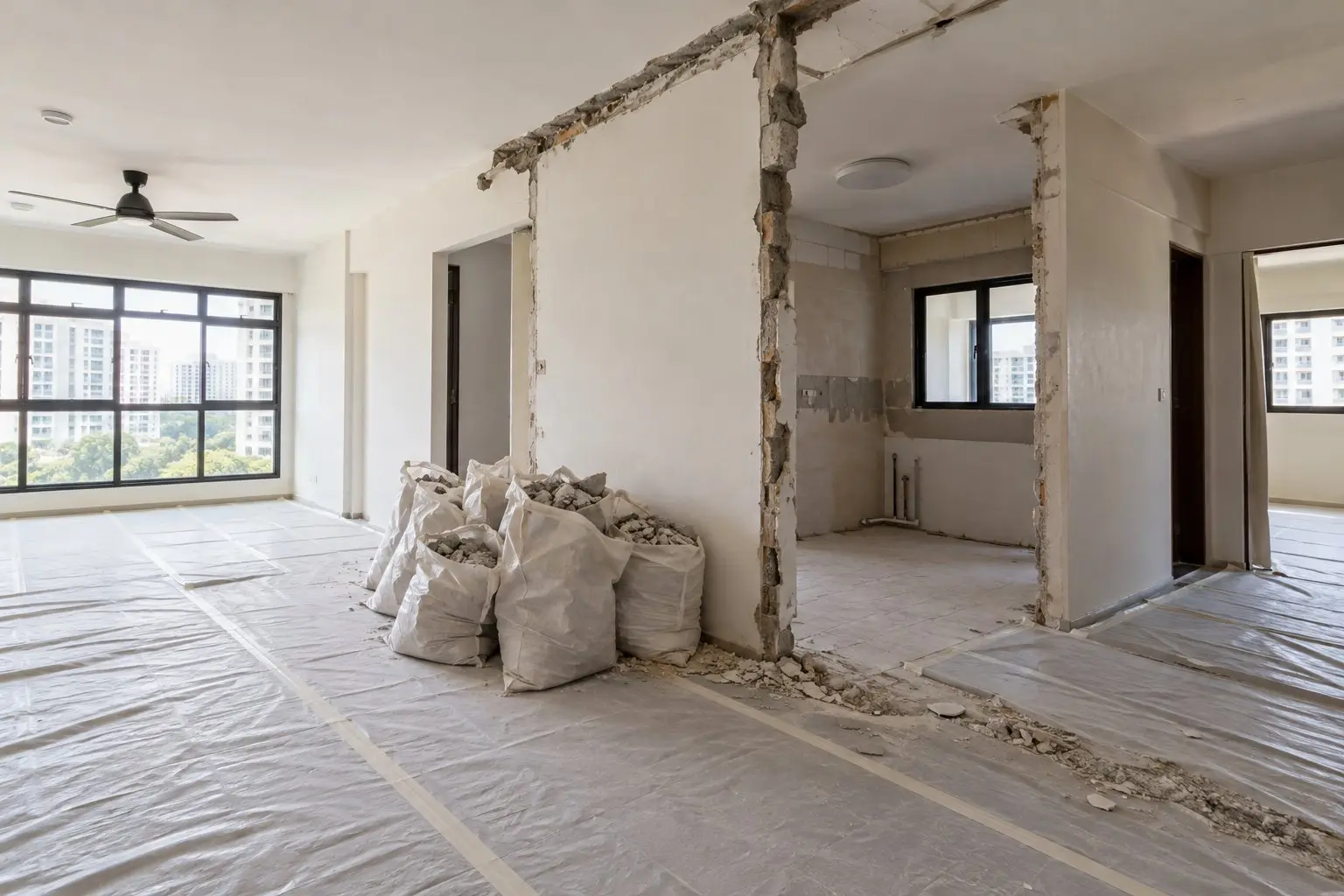
In an HDB flat, all wall hacking needs HDB's prior written approval. You can never hack structural members — reinforced-concrete walls, columns, beams, slabs — or the household shelter. Non-structural walls can be removed to the underside of the RC beam only, and noisy hacking is limited to weekdays 9am–5pm.
On this page (3 sections)
“Can I hack this wall?” is the most common renovation question — and the one most likely to get you in trouble. In an HDB flat, all demolition and hacking of walls, partial or complete, requires HDB’s prior written approval. The approval exists to make sure the work does not weaken the building. Here is what is allowed, what is not, and when the noisy work can happen.
What you can never hack
HDB lists these as disallowed building works:
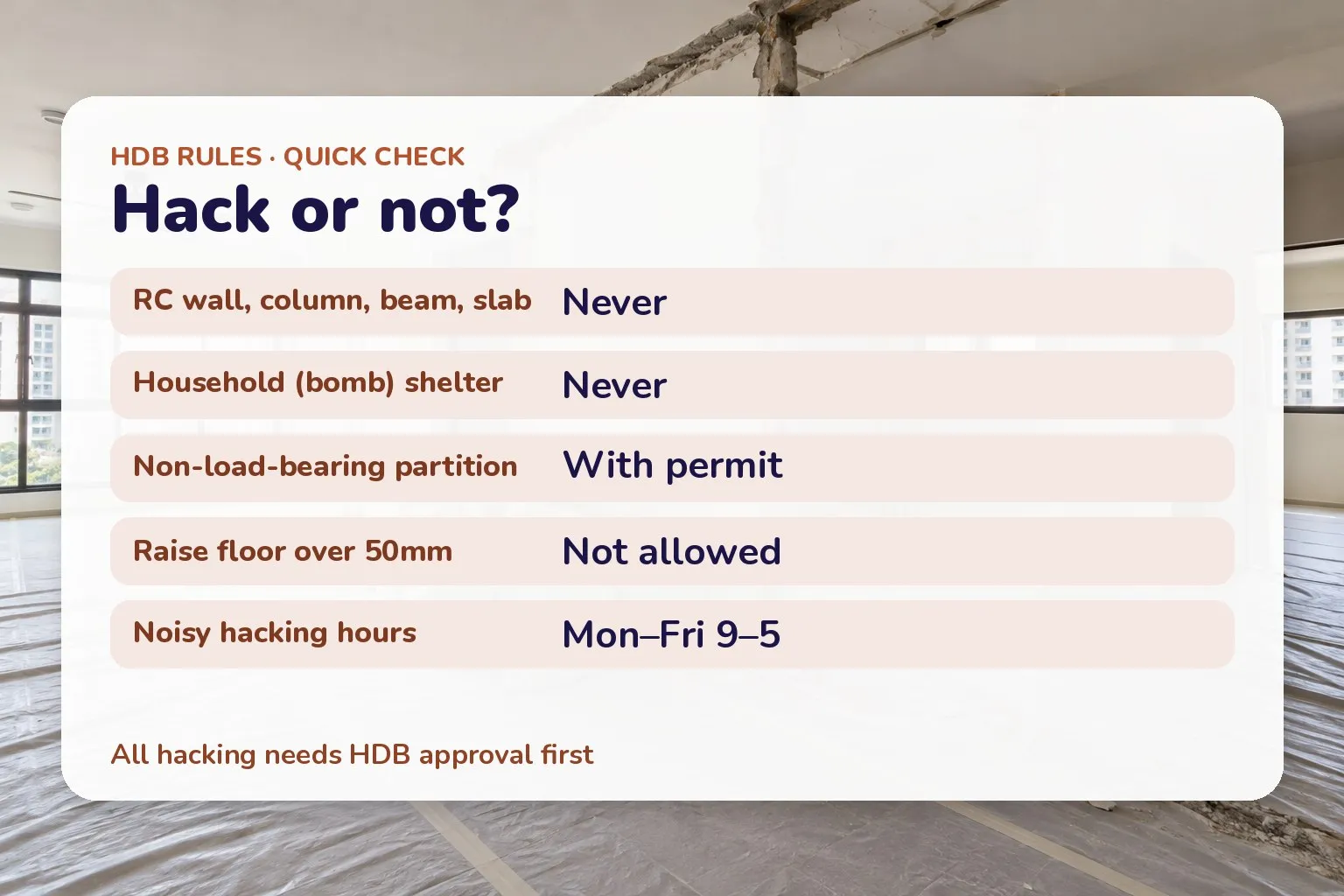
Quick check of what can be hacked. Source: HDB Renovation Guidelines.
- Structural members: reinforced-concrete (RC) walls, columns, beams, slabs and staircases. These hold the building up and are off-limits.
- The household shelter (bomb shelter). Its strengthened walls, floor slab, ceiling slab and steel door are a civil-defence structure. You must not hack or drill them, beyond the few finishing works specifically permitted (such as forming a key for tiling on the designated faces).
- Raising the floor more than 50mm, or overloading the slab beyond 150kg per square metre.
- Plastering ceilings, and partitioning with combustible materials.
What can be removed — carefully
Non-load-bearing and lightweight partition walls (hollow block, brick, drywall, Ferrolite) can be demolished, but only with a permit and within conditions:
- Demolition is allowed only up to the underside of the RC beam or slab.
- Block or brick walls must be taken down top-down; lightweight partitions removed in full, joint to joint.
- If steel bars are discovered during demolition, work must stop immediately and HDB be informed — that is a sign the element may be structural.
- Demolishing a non-load-bearing RC element needs a Professional Engineer (PE) to supervise and certify the repair.
A word on half-walls: because a wall cannot be neatly cut in half, the whole wall is hacked first and a new half-wall built — which is why a half-wall often costs as much as a full one.
When hacking can happen
Noise rules are strict. Under HDB’s renovation terms, noisy works — demolishing walls, removing wall or floor finishes, cutting tiles, heavy drilling — are allowed only Monday to Friday, 9am to 5pm, and not on Saturdays, Sundays, public holidays or the eves of major public holidays. Such works must be completed within 3 consecutive days, and only two HDB-approved power tools may be used at a time. All other, quieter works may run 9am–6pm on weekdays and Saturdays, never on Sundays or public holidays.
Any hacking needs a permit first — see the HDB renovation permit guide, or check your planned works against the renovation permit checklist. Because older flats often need tiles hacked and walls opened up, hacking features heavily in the resale flat renovation cost. Always confirm your contractor is HDB-registered before any hacking starts; our how to choose a renovation firm guide shows how.
Related
General information only, not engineering advice. Rules change; confirm the current requirements on the HDB website before you start.
Sources
- Important Information on Renovations — Housing & Development Board (HDB) (as of October 2026)
- Renovation Guidelines for Building Works — Housing & Development Board (HDB) (as of October 2026)
- HDB Renovation Portal — Terms and Conditions (permitted hours) — Housing & Development Board (HDB) (as of October 2026)