Renovation Cost by Interior Design Style (2026)
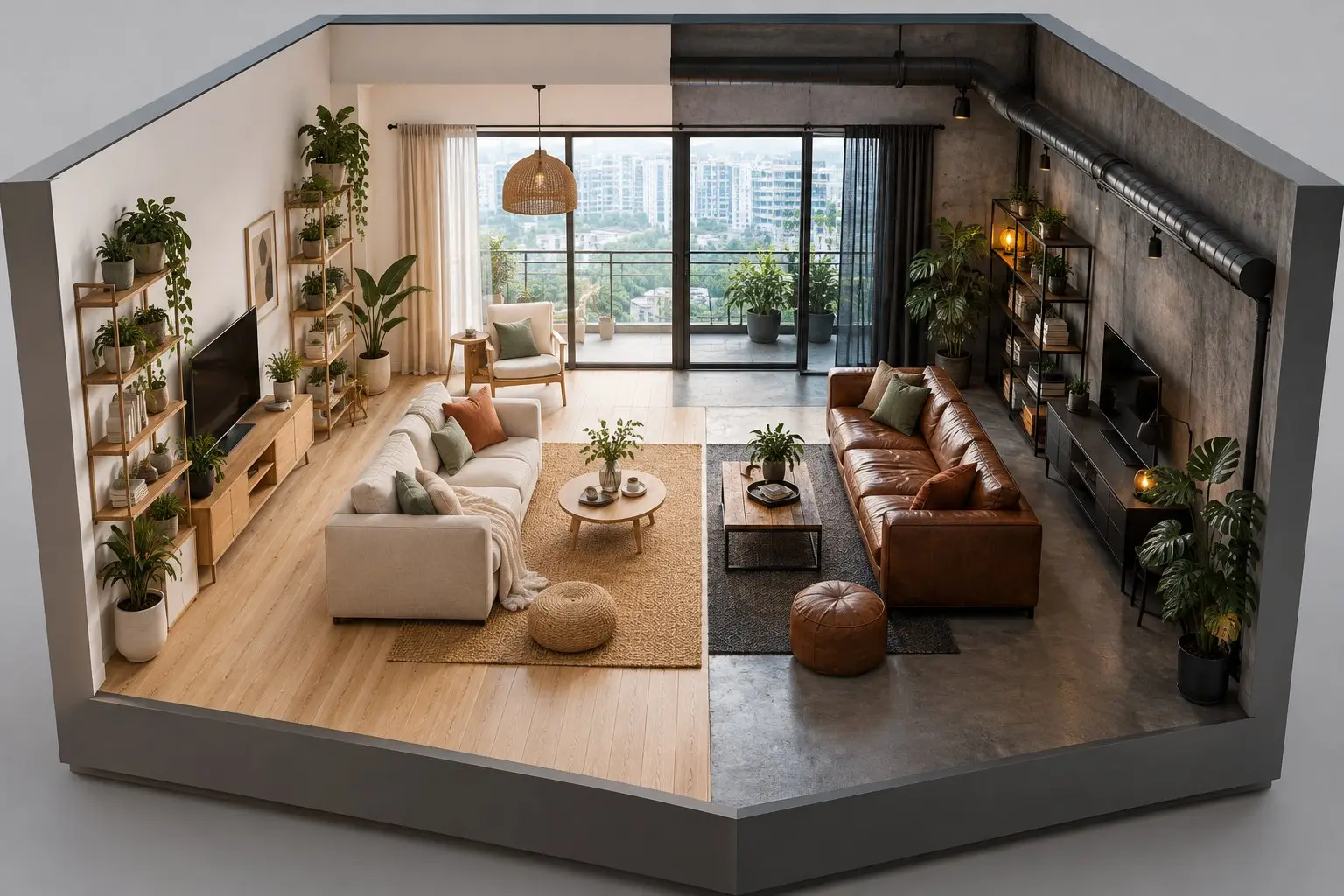
Your interior design style does not fix the price — it steers where the renovation money goes. Illustrative 2026 industry cost ranges for a 4-room flat run from about S$30,000 for Scandinavian to S$80,000 for industrial or luxury schemes; carpentry and finishes, not the style name, drive the gap.
On this page9 sections · tap to jump
- 01Does interior style change what you pay?
- 02Illustrative cost by style (2026)
- 03Scandinavian: the budget-friendly baseline
- 04Why minimalist often costs the most to look the simplest
- 05Industrial and modern luxury: where it climbs
- 06The real cost lever: carpentry, not the style name
- 07Style choices that run into HDB rules
- 08How to get the look for less
- 09Frequently asked questions
Scroll any Singapore renovation feed and the styles blur together — Scandinavian, Japandi, minimalist, industrial, modern luxury. The honest answer to “which one costs more?” is that the style name is not the price tag. A budget buys a certain amount of work, materials, carpentry and detailing; the style you pick decides where that money goes and how far it stretches. Two homes can both spend S$50,000 and look nothing alike. Below are illustrative 2026 industry ranges by style for a 4-room flat, what actually drives each one, and the HDB rules a few looks run into.
Does interior style change what you pay?
Not as much as the flat type, the condition of a resale unit, or how much of the home you touch — but it tips the balance. As one Singapore design studio puts it, a budget “does not buy a style on its own. It buys a certain amount of renovation work, materials, carpentry, and detailing. The style you choose affects how that money gets used.” A restrained scheme lets you decide where not to spend; a detail-heavy one commits the budget before you start. So treat the figures here as planning ranges, not quotes, and read them alongside the HDB renovation cost guide for the flat-type picture.
Illustrative cost by style (2026)
These are compiled industry ranges for a whole 4-room renovation (works, before furniture), not fixed packages — they overlap heavily because scope and finish move them more than the label does.
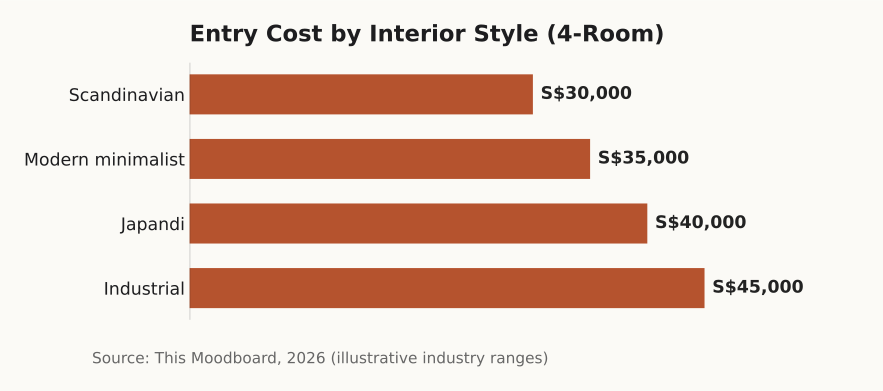
Illustrative low-end of each style’s 4-room whole-renovation range — a planning guide, not quotes.
| Interior design style | Illustrative 4-room range | What drives the cost |
|---|---|---|
| Scandinavian | S$30,000 – S$55,000 | Light wood, open shelving, loose furniture — least built-in carpentry |
| Modern minimalist | S$35,000 – S$60,000 | Concealed, seamless joinery and precise finishes |
| Japandi | S$40,000 – S$70,000 | Oak veneer, fluted timber, custom carpentry |
| Industrial | S$45,000 – S$80,000 | Cement-screed finishes, exposed treatments, feature detailing |
Illustrative industry ranges, approximate as of November 2026 — Source: This Moodboard. Not quotes.
Scandinavian sits at the bottom and industrial at the top, with minimalist and Japandi in between. An independent design firm reports a similar shape: a Scandi 4-room BTO around S$30,000–50,000, a full minimalist execution around S$45,000–70,000, and a Scandinavian-minimalist hybrid around S$35,000–45,000. Push into modern luxury — marble textures, metallic finishes, statement stone — and the whole-home figure climbs toward the S$70,000–150,000 band that any extensively specified renovation reaches.
Scandinavian: the budget-friendly baseline
Scandinavian wins on cost for a structural reason, not a stylistic one: it leans on light wood, white and grey tones, and loose, functional furniture rather than wall-to-wall built-ins. Industry breakdowns put light wood flooring around S$3,000–6,000 and minimalist shelving units around S$1,000–3,000 for a flat — modest next to a fully fitted scheme. The clincher is storage: open shelving runs about S$150–250 per linear metre, against S$800–1,200 per metre for the concealed cabinetry a minimalist look demands. Over 15–20 metres of storage, that gap alone is thousands of dollars. Scandinavian also phases well — you can start with structure and storage, then add textiles and lighting as budget allows.
Why minimalist often costs the most to look the simplest
The counter-intuitive one. A minimalist room looks like it contains less, but the calm comes from concealed construction: floor-to-ceiling storage walls, handleless fronts, a door hidden flush in the panelling. As designers note, “a floor-to-ceiling storage wall, concealed door, and integrated storage can make a minimalist interior look effortless, but the effort is in the construction.” Hidden storage cabinetry alone is quoted around S$4,000–7,000, and the seamless look usually means spray-paint fronts rather than laminate (more on that below). Minimalist schemes also reward doing everything at once — mixing finish batches across phases risks a 15–20% cost escalation on the affected work, because colour and precision are hard to match later.
Industrial and modern luxury: where it climbs
Industrial reads as “raw and unfinished,” but raw is not free. An exposed-brick or cement-screed feature wall runs about S$2,500–5,000, concrete-look flooring about S$3,000–6,000, and metal fixtures and accents add on top — which is why industry guides note that industrial and rustic styles “require custom work, while Scandinavian and contemporary designs offer more affordable options.” Modern luxury climbs further still: marble and sintered-stone surfaces, metallic trims and statement lighting are priced by the slab and the piece, not by the metre, so a single feature can cost more than a room of laminate.
The real cost lever: carpentry, not the style name
Across every style, carpentry is the biggest single trade — roughly 30–40% of the budget — because each built-in is custom-cut to your unit. Kitchen cabinetry alone runs about S$8,000–20,000 and wardrobes about S$3,000–8,000 each, before you choose a finish. And the finish is the second lever. Carpentry is priced per foot run, with a 2026 laminate finish on quality plywood from about S$130–450 per foot; wood veneer adds roughly 30% and spray paint (2-pac/Duco/PU) about 45% on top.
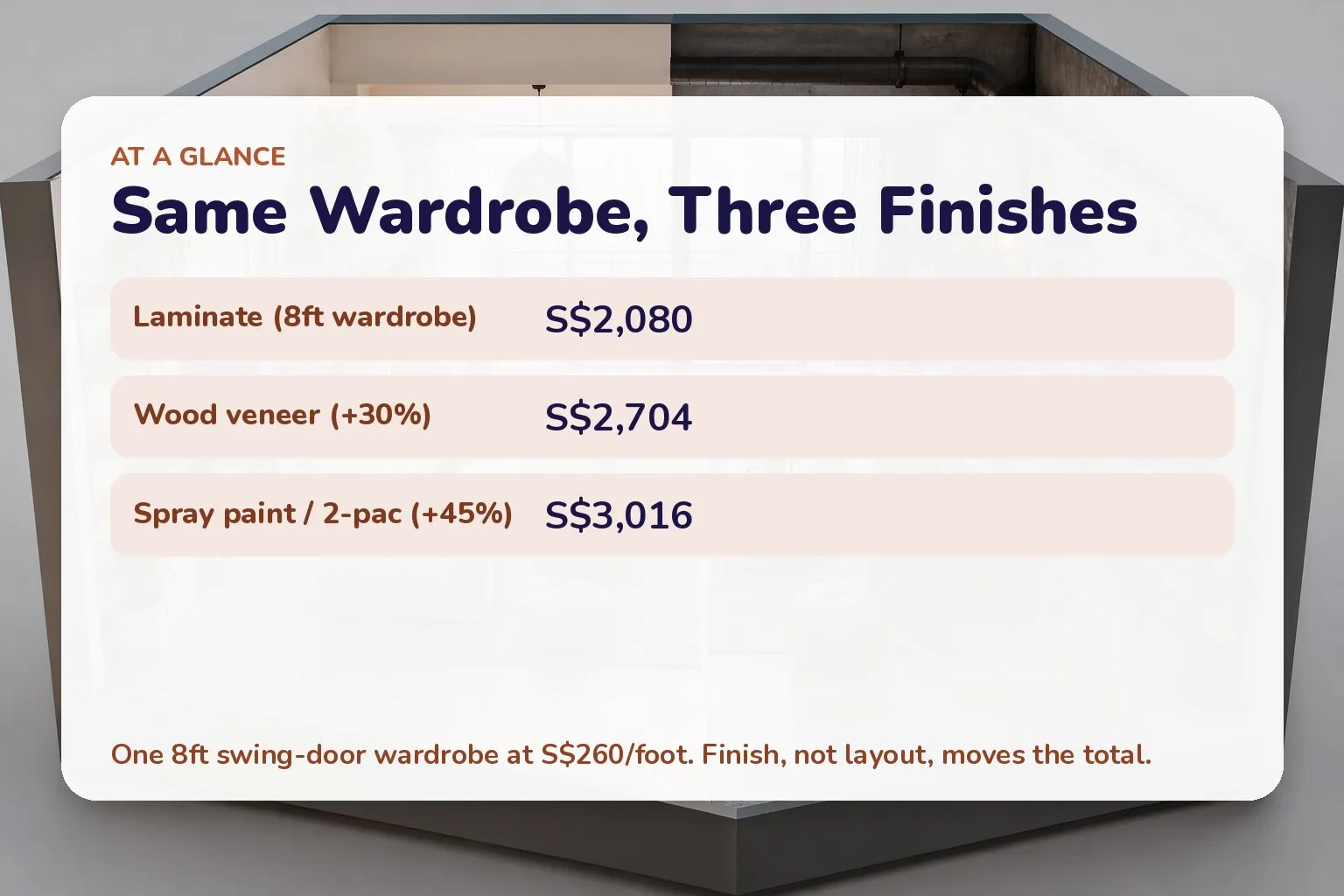
How finish choice alone changes the price of the same carpentry.
This is why the style label misleads. A minimalist flat with spray-paint joinery throughout can out-cost an industrial flat that leaves surfaces raw. The trick most budgets use: run laminate everywhere and reserve veneer or spray paint for one feature piece at eye level. For a worked flat-type breakdown of these trades, see the 4-room BTO renovation cost page.
Style choices that run into HDB rules
Some looks are not just a price question — they need permission. The open-plan layout behind most “modern,” Scandinavian and loft schemes means removing the kitchen or partition wall, and HDB is firm: “all demolition and hacking of walls (be it partial or complete) require HDB’s prior written approval,” and only a contractor from the Directory of Renovation Contractors may do the work. Opening up a layout is quoted around S$8,000–15,000 once hacking and making good are counted.
How to get the look for less
You do not have to drop the style to drop the bill — you trim where the eye does not land.
Whatever the style, get at least three itemised quotations on the same scope before you sign, and vet the firm with the checklist in how to choose a renovation firm. You can also sketch a figure for your own flat with the renovation budget calculator.
Frequently asked questions
Which interior design style is cheapest in Singapore? On illustrative industry ranges, Scandinavian — roughly S$30,000–55,000 for a 4-room — because it uses light materials, open shelving and loose furniture instead of extensive built-ins.
Why is minimalist design so expensive if it looks so plain? The simplicity comes from concealed, seamless joinery and spray-paint finishes, which are more labour-intensive than the open shelving and laminate a Scandinavian look uses. A full minimalist 4-room commonly sits around S$45,000–70,000.
Is the design fee part of the renovation cost? No. Interior-design service fees — space planning, 3D renders, material selection — are quoted separately from the contractor’s renovation works, so budget for both.
Can I do a hybrid of two styles? Yes, and it is often the best value. A Scandinavian-minimalist hybrid 4-room BTO typically lands around S$35,000–45,000 by putting precision finishes in the living areas and keeping bedrooms simple.
Related
- HDB renovation cost guide
- 4-Room BTO renovation cost breakdown
- HDB hacking and wall rules
- ID firm vs contractor
- How to choose a renovation firm
Cost figures are illustrative ranges compiled from published 2026 industry sources (This Moodboard, Ace Interior Design, MRD, SmartCalculator SG), approximate and not quotes; Singapore publishes no official renovation price list. Official rules on hacking approval, the DRC, floor loading and penalties are from HDB and MND pages (November 2026). Rules and prices change — confirm current figures with your contractor and the official sources.
Sources
- Interior Design Budget by Style: What $30k, $50k & $80k Gets You — This Moodboard (as of November 2026)
- Materials, Budget & Climate: Making Either Style Work in Singapore — Ace Interior Design (as of November 2026)
- Exploring Various Interior Design Styles for Your Singapore Home (cost breakdowns) — MRD (as of November 2026)
- Carpentry Cost Singapore (2026): Per Foot Run Price Guide — SmartCalculator SG (as of November 2026)
- Important Information on Renovations (hacking approval, DRC, disallowed works) — Housing & Development Board (HDB) (as of November 2026)
- Renovation Guidelines for Building Works (floor loading and raising limits) — Housing & Development Board (HDB) (as of November 2026)
- Written answer on renovation contractors breaching approval conditions (penalties) — Ministry of National Development (MND) (as of November 2026)