HDB Plumbing Rules in Singapore: Licensed Plumbers
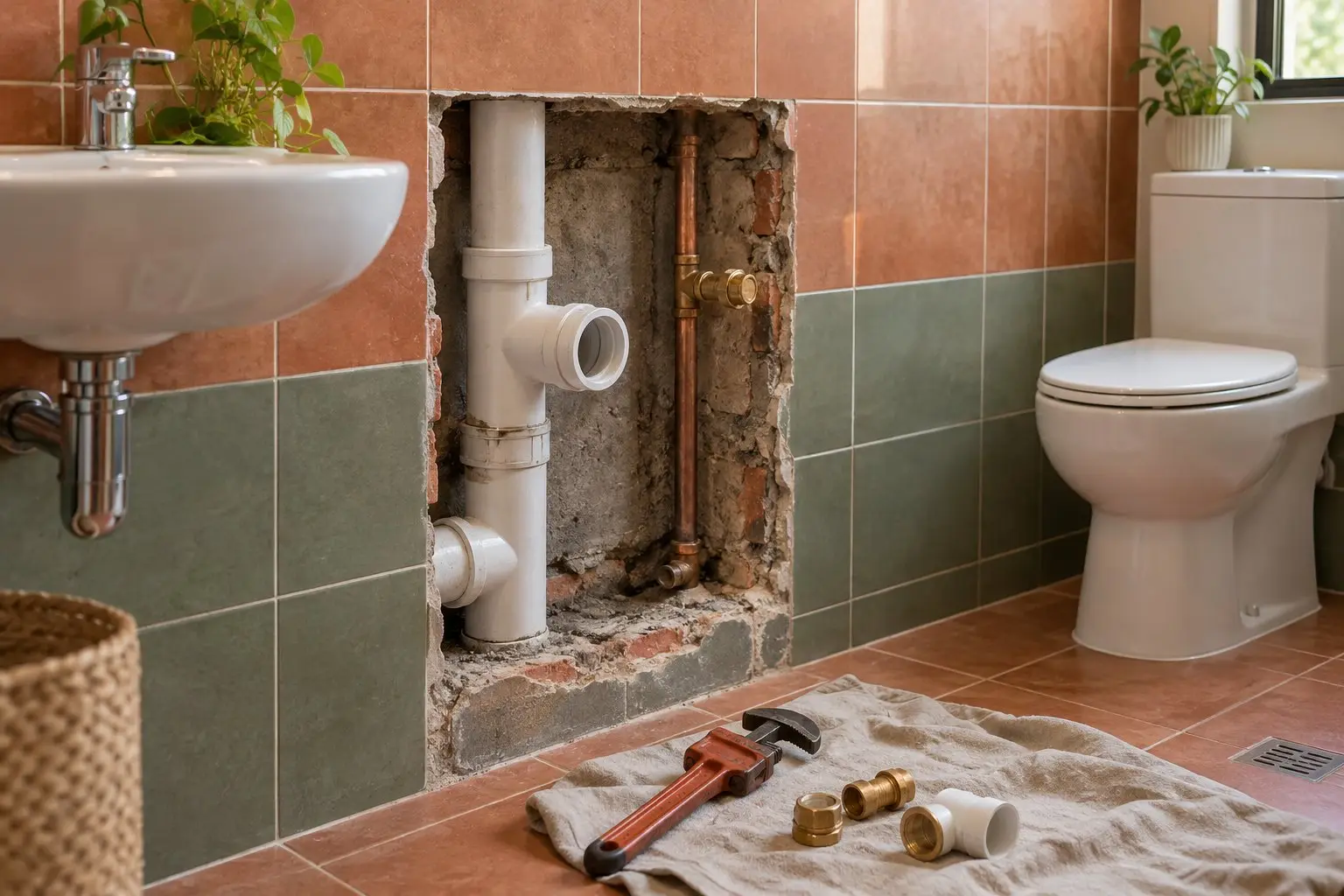
Home plumbing in an HDB flat needs no HDB permit, but all regulated water and sanitary works must by law be done by a PUB Licensed Plumber — hiring an unlicensed one has been an offence since 1 April 2018.
On this page13 sections · tap to jump
- 01Do plumbing works need an HDB permit?
- 02When a PUB Licensed Plumber is the law
- 03Water service vs sanitary works
- 04Simple works a handyman may do
- 05The penalty for unlicensed work
- 06HDB’s technical conditions
- 07Moving and concealing pipes
- 08Toilet bowls and discharge pipes
- 09Drilling near concealed pipes
- 10The other people the law requires
- 11How to check your plumber is licensed
- 12The “PUB submission fee” myth
- 13Frequently asked questions
Most people meet Singapore’s plumbing rules only when something has already gone wrong — a toilet that has to move, a leak behind a wall, a handyman who “can do it cheaper”. The rules are not about paperwork at HDB: home plumbing needs no HDB permit. They are about who is legally allowed to touch your pipes, and a set of technical conditions you still have to meet even without a permit. Get this wrong and you risk a fine, a leak into the flat below, or an insurer’s awkward questions. This is the rules guide; for what each job tends to cost, see the separate plumbing works cost in Singapore page.
Do plumbing works need an HDB permit?
No. HDB is explicit that the water and sanitary plumbing works (and gas works) listed in its renovation guidelines do not require a permit from HDB — but they are “subject to our technical terms and conditions.” That is the catch most homeowners miss. Work that needs no permit must still comply with the guidelines; if it does not, HDB treats it as unauthorised work and can require you to correct or reinstate it. So “no permit” is not “no rules” — it simply moves the compliance burden onto the licensed plumber and the contractor you engage.
When a PUB Licensed Plumber is the law
This is the rule that catches people out. All regulated water service and sanitary plumbing works must be carried out by a PUB Licensed Plumber (LP) — and since 1 April 2018 it is an offence to engage a plumber who is not licensed by PUB for those works. The licence is not a rubber stamp: LPs must follow PUB’s technical, safety, water-quality and water-conservation requirements, and they are responsible for lodging the necessary regulatory submissions to PUB.
The 2018 change was significant. Before it, only water-service plumbers (the drinking-water side) were regulated; the licensing of sanitary plumbers — the used-water side, including toilets and discharge pipes — was added then, after a six-month transition that ran to 30 September 2018. So the plumber who moves your toilet today is doing work that was brought under licensing specifically because of its risk to the building.
Water service vs sanitary works
PUB splits home plumbing into two systems, and both are regulated. Water service plumbing is the drinking-water side: “the laying, installation, alteration, repair or replacement of water pipes, tanks, taps and fittings in the drinking water supply system.” Sanitary plumbing is the used-water side: the discharge pipes and appliances — water closet, urinal, sink — including “installing, changing or relocating toilet bowls and sanitary piping.” Work on either system, beyond the short “simple works” list below, needs an LP.
Simple works a handyman may do
Not everything needs a licensed plumber. PUB publishes a specific list of simple works that a handyman may do without a licence:
- Replacing or removing any tap or mixer.
- Replacing or removing a shower hose or showerhead, a connecting hose with a self-closing nozzle, a washing-machine or dishwasher connecting hose, or a flexible hose.
- Replacing or removing the pipe between a stop valve and an instantaneous (instant) water heater.
- Replacing a cistern’s flushing mechanism or the flexible hose after the ball valve.
- Installing, replacing or removing a washbasin or sink (with its bottle or fitting trap), a bathtub, shower tray or shower enclosure, or a floor waste outlet; replacing a floor trap grating or cover; installing a urinal; and clearing a blockage in a floor trap, water closet or appliance.
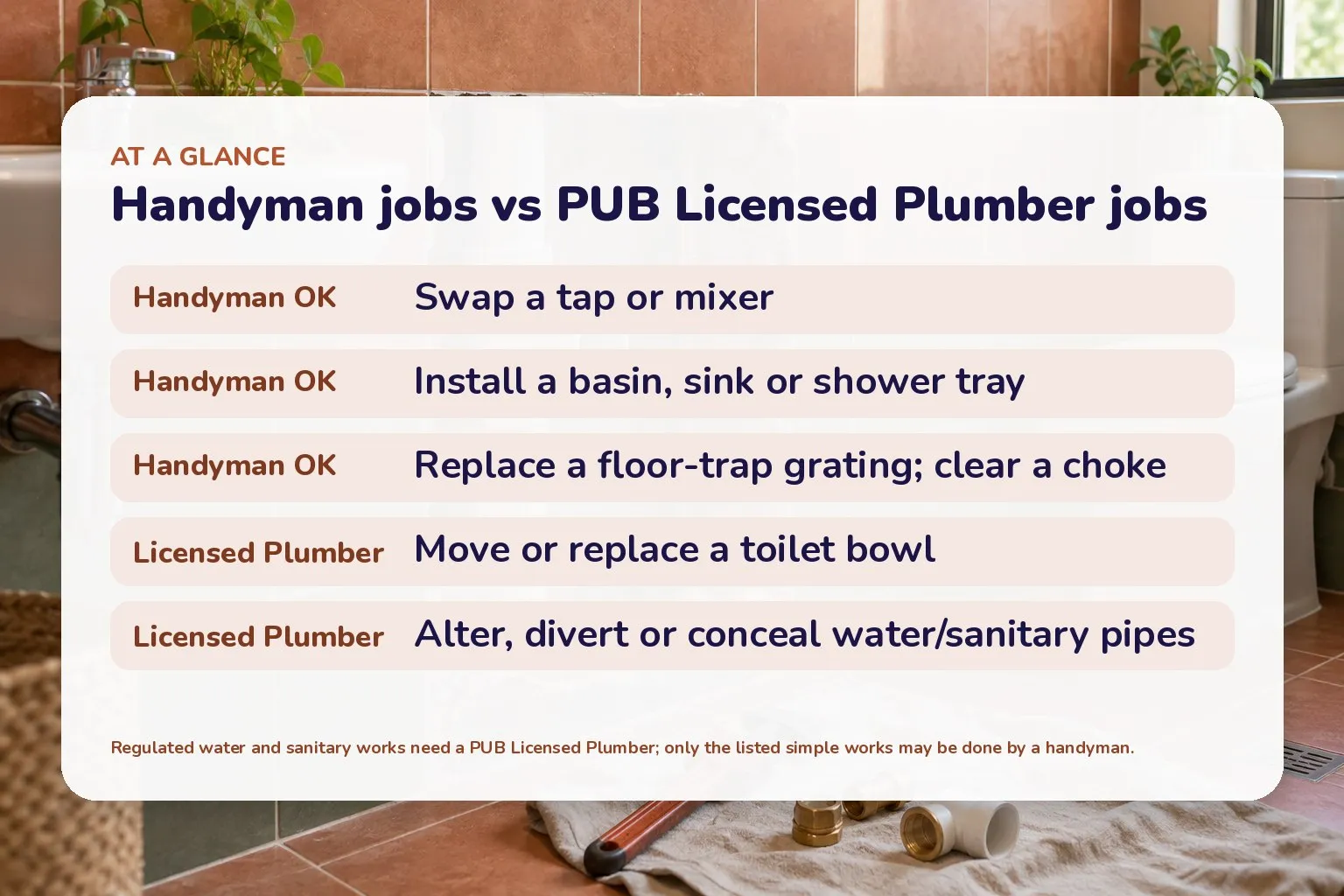
If a job is not on that list — changing or moving a toilet bowl, altering or relocating sanitary pipes, concealing pipes in a wall — it is regulated, and a handyman doing it is working illegally.
The penalty for unlicensed work
The teeth are in the Public Utilities Act 2001. An owner or occupier who wants sanitary or water-service installation works done “must only engage a person permitted under the Act” — that is, an LP or someone under an LP’s direct supervision. Carrying out regulated works without a licence (or holding yourself out as authorised) is an offence: on conviction, a fine of up to $10,000 or imprisonment of up to 3 years, or both. The same exposure applies to the person who hires an unlicensed plumber for regulated works. Separately, HDB’s own Housing & Development (Renovation Control) Rules carry a fine of up to $5,000 for breaching its renovation rules or not using a listed contractor — so a botched job can attract both.
HDB’s technical conditions
Even without a permit, HDB sets hard limits on how pipes are run. The recurring theme is simple: do not touch the structure. From HDB’s water-and-sanitary guidelines:
- Concealed waste or water pipes may run in floor finishes or walls, but “the floor slab and wall must not be tampered with,” the work must comply with PUB requirements, and an LP must do it.
- A diverted sink waste pipe must not be embedded in the floor slab — it may sit within the floor finishes only.
- Where pipes are boxed in (enclosed service ducts), you must leave a removable access opening of at least 600mm x 600mm for inspection and future replacement.
- Removal of vent pipes is not allowed.
Moving and concealing pipes
Relocating a sink or moving a toilet is where a bathroom’s plumbing rules really bite. Because a diverted waste pipe cannot cut the structural slab and may only sit within the floor finishes, there is a physical limit to how far a toilet or floor trap can shift — the pipe needs fall (a downward gradient) within a thin screed. That constraint, not just the plumber’s rate, is why “let’s just move the toilet to the other wall” is often expensive or simply not possible. The same logic protects you: pipes kept within the finishes, with proper access panels, can be reached later without hacking the slab.
Toilet bowls and discharge pipes
Installing, replacing or removing a toilet pan and sealing up the discharge pipe is sanitary work and must be done by a PUB Licensed Plumber — never a handyman, even though swapping a basin is handyman-eligible. HDB adds two structural conditions: holes cannot be hacked in the existing floor slab, and if you raise the floor, the minimum ceiling height from the finished raised floor slab is 2.2m. A squat-to-pedestal conversion must follow HDB’s addition-and-alteration guidelines for squat pans.
Drilling near concealed pipes
HDB flats come with concealed water pipes behind kitchen and toilet walls, and drilling into one is a classic, avoidable disaster. HDB’s rule: treat the kitchen and toilet concealed-pipe layout plans as a guide only, and “use a metal detector to confirm the exact location of the concealed water pipes” before any drilling, keeping ramsets, nails and screws well clear. A good contractor does this as routine; ask whether they will.
The other people the law requires
A plumber’s licence covers only water and sanitary work. HDB requires a whole cast of licensed people for a renovation:
- A contractor listed in the Directory of Renovation Contractors (DRC) for all renovation works.
- A PUB Licensed Plumber for water-service and sanitary works.
- An EMA-licensed gas service worker for gas works (a plumber cannot touch gas).
- A BCA-approved window contractor (listed with HDB) for windows, and an EMA Licensed Electrical Worker for electrical work.
For how electrical fits in, see the electrical works rules; for the permit side of a renovation, the HDB renovation permit guide. And because wet works and waterproofing travel together, read the HDB bathroom waterproofing rules before you redo a toilet.
How to check your plumber is licensed
You can verify an LP, or find one, through PUB’s online Licensed Plumber search, the Singapore Plumbing Society, or your Town Council. A licensed plumber carries a PUB licence card, and PUB maintains a public register. Where the design involves pumping equipment or a storage tank, a Professional Engineer must be engaged for both design and supervision — relevant for landed homes and some condos, rarely for a flat.
The “PUB submission fee” myth
Frequently asked questions
Do I need an HDB permit to change a toilet or basin? No HDB permit is needed for the listed water and sanitary works, but they must comply with HDB’s technical conditions, and moving or replacing a toilet bowl must be done by a PUB Licensed Plumber.
Can a handyman legally move my toilet? No. Installing, changing or relocating a toilet bowl and its discharge pipe is regulated sanitary work for a PUB Licensed Plumber. A handyman may only do the simple works on PUB’s list, such as swapping a tap, basin or floor-trap grating.
What is the penalty for hiring an unlicensed plumber? Under the Public Utilities Act, carrying out — or engaging someone for — regulated works without a licence is an offence carrying a fine of up to $10,000, imprisonment of up to 3 years, or both.
How do I check a plumber is a PUB Licensed Plumber? Ask for the PUB licence card and confirm it on PUB’s online Licensed Plumber search, through the Singapore Plumbing Society, or via your Town Council.
Is there really no HDB permit for plumbing? Correct — HDB’s listed water, sanitary and gas works need no permit. But the technical conditions (LP required, no tampering with the slab, 600mm x 600mm access panels, no vent-pipe removal) still apply, and non-compliance is treated as unauthorised work.
Related
- Plumbing works cost in Singapore
- HDB bathroom waterproofing rules
- Electrical works rules and costs
- HDB renovation permit guide
- How to choose a renovation firm
General information only, not legal or plumbing advice. Licensing and renovation rules are from PUB and HDB and can change — confirm current requirements with PUB, HDB and a PUB Licensed Plumber before you start work.
Sources
- Plumbing Works (regulated vs simple works; Licensed Plumbers) — PUB, Singapore's National Water Agency (as of November 2026)
- Public Utilities Act 2001, Section 40G (regulated works offence) — Singapore Statutes Online (AGC) (as of November 2026)
- Renovation Guidelines for Water and Sanitary Plumbing Works and Gas Works — Housing & Development Board (HDB) (as of November 2026)
- Applying for Approval (DRC and licensed persons) — Housing & Development Board (HDB) (as of November 2026)
- Important Information on Renovations (penalties, DRC) — Housing & Development Board (HDB) (as of November 2026)
- Stricter licensing regime for plumbers kicks in from April — Channel NewsAsia (as of November 2026)