Renovation Loan Eligibility in Singapore

Singapore banks typically lend a renovation loan only to citizens and permanent residents aged 21 to 65, earning at least S$24,000 a year, who own the flat or are close family of the owner. The loan is capped at 6 times monthly income or S$30,000.
Before a bank will fund your renovation, you have to clear a short list of fixed hurdles — and they trip up more applicants than the interest rate ever does. This page sets out who actually qualifies for a renovation loan in Singapore, how your income decides the size, who can join the application, what to bring, and the reasons an approval quietly falls through.
Who can get a renovation loan
A renovation loan is a narrow, purpose-built product, so the eligibility bar is specific. Using DBS and POSB — among the largest renovation lenders — as the reference, an applicant must meet four conditions at once.
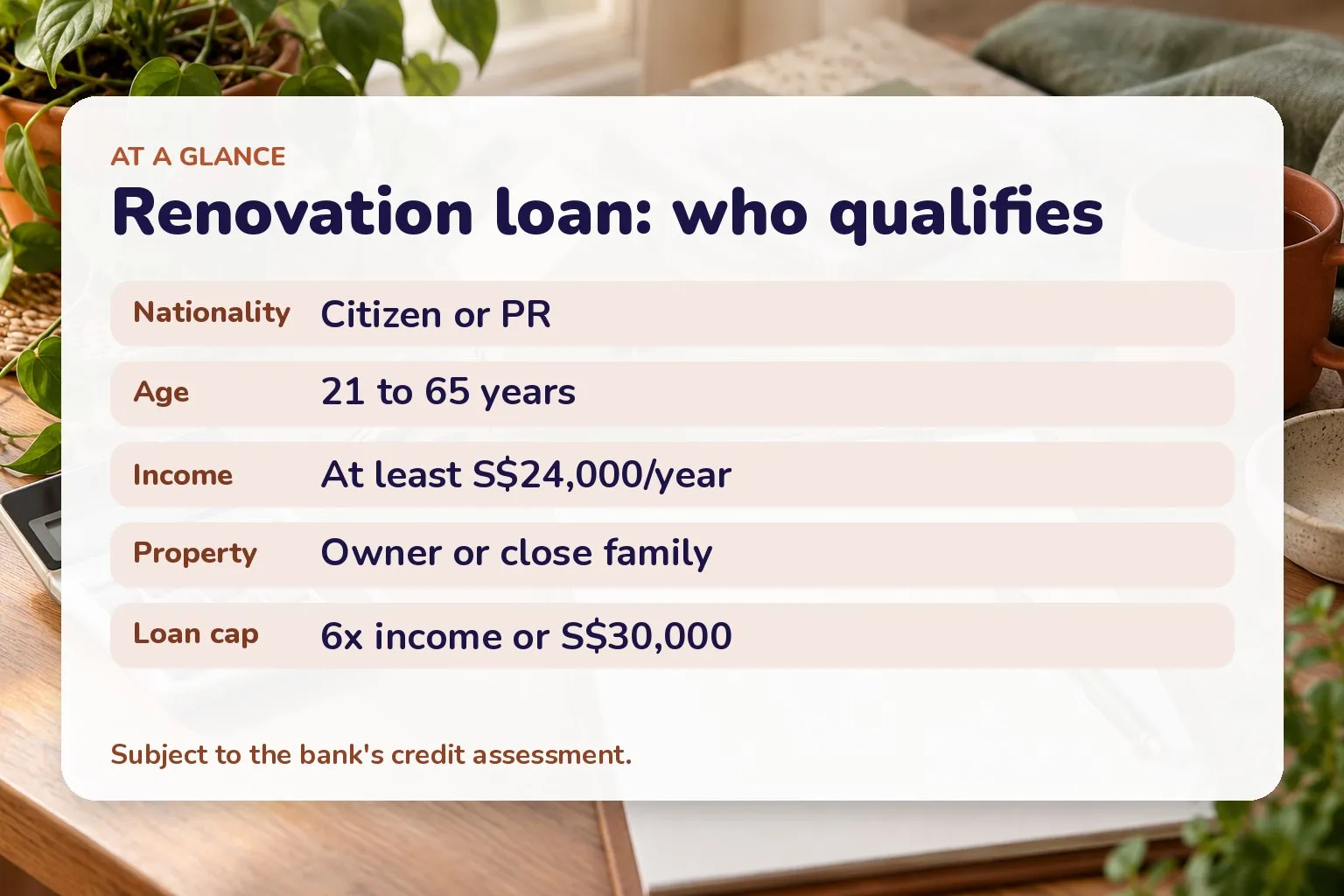
The core eligibility conditions and the quantum cap. Source: DBS; MAS Notice 635, 2026.
DBS lists its renovation loan eligibility as a Singapore Citizen or Permanent Resident, aged 21 to 65, with a minimum income of S$24,000 per annum, and the property owned by the applicant or a related family member (parent, spouse, child or sibling) who has the owner’s consent. POSB applies the same criteria. Other banks publish broadly similar conditions, so treat these four as the universal starting point and confirm the exact figures on your chosen bank’s page.
Miss any one of these and the application is a non-starter — no interest-rate comparison will rescue it. For how the loan itself works once you qualify, see the renovation loan guide.
The income floor and how it sets your limit
Your income does two jobs: it clears the S$24,000-a-year floor, and it sizes the loan. DBS states you may borrow up to 6 times your monthly income or S$30,000, whichever is lower, and adds that approval is still “subjected to approval based on your credit eligibility.”
The maths is simple. Earn S$4,000 a month and six months’ income is S$24,000, so that is your ceiling. Earn S$5,000 a month or more and six months’ income clears S$30,000, so you are held at the S$30,000 cap — earning more does not unlock a larger loan. That ceiling is not just a bank policy: under MAS Notice 635, a renovation loan is defined as one where each borrower’s share is “not more than 6 months’ income of the borrower or $30,000, whichever is the lower.”
If your works will run past S$30,000 — most full renovations do — plan the shortfall from cash or a personal loan, and size the whole budget with the HDB renovation cost guide. You can also try amounts and tenures in the renovation loan calculator.
Joint applications and co-borrowers
A joint application can lift a borrower who earns too little alone, but only within the family. DBS requires the joint applicant to be the main applicant’s parent, spouse, child or sibling, with the main applicant earning at least S$24,000 per annum and the joint applicant at least S$12,000 per annum. MAS Notice 635 similarly limits a joint renovation loan to close family.
Crucially, a joint application does not double the ceiling. The bank uses the lower income to compute the loan, and the maximum considered is still S$30,000. DBS’s own example: if your monthly income is S$4,000 and the joint applicant’s is S$1,500, “you can borrow up to a maximum of S$18,000 (S$1500 x 12).”
Can foreigners or non-owners apply?
Here the renovation loan is unforgiving. Because DBS and POSB list eligibility as Singapore Citizen or Permanent Resident, a foreigner renting or living in the flat generally cannot take a bank renovation loan, even if they pay the household bills. A non-owner can only come in as a close-family co-borrower with the owner’s consent, not as a solo applicant on someone else’s property.
The usual workaround is a different product. DBS opens its personal loan to Singapore Citizens, PRs, and foreigners who already hold a Cashline or Credit Card account, aged 21 to 75, on a minimum annual income of S$20,000 — and that cash can also buy furniture a renovation loan cannot. The trade-offs between the two are worked through in renovation loan vs personal loan. Note too that DBS allows a maximum of 2 renovation loans so long as the total stays within S$30,000 — not a way around the cap.
Documents you need to apply
Eligibility on paper is not enough; the bank disburses only against proof. For a DBS or POSB application you need a DBS or POSB deposit account to service the loan, plus:
- A signed renovation quotation or invoice from your appointed contractor (the loan is unsecured, so the quotation is how the bank confirms the money is for renovation).
- Income documents — for a salaried employee, the latest payslip, or three months of salary-crediting bank statements, or three months of CPF Transaction History, together with the latest one-year Income Tax Notice of Assessment.
- Proof of ownership — a property tax bill, HDB renovation permit, CPF housing withdrawal statement, HDB letter of approval, or completed sales and purchase agreement.
- An HDB or MCST renovation permit where the works require one.
For a first renovation, fold the loan paperwork into the wider plan in the first-time renovation guide.
Why applications get rejected
Clearing the four conditions gets you considered, not approved. A renovation loan is unsecured, so the bank still runs a credit assessment — DBS repeats that every approval is “subjected to approval based on your credit eligibility.” The common reasons an eligible applicant is still turned down or offered less:
- Too much existing unsecured debt. MoneySense warns that if your debt across all credit cards and unsecured facilities “exceeds 12 times your monthly income for three consecutive months,” you cannot get additional credit and your existing lines are suspended. A renovation loan is unsecured credit, so it sits inside that ceiling.
- A weak repayment record. Late or missed payments, MoneySense notes, “may lower your chances of getting a loan in the future, or require you to pay a higher interest rate for a loan.”
- A thin or missing quotation. Without a signed contractor’s quotation the bank cannot confirm the purpose, and the loan is not disbursed.
- A competing property loan. If you are also taking a housing loan, that loan is bound by MAS’s Total Debt Servicing Ratio, “set at a maximum of 55% of the borrower’s monthly income,” and your renovation-loan instalment counts toward it — shrinking what the mortgage will allow.
Frequently asked questions
What is the minimum income for a renovation loan? DBS and POSB set it at S$24,000 a year (about S$2,000 a month) for the main applicant, and S$12,000 a year for a family joint applicant. Other banks are broadly similar.
Can a foreigner get a renovation loan in Singapore? Generally no — DBS and POSB list the renovation loan for Singapore Citizens and PRs only. A foreigner’s route is usually a personal loan, which some banks open to foreigners who already hold an account with them.
Do I have to own the flat? You must either own it or be the owner’s parent, spouse, child or sibling applying as a co-borrower with their consent. A renovation loan is not granted to a non-owner on someone else’s property otherwise.
Does meeting the income floor guarantee approval? No. The loan is unsecured, so the bank assesses your credit record and existing debts; too much unsecured debt or a poor repayment history can still mean rejection or a smaller amount.
Can I use CPF instead of qualifying for a loan? No. CPF savings cannot be used for renovation, improvement or repair work, so the money is cash or a loan.
Related
- Renovation loans in Singapore: cap and costs
- Renovation loan vs personal loan
- HDB renovation cost guide
- First-time renovation: the full guide
General information for comparison only, not financial advice or a product recommendation. Eligibility criteria, rates and rules change; confirm current terms with the bank, MAS and CPF.
Sources
- MAS Notice 635 (renovation loan definition: cap, tenure, co-borrowers) — Monetary Authority of Singapore (MAS) (as of November 2026)
- DBS Renovation Loan (eligibility, cap, fees, disbursement) — DBS Bank (as of November 2026)
- Apply for Renovation Loan (documents, joint applicants, servicing account) — DBS Bank (as of November 2026)
- Guide: How does a renovation loan work (eligibility, personal-loan fallback) — DBS Bank (as of November 2026)
- POSB Renovation Loan (eligibility and cap) — POSB (DBS Bank) (as of November 2026)
- Can I use my CPF savings for renovation and repairs? — Central Provident Fund Board (CPF) (as of November 2026)
- Managing debt: what can you do? (unsecured credit limit) — MoneySense (MAS) (as of November 2026)
- TDSR thresholds for property loans — Monetary Authority of Singapore (MAS) (as of November 2026)