Renovation Loan vs Personal Loan in Singapore

For renovation works within S$30,000 where you qualify for a bank's lowest promotional rate, a renovation loan usually wins on cost; a personal loan wins when you need more than S$30,000, want the cash in your own account, or must also buy furniture.
On this page12 sections · tap to jump
- 01Quick verdict
- 02How much each lets you borrow
- 03What each can pay for
- 04How the money reaches you
- 05Rates and fees: compare the EIR
- 06TDSR and the credit limit
- 07Can CPF help?
- 08A worked comparison (illustrative)
- 09When a personal loan wins
- 10Who should not pick the renovation loan
- 11Eligibility at a glance
- 12Frequently asked questions
Both loans can fund a renovation, but they are built for different jobs — and picking the wrong one quietly costs you either in interest or in flexibility. A renovation loan is cheap, ring-fenced credit the bank pays to your contractor; a personal loan is open cash in your own account. This page sets them side by side on the numbers that actually decide it.
Quick verdict
The rest of this page shows the maths behind that verdict. For how a renovation loan works end to end, see the renovation loan guide.
How much each lets you borrow
This is usually the deciding line. A renovation loan is defined, under MAS Notice 635, as one repaid within five years where each borrower’s share is “not more than 6 months’ income of the borrower or $30,000, whichever is the lower.” DBS states the same ceiling plainly: you may borrow “up to 6 times of your monthly income or S$30,000, whichever is lower.” Earn S$5,000 a month or more and you are held at the S$30,000 cap; earn less and six months’ income is your limit.
A personal loan has no such renovation-specific cap. It sits inside your overall unsecured credit limit, which MoneySense warns is policed hard: if your debt across all credit cards and unsecured facilities “exceeds 12 times your monthly income for three consecutive months,” you cannot get new credit and your existing lines are suspended. Within that envelope, a personal loan can run well past S$30,000 — which is the whole reason to reach for one.
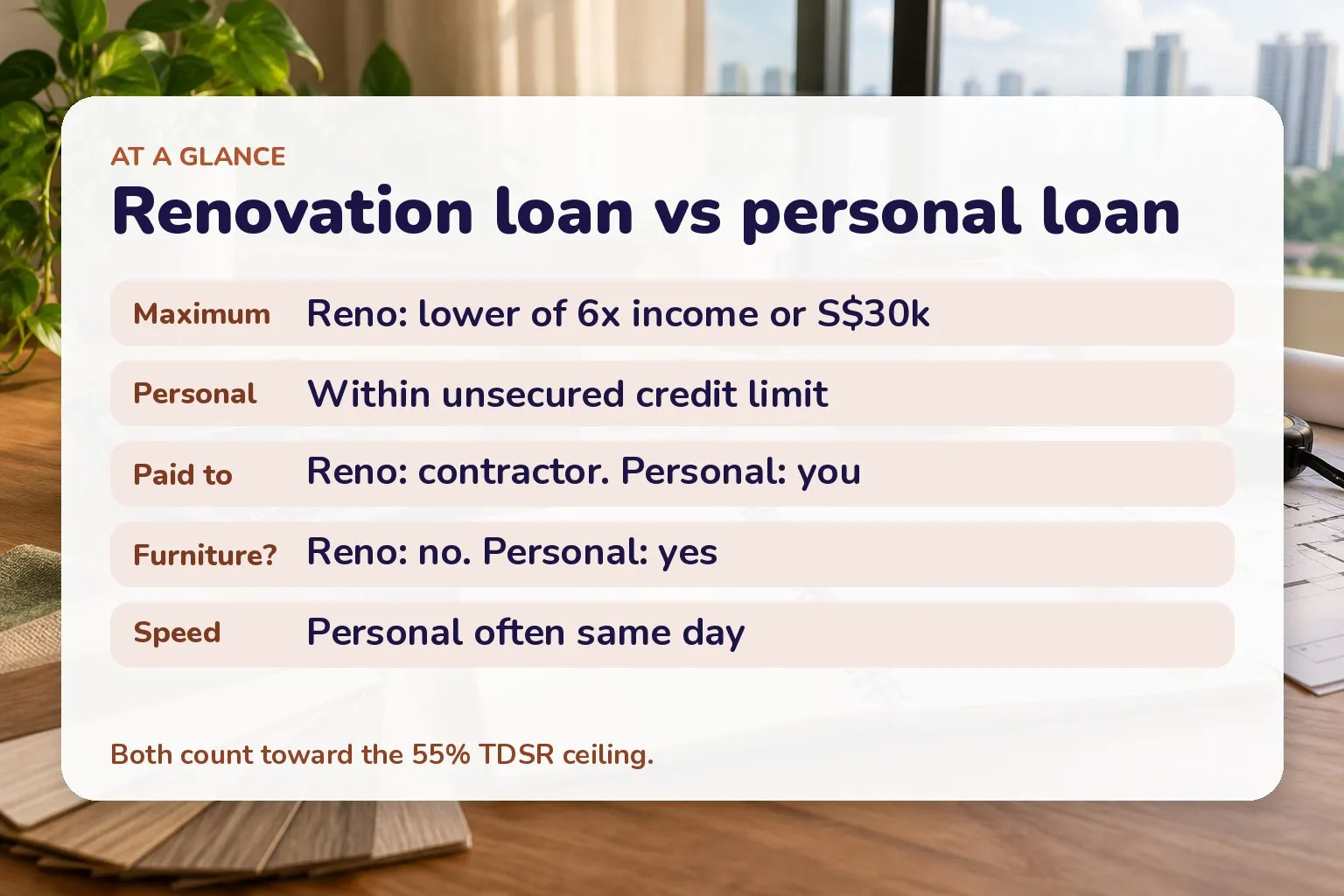
How the two loans differ on the lines that decide it. Source: MAS; DBS, 2026.
| Feature | Renovation loan | Personal loan |
|---|---|---|
| Maximum | Lower of 6× monthly income or S$30,000 | Within your unsecured credit limit (no renovation cap) |
| Paid to | Your contractor | Your own deposit account |
| Can buy furniture or appliances? | No | Yes |
| Tenure | Up to 5 years | The bank’s term |
| Speed to cash | 1–3 working days to the contractor | Often same day to your account |
| Counts in TDSR | Yes | Yes |
Structural features from MAS Notice 635 and DBS’s own pages, 2026. Interest rates are promotional and change; confirm on each bank’s page.
What each can pay for
A renovation loan is ring-fenced by design — that purpose restriction is why it prices lower. MAS requires the bank to take “reasonable steps to ascertain that the proceeds of the renovation loan will only be applied towards the defraying of the costs of renovations.” In practice that means fixed works — flooring, carpentry, electrical, plumbing, painting, hacking, doors and windows — and the bank disburses to your contractor, not to you.
A personal loan has no purpose test. The cash lands in your own account, so it can cover the sofa, the fridge, the curtains and the works all at once. If a large slice of your budget is furniture and appliances, that alone can settle the decision.
How the money reaches you
With a renovation loan you never touch the cash: the bank pays your appointed contractor directly, typically over one to three working days. A personal loan credits your own deposit account — DBS notes that unless a loan is approved very late at night, “the funds will only be credited to the designated deposits account on the following day,” meaning same-day in most cases. If you need to move fast, or want to hold the money and pay trades yourself, the personal loan has the edge.
Rates and fees: compare the EIR
Renovation loans quote a flat (add-on) rate charged on the full original principal for the whole tenure. The real cost is the effective interest rate (EIR), which is always higher once the shrinking balance and upfront fees are counted. DBS’s eco/home-loan promotional rate, for example, shows the gap in its own numbers: 3.38% p.a. flat equals a 4.49% p.a. EIR. Always compare the EIR the bank quotes you, not the headline flat rate.
Then add the fees that come off the top of a renovation loan before you see a cent — at DBS, a 2% handling fee and a 1% insurance premium of the approved amount, plus a 1% pre-payment fee if you repay early and a S$35 late-payment fee per month. A personal loan’s pricing is quoted per applicant’s credit profile and promotion, so the only fair test is to put the EIR the bank offers you next to the renovation-loan EIR — not to assume one is always cheaper.
TDSR and the credit limit
Whichever loan you take, the instalment counts toward the Monetary Authority of Singapore’s Total Debt Servicing Ratio (TDSR), set at a maximum of 55% of monthly income for a property loan. MAS’s own example: if existing debts already use 10% of your income, only 45% is left for new borrowing. A car loan or mortgage therefore shrinks what you are approved for on either product — and if you are also applying for a home loan, the renovation instalment eats into that same 55%.
Can CPF help?
No. The CPF Board is explicit: “CPF savings cannot be used for renovation, improvement or repair work for your property” — you “will need to use your own cash savings to cover the costs.” CPF can pay for the flat and the housing loan, but every dollar of renovation, and every monthly loan repayment, comes from cash. That is precisely why so many homeowners finance the works with one of these two loans.
A worked comparison (illustrative)
Interest varies by bank and promotion, so treat the figures below as illustrative arithmetic, not a quote. They use DBS’s published 3.38% p.a. flat renovation rate for a home-loan customer; your rate will differ.
If your renovation is likely to run past S$30,000, see realistic totals in the HDB renovation cost guide and the 4-room BTO breakdown, and try amounts and tenures in the renovation loan calculator.
When a personal loan wins
Reach for the personal loan when:
- Your works plus furnishings exceed the S$30,000 renovation-loan cap.
- A big part of the budget is loose furniture, appliances or white goods a renovation loan can’t fund.
- You want the money in your own account, fast, to pay trades directly.
- The EIR a bank offers you on a personal loan actually beats the renovation-loan EIR for your profile.
Who should not pick the renovation loan
The renovation loan is the cost winner for a typical sub-S$30,000 job, but skip it if your wishlist is mostly furniture and appliances (it can’t pay for them), if your total budget clears S$30,000 (it can’t stretch), or if you need the cash in your own hands the same day. In those cases the “cheaper” label is irrelevant, because the loan can’t do the job you need.
Eligibility at a glance
A personal loan at DBS runs from age 21 to 70, with a minimum income of S$20,000 a year for citizens and PRs, or S$60,000 for foreigners. A renovation loan’s limit is tied to income through the six-months-of-income cap, and a joint renovation loan may only be taken with close family — MAS Notice 635 names “a spouse, child, parent or sibling… or a fiancé or fiancée.” For the full renovation-loan mechanics, documents and the eco-rate variant, see the renovation loan guide and plan the borrowing as one line of your first-time renovation budget.
Frequently asked questions
Which is cheaper? For a sub-S$30,000 job and a strong credit profile, the renovation loan is usually the cheaper, purpose-built option; but a promotional personal-loan EIR can undercut it, so compare the EIR each bank quotes you.
Can I use a personal loan to buy furniture and appliances? Yes — the cash goes to your own account with no purpose test, so it can fund furnishings a renovation loan cannot.
Can a couple borrow more with a renovation loan? Each borrower’s share is capped at the lower of six months’ income or S$30,000, so a single joint renovation loan still tops out at S$30,000; larger budgets need a personal loan or cash on top.
Does either loan touch my CPF? No. CPF cannot pay for renovation or for the loan repayments — both come from cash.
Related
- Renovation loans in Singapore: cap and costs
- HDB renovation cost guide
- 4-room BTO renovation cost breakdown
- First-time renovation: the full guide
General information for comparison only, not financial advice or a product recommendation. Rates and rules change; confirm current terms with the bank, MAS and CPF.
Sources
- MAS Notice 635 (renovation loan definition: cap, tenure, co-borrowers) — Monetary Authority of Singapore (MAS) (as of November 2026)
- TDSR thresholds for property loans — Monetary Authority of Singapore (MAS) (as of November 2026)
- Can I use my CPF savings for renovation and repairs of my property? — Central Provident Fund Board (CPF) (as of November 2026)
- DBS Renovation Loan (cap, fees, disbursement, rates) — DBS Bank (as of November 2026)
- DBS Personal Loan (eligibility, income, disbursement) — DBS Bank (as of November 2026)
- Managing debt: what can you do? (credit limits, highest-interest-first) — MoneySense (MAS) (as of November 2026)