Condo Renovation Rules and Costs in Singapore
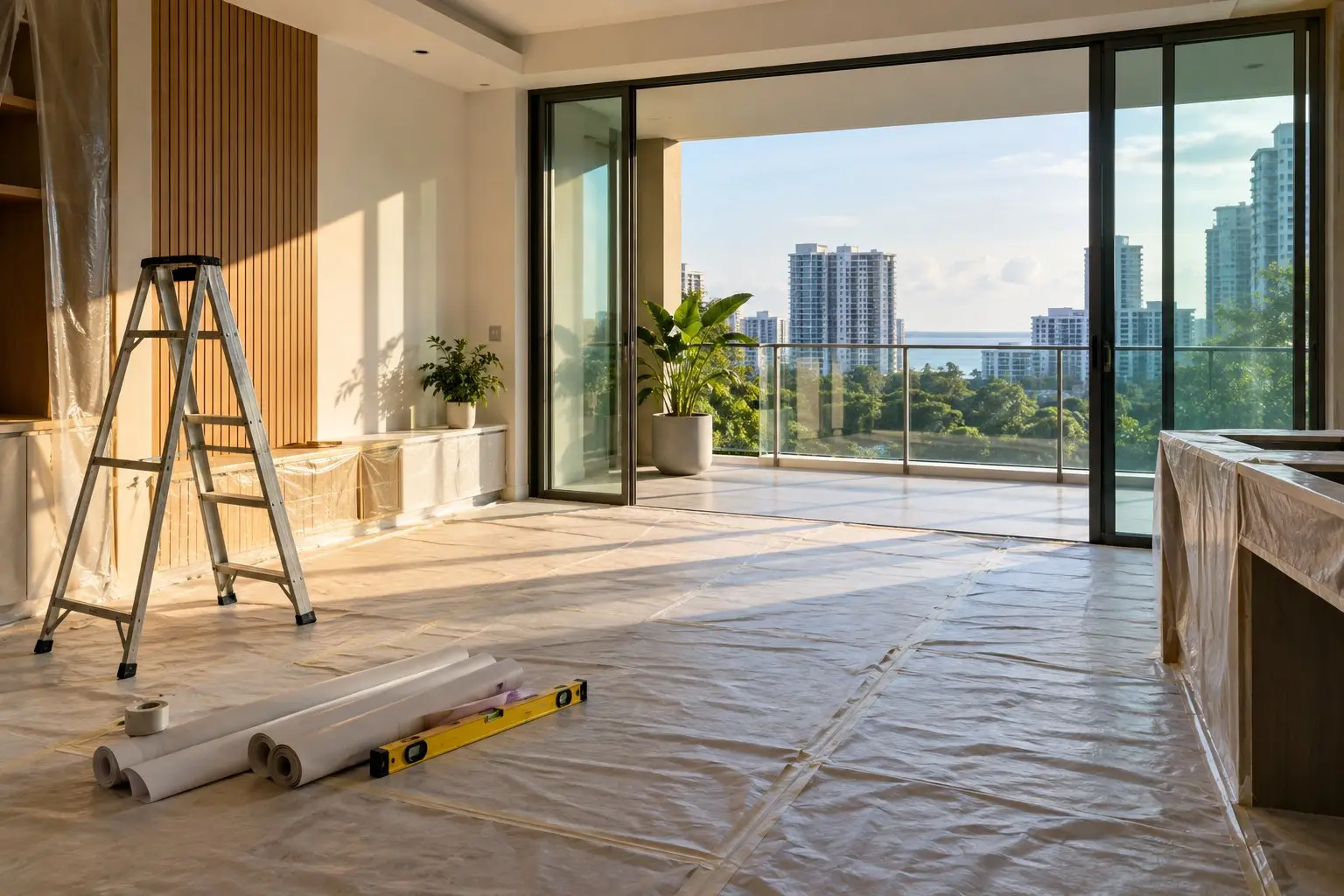
In a condo there is no HDB-style national permit: your Management Corporation (MCST) approves renovations under its by-laws, while structural changes need a Professional Engineer and the Commissioner of Building Control. Internal works need no URA planning permission if floor area is unchanged.
On this page9 sections · tap to jump
Renovating a condo works differently from an HDB flat. There is no single national permit scheme. Instead, approval runs through your Management Corporation (MCST) under its by-laws, while anything touching the building’s structure needs a Professional Engineer (PE) and the Commissioner of Building Control. For ordinary internal works, you usually need no URA planning permission at all — provided you do not add floor area or carve the unit into sub-units.
Who approves a condo renovation
The moment you own a condo unit you are a subsidiary proprietor (SP) and part of the MCST. That membership comes with rules: you must comply with all by-laws, “even if you were not present during voting,” once the MCST enacts them. So the first stop for any renovation is your managing agent, not a government counter.
Before you plan anything, BCA advises checking “with the developer or the MCST and the Sale and Purchase Agreement (S&PA) about renovation restrictions.” New developments often carry extra conditions during the Defects Liability Period (DLP), when the developer is still responsible for resolving defects under the S&P agreement — hacking or altering finishes early can complicate a defect claim.
When planning and BCA approval are needed
URA’s position on strata homes is generous for ordinary work: “internal works within your flat, condominium or strata landed unit do not require planning permission when there is no increase in Gross Floor Area (GFA) and the premises continues to function as a self-sufficient residential unit.” Internal partitioning is exempt too — unless it “results in the creation of new sub-units,” which is not allowed without permission.
BCA is a separate matter. Private-property owners “may be required to submit building / structural plans to BCA for approval,” but minor insignificant building works (listed in the First Schedule to the Building Control Regulations) are exempt from plan submission. When in doubt, BCA says to engage a Qualified Person (QP) — an architect registered with the Board of Architects, or a PE registered with the Professional Engineers Board — who holds a valid practising certificate and can advise which clearances you actually need.
Hacking walls and structural work
This is where condos are strict. Structural elements — “slabs, beams, columns, and walls — cannot be altered without proper assessment by a Professional Engineer,” and approval from the Commissioner of Building Control is also required. Under the Building Control Act, demolition of structural elements “require[s] plan to be approved by the Commissioner of Building Control (CBC) and a permit for commencement,” supervised by a QP.
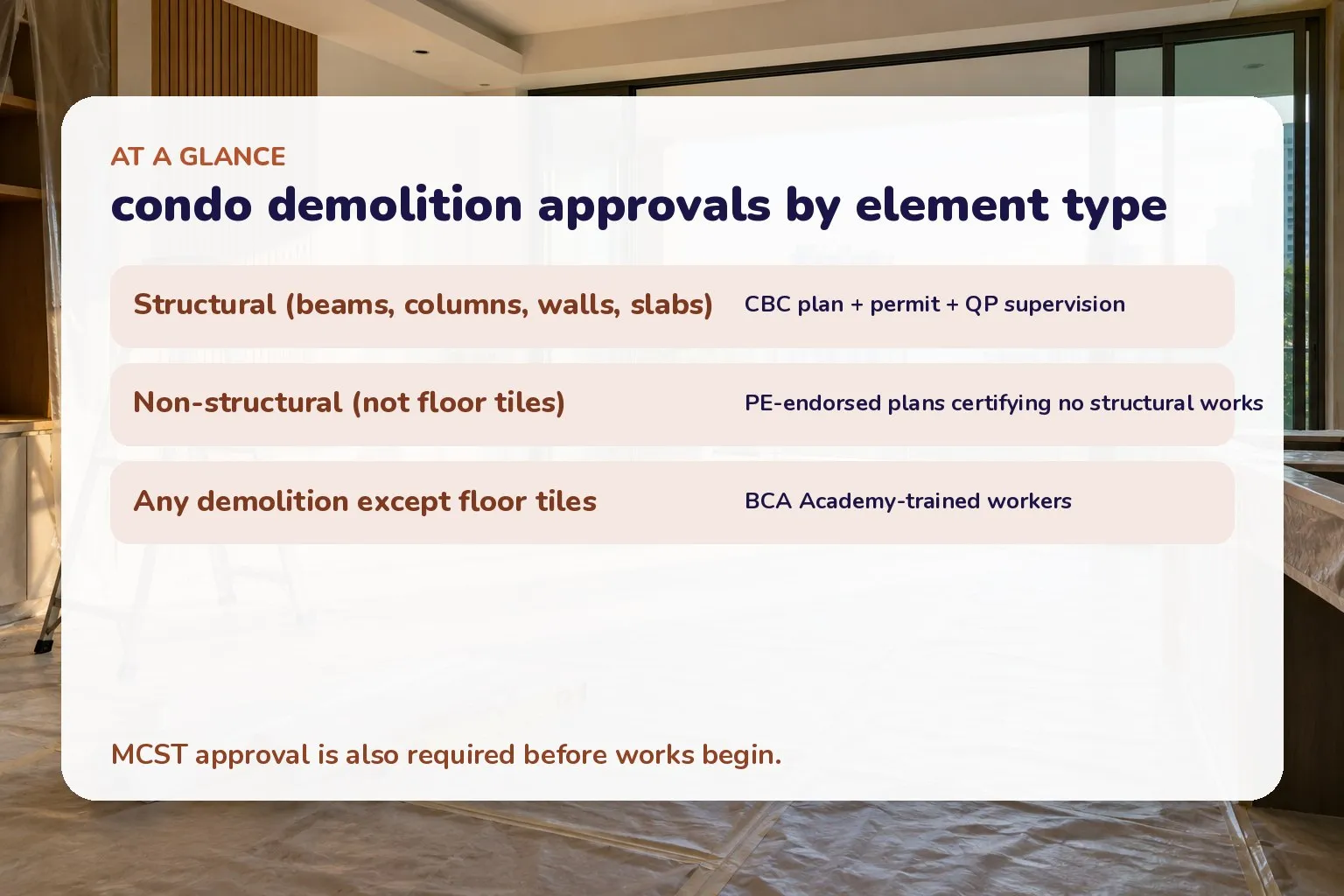
What each type of condo demolition needs — Source: BCA Advisory on Control of Renovation Works (BMSMA s.37(4)), 2026
Even a non-structural wall is controlled. BCA’s advisory on renovation works, issued under section 37(4) of the Building Maintenance and Strata Management Act (BMSMA), lets the MCST impose conditions before approving work, and sets out what it should require:
| Type of demolition | What is required |
|---|---|
| Structural elements (beams, columns, shear walls, slabs) | CBC-approved plan + commencement permit + QP supervision |
| Non-structural elements (other than floor tiles) | Renovation plans endorsed by a Civil/Structural PE certifying no structural works |
| Any demolition other than floor tiles | Carried out by contractors with BCA Academy (BCAA)-trained workers |
Source: BCA Advisory on Control of Renovation Works (BMSMA s.37(4)).
What the MCST controls: by-laws and deposits
Your estate runs on two layers of by-laws: prescribed by-laws in the Second Schedule to the Building Maintenance (Strata Management) Regulations, which apply to every estate, and additional by-laws the MCST makes for its own development. Additional by-laws can cover “floor coverings” and “architectural & landscape guidelines to be observed by all SPs,” among other things — which is why many condos require acoustic underlay under hard flooring above the ground floor.
Additional by-laws are created or changed by a special resolution: at least 21 days’ written notice and the support of 75% of the share value of valid votes cast at a general meeting.
Balconies, lofts and external features
Several popular changes are restricted by rule, not by taste. URA states that balconies “are meant to be semi-outdoor spaces and shall not be enclosed with walls or glass panels” — blinds are allowed, enclosure is not. A loft or furniture deck is permitted without planning permission but “limited to one per residential unit” and may “not exceed 5sqm.”
Anything on the building’s exterior needs MCST sign-off. “Alterations to features fixed on the external building, such as windows and walls, are not allowed without approval from the MCST and any relevant government agencies,” and covers over a private enclosed space (PES) need the MCST’s agreement. If a change increases the estate’s total GFA — roofing a PES, or putting a slab over a void — you need a 90% resolution from the MCST, evidenced by a letter from the council’s secretary or chairperson, submitted with your URA planning application.
Renovation hours and noise in a condo
Here is the biggest practical difference from an HDB flat: there is no national condo renovation-hours rule. HDB’s familiar “noisy works 9am–5pm weekdays only” applies to HDB flats. In a condo, permitted hours, the renovation deposit, neighbour notice and approved contractors are set by your MCST’s by-laws and house rules. Most estates publish a renovation guideline with their own hours and a deposit figure; read it before signing a contractor’s quote, because the contractor must work within those windows.
What a condo renovation costs
Treat all figures here as illustrative industry ranges for 2026, not quotes or official data. Published renovation guides put a typical condo renovation at roughly S$30,000–S$90,000, or about S$50–S$120 per square foot for a full job with mid-range finishes; premium homes with stone and integrated systems run well past S$150,000. The biggest single variable is new versus resale: median-based industry figures suggest around S$44,000–S$62,000 for a new unit against S$78,000–S$105,000 for a comparable resale, because a resale first needs hacking, rewiring and waterproofing before new work begins.
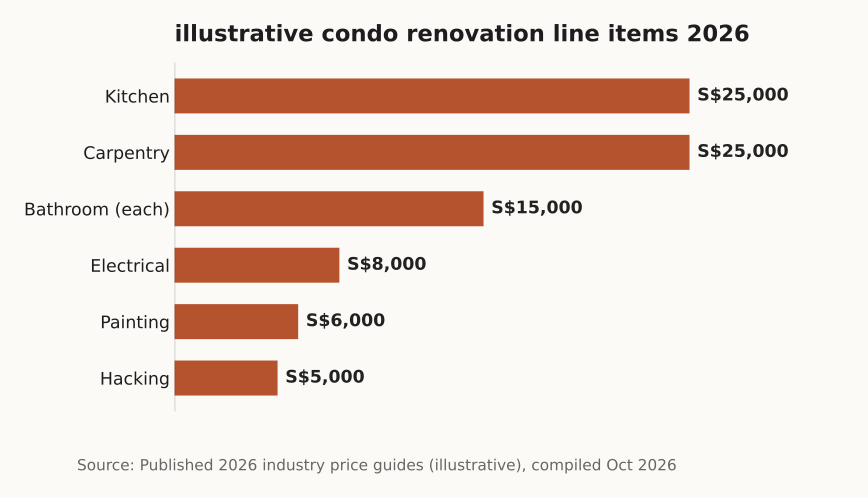
Illustrative upper-end of common condo renovation line items (2026) — Source: published industry price guides, not quotes
| Line item | Illustrative 2026 range (SGD) |
|---|---|
| Carpentry (wardrobes, cabinets, feature walls) | S$8,000 – S$25,000 |
| Kitchen (cabinets, worktop, wet works) | S$10,000 – S$25,000 |
| Bathroom (per bathroom, full waterproofing) | S$8,000 – S$15,000 |
| Electrical and lighting | S$3,000 – S$8,000 |
| Painting (whole unit) | S$2,500 – S$6,000 |
| Hacking and disposal | S$3,000 – S$5,000 |
Illustrative ranges compiled from published 2026 industry price guides, not quotes.
Carpentry is usually the largest line because built-ins are priced by the running foot. For how the services bill works, see the electrical works rules and costs guide; for the undoing-and-repairing premium on older units, the resale flat renovation cost guide explains the same dynamic for HDB.
Penalties and disputes
Two tracks matter. On the building-control side, unauthorised additions or alterations “committed an offence under the Building Control Act and will be subject to the appropriate enforcement action,” and an unresolved unauthorised structure can even delay a Certificate of Statutory Completion. On the estate side, disputes “between unit owners or with the management council are private matters” — you resolve them yourself, through the Community Mediation Centre or Singapore Mediation Centre, or by applying to the Strata Titles Boards.
The safest route is boring: engage a QP early where structure is involved, lodge your renovation application with the MCST, keep the PE endorsement and approvals on file, and hold your contractor to the estate’s hours. For choosing that contractor, see how to choose a renovation firm.
FAQ
Do I need a government permit to renovate my condo? Not usually for internal work. There is no HDB-style permit for condos. Your MCST approves the work under its by-laws; URA planning permission is only needed if you increase GFA, and BCA/CBC approval only for structural works.
Can I hack a wall between the kitchen and living room? Only after checking it is non-structural. A Civil or Structural PE must endorse the plans certifying no structural works, the MCST must approve, and the demolition must be done by a contractor with BCAA-trained workers. Structural walls, columns and beams cannot be altered without CBC approval.
Can my MCST keep my renovation deposit if I breach a rule? No. BCA’s guidance states management corporations cannot impose fines or forfeit deposits. They may recover administrative costs for a breach and, if needed, apply to the Strata Titles Boards or the court.
What are the renovation hours in a condo? They are set by your estate’s by-laws and house rules, not by national regulation. Check your MCST’s renovation guidelines for the permitted hours, deposit and notice requirements.
Can I enclose my balcony to make the room bigger? No. URA does not allow balconies to be enclosed with walls or glass panels; they must stay semi-outdoor. Blinds are allowed. Enclosing a balcony also usually breaches the estate’s facade by-laws.
Related
- Electrical works: rules and costs
- Resale flat renovation cost
- HDB renovation permit guide
- How to choose a renovation firm
- First-time renovation: the full guide
General information only, not legal advice. Cost figures are illustrative industry ranges (approximate, 2026), not quotes. Rules, fees and by-laws change; confirm current requirements with your MCST, BCA and a Qualified Person before you start.
Sources
- What to know as a condo owner — Building and Construction Authority (BCA) (as of October 2026)
- Strata-titled Residential (renovating private residential property) — Urban Redevelopment Authority (URA) (as of October 2026)
- Building works not requiring approval — Building and Construction Authority (BCA) (as of October 2026)
- Advisory on Control of Renovation Works Involving Demolition of Non-Structural Elements — Building and Construction Authority (BCA) (as of October 2026)
- Strata Management Guide 10: By-Laws — Building and Construction Authority (BCA) (as of October 2026)